Estonia Construction and Mining Machinery Market Top 5 Importing Countries and Market Competition (HHI) Analysis
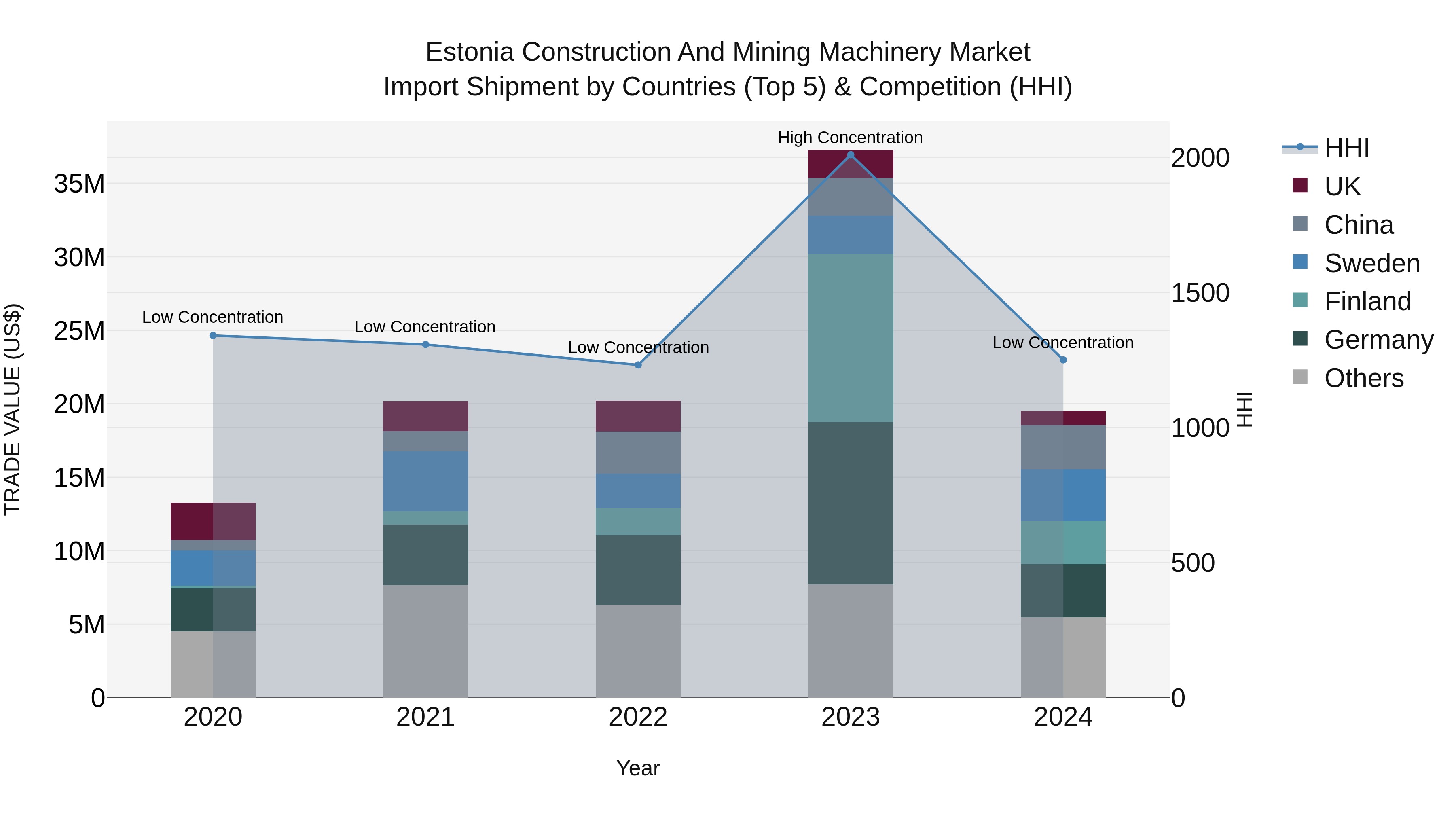
In 2024, Estonia`s construction and mining machinery import market saw a shift in concentration from high to low, indicating increased diversification among suppliers. The top exporting countries - Germany, Sweden, China, Finland, and Belgium - continue to play a significant role in supplying machinery to Estonia. Despite a notable decline in growth rate from 2023 to 2024, the compound annual growth rate (CAGR) for 2020-2024 stands at a healthy 10.15%, reflecting sustained industry expansion. This changing landscape suggests opportunities for market players to explore new partnerships and enhance competitiveness in the sector.
Key Highlights of the Report:
- Estonia Construction and Mining Machinery Market Outlook
- Market Size of Estonia Construction and Mining Machinery Market, 2025
- Forecast of Estonia Construction and Mining Machinery Market, 2032
- Historical Data and Forecast of Estonia Construction and Mining Machinery Revenues & Volume for the Period 2022 - 2032F
- Estonia Construction and Mining Machinery Market Trend Evolution
- Estonia Construction and Mining Machinery Market Drivers and Challenges
- Estonia Construction and Mining Machinery Price Trends
- Estonia Construction and Mining Machinery Porter`s Five Forces
- Estonia Construction and Mining Machinery Industry Life Cycle
- Historical Data and Forecast of Estonia Construction and Mining Machinery Market Revenues & Volume By Product Types for the Period 2022 - 2032F
- Historical Data and Forecast of Estonia Construction and Mining Machinery Market Revenues & Volume By Loaders for the Period 2022 - 2032F
- Historical Data and Forecast of Estonia Construction and Mining Machinery Market Revenues & Volume By Dozers for the Period 2022 - 2032F
- Historical Data and Forecast of Estonia Construction and Mining Machinery Market Revenues & Volume By Excavators for the Period 2022 - 2032F
- Historical Data and Forecast of Estonia Construction and Mining Machinery Market Revenues & Volume By Crushing for the Period 2022 - 2032F
- Historical Data and Forecast of Estonia Construction and Mining Machinery Market Revenues & Volume By Pulverizing & Screening Equipment for the Period 2022 - 2032F
- Historical Data and Forecast of Estonia Construction and Mining Machinery Market Revenues & Volume By Others for the Period 2022 - 2032F
- Historical Data and Forecast of Estonia Construction and Mining Machinery Market Revenues & Volume By Applications for the Period 2022 - 2032F
- Historical Data and Forecast of Estonia Construction and Mining Machinery Market Revenues & Volume By Infrastructure for the Period 2022 - 2032F
- Historical Data and Forecast of Estonia Construction and Mining Machinery Market Revenues & Volume By Mineral Mining for the Period 2022 - 2032F
- Historical Data and Forecast of Estonia Construction and Mining Machinery Market Revenues & Volume By Residential Building for the Period 2022 - 2032F
- Historical Data and Forecast of Estonia Construction and Mining Machinery Market Revenues & Volume By Metal Mining for the Period 2022 - 2032F
- Historical Data and Forecast of Estonia Construction and Mining Machinery Market Revenues & Volume By Others for the Period 2022 - 2032F
- Estonia Construction and Mining Machinery Import Export Trade Statistics
- Market Opportunity Assessment By Product Types
- Market Opportunity Assessment By Applications
- Estonia Construction and Mining Machinery Top Companies Market Share
- Estonia Construction and Mining Machinery Competitive Benchmarking By Technical and Operational Parameters
- Estonia Construction and Mining Machinery Company Profiles
- Estonia Construction and Mining Machinery Key Strategic Recommendations






































