Estonia Cyclohexane Market Top 5 Importing Countries and Market Competition (HHI) Analysis
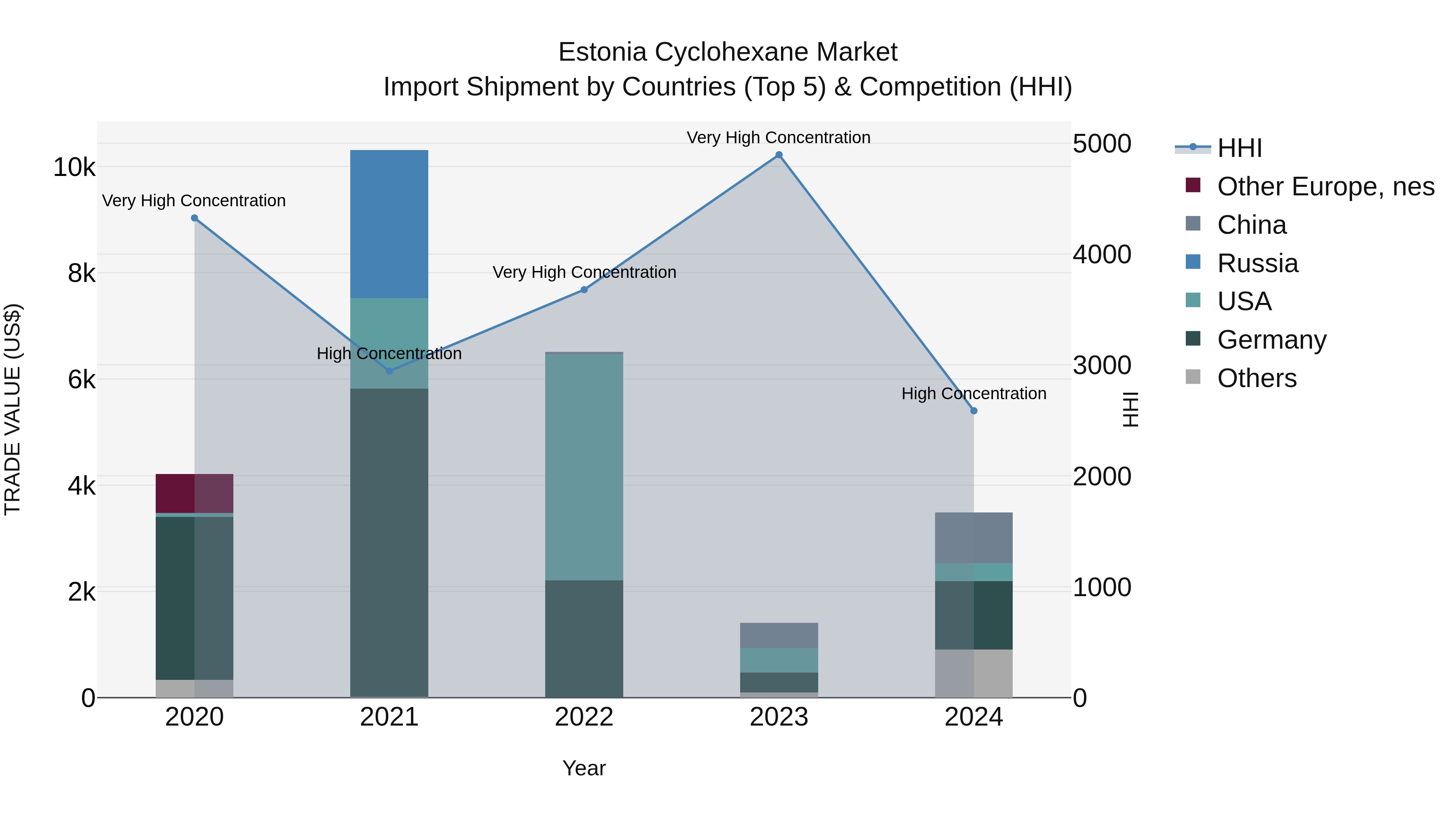
Estonia`s cyclohexane import market in 2024 continued to be dominated by top exporters such as Germany, China, Latvia, USA, and Netherlands. The high Herfindahl-Hirschman Index (HHI) indicates a concentrated market structure. Despite a negative compound annual growth rate (CAGR) from 2020 to 2024, the impressive growth rate from 2023 to 2024 demonstrates a significant uptick in demand or shifting market dynamics. This data suggests that Estonia`s cyclohexane import market is experiencing fluctuations, possibly influenced by global economic trends or regional supply factors.
Cyclohexane Market: Estonia vs Top 5 Major Economies in 2027 (Europe)
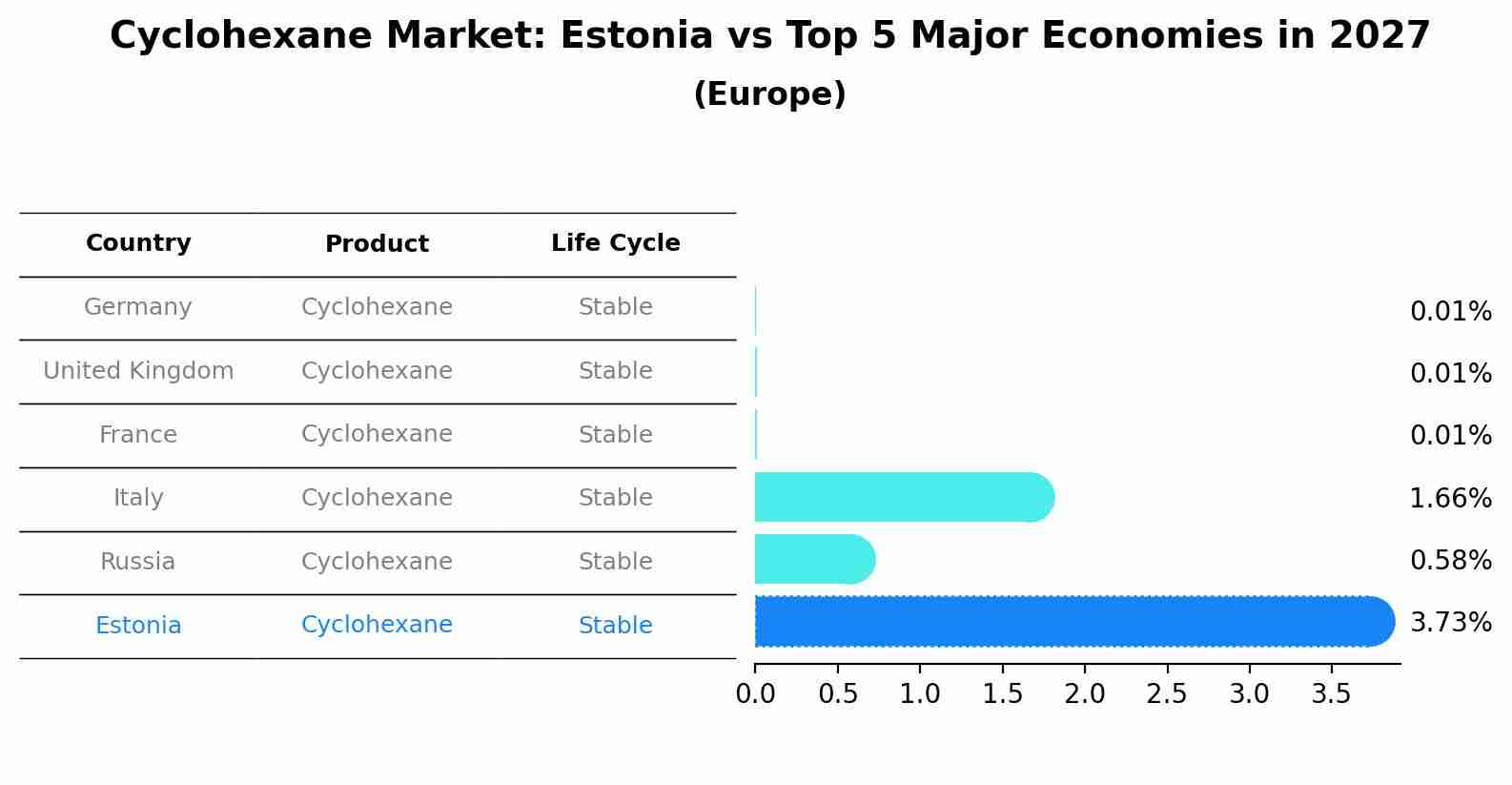
In the Europe region, the Cyclohexane market in Estonia is projected to expand at a stable growth rate of 3.73% by 2027. The largest economy is Germany, followed by United Kingdom, France, Italy and Russia.
Estonia Cyclohexane Market Overview
The cyclohexane market in Estonia is growing due to its use in the production of synthetic fibers, plastics, and other chemicals. Cyclohexane is primarily used as a solvent in the manufacturing of nylon, which is widely used in textiles, automotive, and packaging industries. As Estonias industrial sector continues to develop, the demand for cyclohexane is expected to rise. Additionally, the increasing use of cyclohexane in the production of other chemicals and its role in sustainable manufacturing processes are likely to contribute to the market`s expansion.
Drivers of the market
The Estonia cyclohexane market is driven by the chemical industry`s strong demand for this solvent in the production of nylon, synthetic fibers, and plastics. Cyclohexane serves as a key raw material in the manufacturing of adipic acid, which is used in the production of nylon 6,6. As industries such as textiles, automotive, and consumer goods continue to expand, the demand for cyclohexane as a solvent and intermediate product in chemical processes remains robust. Furthermore, the growing demand for high-quality plastics in automotive and packaging industries is a significant factor in the market`s growth.
Challenges of the market
The Estonia Cyclohexane Market faces challenges related to the volatility of raw material prices and environmental concerns. Cyclohexane is primarily derived from petroleum, and fluctuations in crude oil prices can have a significant impact on the cost of production. Additionally, as environmental regulations become stricter, there is increased pressure on manufacturers to adopt greener production processes or alternative chemicals that are less harmful to the environment. The demand for cyclohexane is also influenced by the growth of industries like textiles and chemicals, which can vary in different economic cycles, further contributing to market volatility.
Government Policy of the market
The government supports the chemical industry by providing grants for sustainable cyclohexane production. Policies focus on reducing greenhouse gas emissions and ensuring compliance with international environmental standards.
Key Highlights of the Report:
- Estonia Cyclohexane Market Outlook
- Market Size of Estonia Cyclohexane Market, 2024
- Forecast of Estonia Cyclohexane Market, 2031
- Historical Data and Forecast of Estonia Cyclohexane Revenues & Volume for the Period 2021-2031
- Estonia Cyclohexane Market Trend Evolution
- Estonia Cyclohexane Market Drivers and Challenges
- Estonia Cyclohexane Price Trends
- Estonia Cyclohexane Porter`s Five Forces
- Estonia Cyclohexane Industry Life Cycle
- Historical Data and Forecast of Estonia Cyclohexane Market Revenues & Volume By Application for the Period 2021-2031
- Historical Data and Forecast of Estonia Cyclohexane Market Revenues & Volume By Adipic acid for the Period 2021-2031
- Historical Data and Forecast of Estonia Cyclohexane Market Revenues & Volume By Caprolactam for the Period 2021-2031
- Historical Data and Forecast of Estonia Cyclohexane Market Revenues & Volume By Others for the Period 2021-2031
- Historical Data and Forecast of Estonia Cyclohexane Market Revenues & Volume By End-use for the Period 2021-2031
- Historical Data and Forecast of Estonia Cyclohexane Market Revenues & Volume By Nylon 6 for the Period 2021-2031
- Historical Data and Forecast of Estonia Cyclohexane Market Revenues & Volume By Nylon 66 for the Period 2021-2031
- Historical Data and Forecast of Estonia Cyclohexane Market Revenues & Volume By Others for the Period 2021-2031
- Estonia Cyclohexane Import Export Trade Statistics
- Market Opportunity Assessment By Application
- Market Opportunity Assessment By End-use
- Estonia Cyclohexane Top Companies Market Share
- Estonia Cyclohexane Competitive Benchmarking By Technical and Operational Parameters
- Estonia Cyclohexane Company Profiles
- Estonia Cyclohexane Key Strategic Recommendations






































