Estonia Foam Insulation Market Top 5 Importing Countries and Market Competition (HHI) Analysis
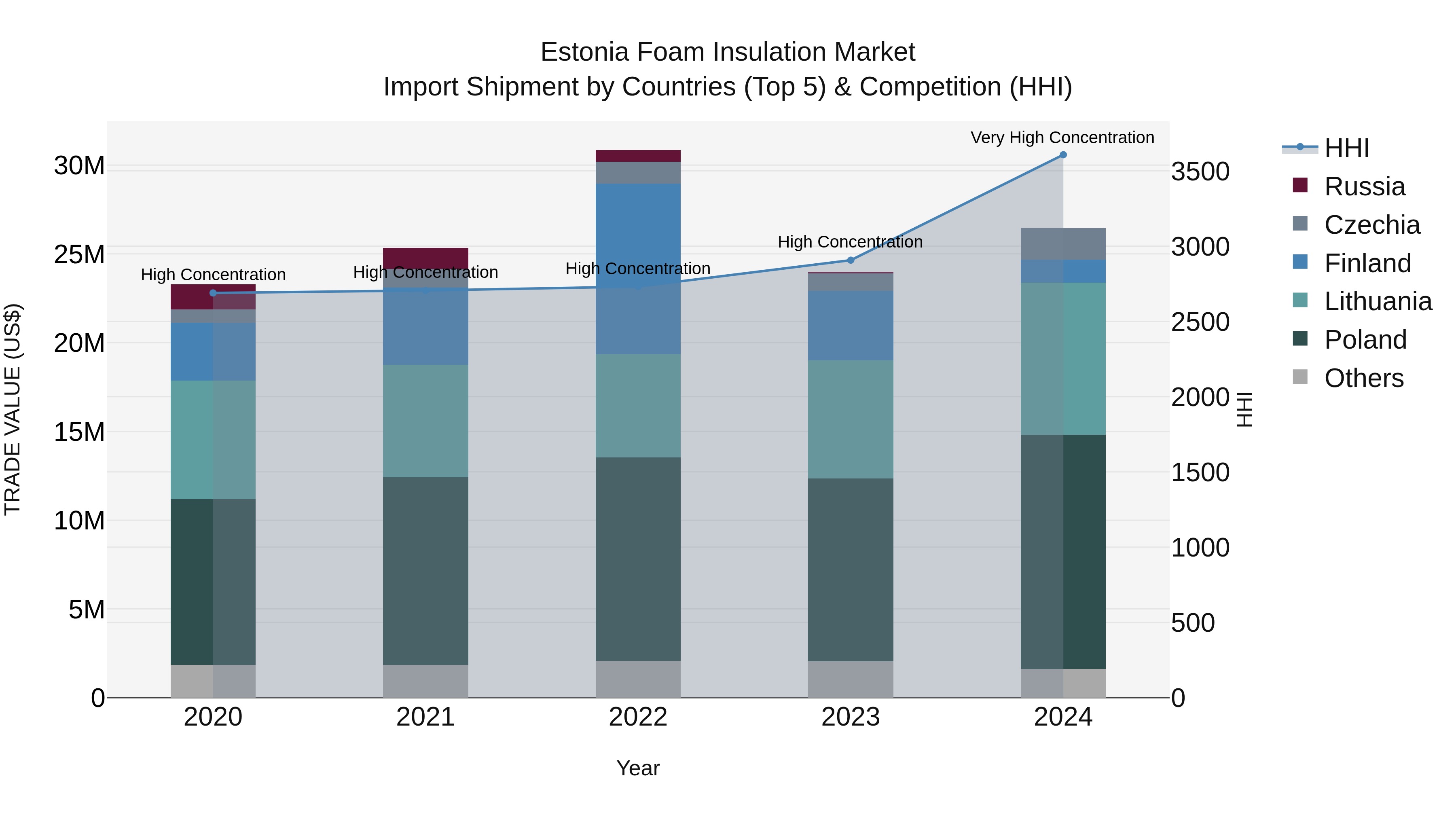
Estonia`s foam insulation import market continues to be dominated by key suppliers such as Poland, Lithuania, Czechia, Finland, and Ukraine. The high Herfindahl-Hirschman Index (HHI) indicates a very high level of market concentration, suggesting limited competition. Despite this, the market has shown steady growth with a Compound Annual Growth Rate (CAGR) of 3.25% from 2020 to 2024. The impressive growth rate of 10.31% in 2024 highlights a surge in demand for foam insulation in Estonia, potentially driven by construction and energy efficiency projects.
Estonia Foam Insulation Market Overview
This market focuses on foam insulation solutions for residential and industrial buildings, driven by the need for energy efficiency and sustainable practices.
Drivers of the market
The Foam Insulation market in Estonia is being driven by the increasing demand for energy-efficient building materials and the growth of the construction industry. Foam insulation, known for its superior thermal properties and lightweight nature, is widely used in residential, commercial, and industrial buildings to reduce heat loss and improve energy efficiency. With Estonia`s focus on sustainability, green building standards, and energy conservation, the demand for foam insulation is rising. Additionally, the expansion of the construction sector, particularly in eco-friendly and energy-efficient buildings, is further boosting the market.
Challenges of the market
The foam insulation market encounters challenges from rising raw material costs and increasing regulatory demands for eco-friendly insulation solutions. Manufacturers face pressure to innovate while keeping costs competitive. Additionally, market growth is hindered by competition from alternative insulation methods, such as fiberglass and mineral wool.
Government Policy of the market
Estonias government encourages the development of the foam insulation market by focusing on energy efficiency and sustainability. Policies support the use of environmentally friendly and high-performance foam materials in construction and industrial applications, ensuring compliance with EU environmental standards and promoting the reduction of energy consumption.
Key Highlights of the Report:
- Estonia Foam Insulation Market Outlook
- Market Size of Estonia Foam Insulation Market, 2024
- Forecast of Estonia Foam Insulation Market, 2031
- Historical Data and Forecast of Estonia Foam Insulation Revenues & Volume for the Period 2021-2031
- Estonia Foam Insulation Market Trend Evolution
- Estonia Foam Insulation Market Drivers and Challenges
- Estonia Foam Insulation Price Trends
- Estonia Foam Insulation Porter`s Five Forces
- Estonia Foam Insulation Industry Life Cycle
- Historical Data and Forecast of Estonia Foam Insulation Market Revenues & Volume By Product Type for the Period 2021-2031
- Historical Data and Forecast of Estonia Foam Insulation Market Revenues & Volume By Polystyrene for the Period 2021-2031
- Historical Data and Forecast of Estonia Foam Insulation Market Revenues & Volume By Polyurethane & Polyisocyanurate for the Period 2021-2031
- Historical Data and Forecast of Estonia Foam Insulation Market Revenues & Volume By Polyolefin for the Period 2021-2031
- Historical Data and Forecast of Estonia Foam Insulation Market Revenues & Volume By Elastomeric for the Period 2021-2031
- Historical Data and Forecast of Estonia Foam Insulation Market Revenues & Volume By Phenolic for the Period 2021-2031
- Historical Data and Forecast of Estonia Foam Insulation Market Revenues & Volume By End Use Industry for the Period 2021-2031
- Historical Data and Forecast of Estonia Foam Insulation Market Revenues & Volume By Building & Construction for the Period 2021-2031
- Historical Data and Forecast of Estonia Foam Insulation Market Revenues & Volume By Transportation for the Period 2021-2031
- Historical Data and Forecast of Estonia Foam Insulation Market Revenues & Volume By Consumer Appliances for the Period 2021-2031
- Estonia Foam Insulation Import Export Trade Statistics
- Market Opportunity Assessment By Product Type
- Market Opportunity Assessment By End Use Industry
- Estonia Foam Insulation Top Companies Market Share
- Estonia Foam Insulation Competitive Benchmarking By Technical and Operational Parameters
- Estonia Foam Insulation Company Profiles
- Estonia Foam Insulation Key Strategic Recommendations






































