Estonia Formaldehyde Market Top 5 Importing Countries and Market Competition (HHI) Analysis
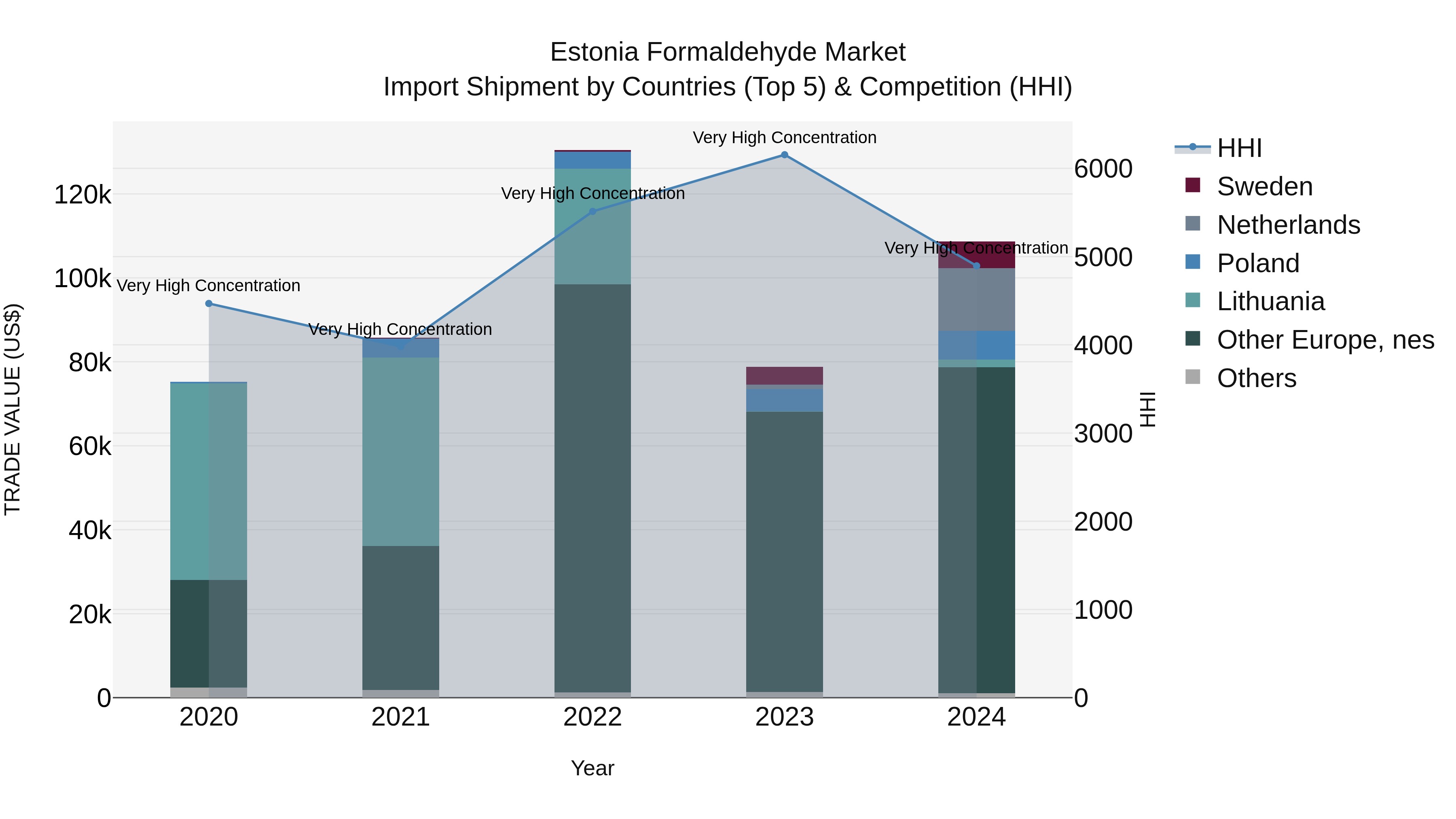
In 2024, Estonia continued to show a strong demand for formaldehyde imports, with top exporting countries including Other Europe, nes, Netherlands, Poland, Sweden, and Lithuania. The market exhibited a high level of concentration, as indicated by the high HHI value. The compound annual growth rate (CAGR) from 2020 to 2024 stood at an impressive 9.63%, showcasing sustained expansion in the market. Moreover, the growth rate from 2023 to 2024 spiked to 37.86%, indicating a significant uptick in demand for formaldehyde imports in Estonia.
Formaldehyde Market: Estonia vs Top 5 Major Economies in 2027 (Europe)
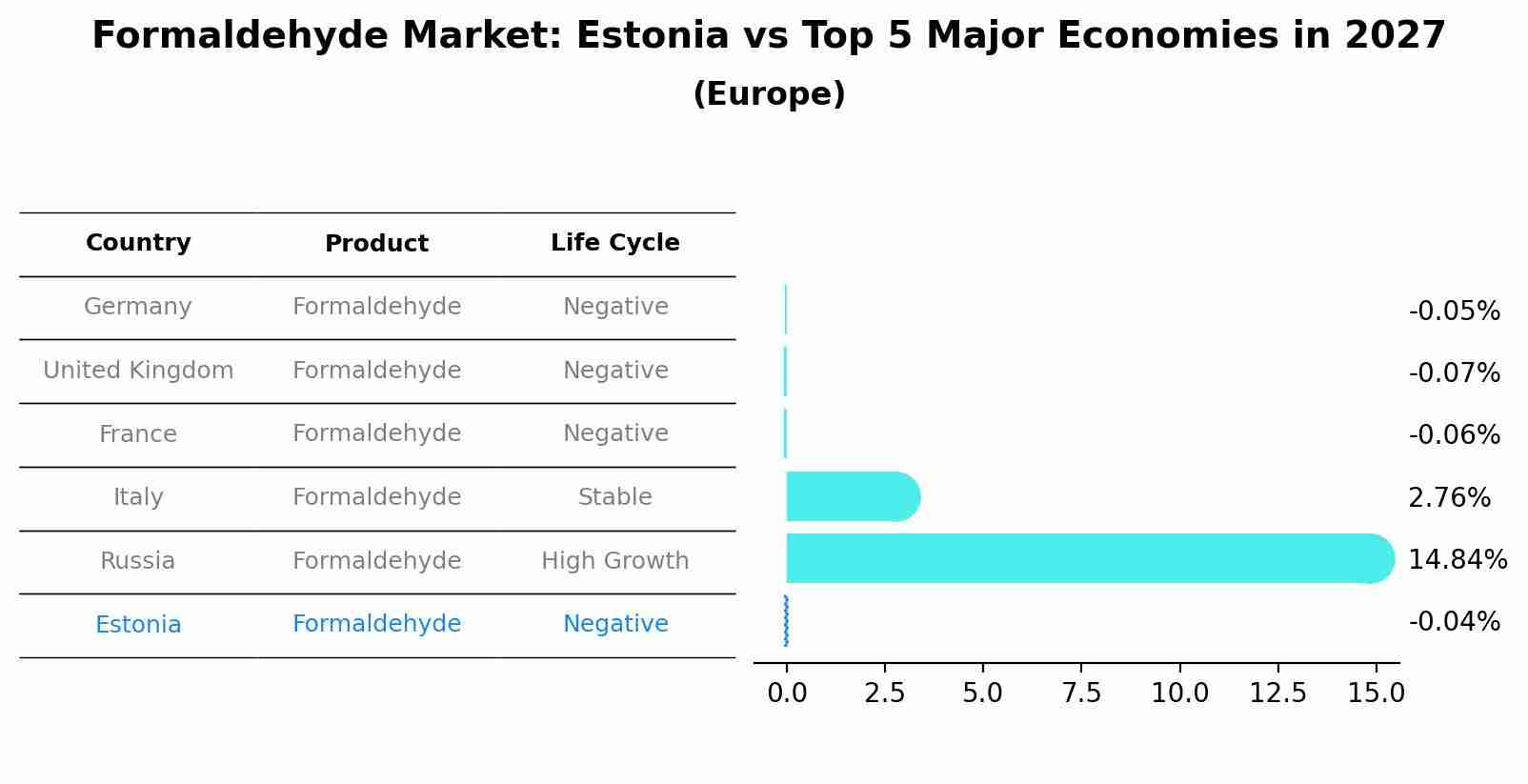
In the Europe region, the Formaldehyde market in Estonia is projected to expand at a negative growth rate of -0.04% by 2027. The largest economy is Germany, followed by United Kingdom, France, Italy and Russia.
Estonia Formaldehyde Market Overview
The formaldehyde market supplies raw materials for producing resins, adhesives, and plastics, playing a critical role in construction and manufacturing.
Drivers of the market
The Formaldehyde market in Estonia is driven by its use in various industrial applications, including the production of resins, adhesives, and plastics. Formaldehyde is a key component in the manufacturing of materials like plywood, particleboard, and insulation, which are widely used in construction, automotive, and furniture industries. As Estonia`s industrial and construction sectors continue to grow, the demand for formaldehyde-based products is increasing. Furthermore, the push for environmentally friendly alternatives and stricter regulatory standards on formaldehyde emissions is shaping the market dynamics, leading to innovations in safer and more sustainable formaldehyde applications.
Challenges of the market
The formaldehyde market in Estonia encounters regulatory challenges due to its toxicity and environmental concerns. Manufacturers must invest in cleaner production methods, increasing operational costs. Additionally, competition from substitutes like low-emission adhesives further impacts market demand.
Government Policy of the market
Estonian regulations on formaldehyde emphasize its safe use and environmental impact. Government policies enforce strict standards for its application in industrial processes, promoting alternatives where possible, in alignment with EU health and safety guidelines to minimize risks to human health and the environment.
Key Highlights of the Report:
- Estonia Formaldehyde Market Outlook
- Market Size of Estonia Formaldehyde Market, 2024
- Forecast of Estonia Formaldehyde Market, 2031
- Historical Data and Forecast of Estonia Formaldehyde Revenues & Volume for the Period 2021-2031
- Estonia Formaldehyde Market Trend Evolution
- Estonia Formaldehyde Market Drivers and Challenges
- Estonia Formaldehyde Price Trends
- Estonia Formaldehyde Porter`s Five Forces
- Estonia Formaldehyde Industry Life Cycle
- Historical Data and Forecast of Estonia Formaldehyde Market Revenues & Volume By Application for the Period 2021-2031
- Historical Data and Forecast of Estonia Formaldehyde Market Revenues & Volume By Resins for the Period 2021-2031
- Historical Data and Forecast of Estonia Formaldehyde Market Revenues & Volume By Fibers for the Period 2021-2031
- Historical Data and Forecast of Estonia Formaldehyde Market Revenues & Volume By Solvents for the Period 2021-2031
- Historical Data and Forecast of Estonia Formaldehyde Market Revenues & Volume By Plasticizers for the Period 2021-2031
- Historical Data and Forecast of Estonia Formaldehyde Market Revenues & Volume By Drying Agents for the Period 2021-2031
- Historical Data and Forecast of Estonia Formaldehyde Market Revenues & Volume By Other Chemical Intermediates for the Period 2021-2031
- Historical Data and Forecast of Estonia Formaldehyde Market Revenues & Volume By Derivative for the Period 2021-2031
- Historical Data and Forecast of Estonia Formaldehyde Market Revenues & Volume By Urea-formaldehyde Resin for the Period 2021-2031
- Historical Data and Forecast of Estonia Formaldehyde Market Revenues & Volume By Phenol Formaldehyde Resin for the Period 2021-2031
- Historical Data and Forecast of Estonia Formaldehyde Market Revenues & Volume By Polyoxymethylene for the Period 2021-2031
- Historical Data and Forecast of Estonia Formaldehyde Market Revenues & Volume By Melamine Formaldehyde Resin for the Period 2021-2031
- Historical Data and Forecast of Estonia Formaldehyde Market Revenues & Volume By Pentaerythritol for the Period 2021-2031
- Historical Data and Forecast of Estonia Formaldehyde Market Revenues & Volume By Methylene Diphenyl Diisocyanate for the Period 2021-2031
- Historical Data and Forecast of Estonia Formaldehyde Market Revenues & Volume By Hexamethylenetetramine for the Period 2021-2031
- Historical Data and Forecast of Estonia Formaldehyde Market Revenues & Volume By Others for the Period 2021-2031
- Historical Data and Forecast of Estonia Formaldehyde Market Revenues & Volume By End-Use for the Period 2021-2031
- Historical Data and Forecast of Estonia Formaldehyde Market Revenues & Volume By Chemicals for the Period 2021-2031
- Historical Data and Forecast of Estonia Formaldehyde Market Revenues & Volume By Agriculture for the Period 2021-2031
- Historical Data and Forecast of Estonia Formaldehyde Market Revenues & Volume By Building & Construction for the Period 2021-2031
- Historical Data and Forecast of Estonia Formaldehyde Market Revenues & Volume By Personal Care & Cosmetics for the Period 2021-2031
- Historical Data and Forecast of Estonia Formaldehyde Market Revenues & Volume By Healthcare for the Period 2021-2031
- Historical Data and Forecast of Estonia Formaldehyde Market Revenues & Volume By Automotive for the Period 2021-2031
- Historical Data and Forecast of Estonia Formaldehyde Market Revenues & Volume By Others for the Period 2021-2031
- Estonia Formaldehyde Import Export Trade Statistics
- Market Opportunity Assessment By Application
- Market Opportunity Assessment By Derivative
- Market Opportunity Assessment By End-Use
- Estonia Formaldehyde Top Companies Market Share
- Estonia Formaldehyde Competitive Benchmarking By Technical and Operational Parameters
- Estonia Formaldehyde Company Profiles
- Estonia Formaldehyde Key Strategic Recommendations






































