Estonia Glycerol Market Top 5 Importing Countries and Market Competition (HHI) Analysis
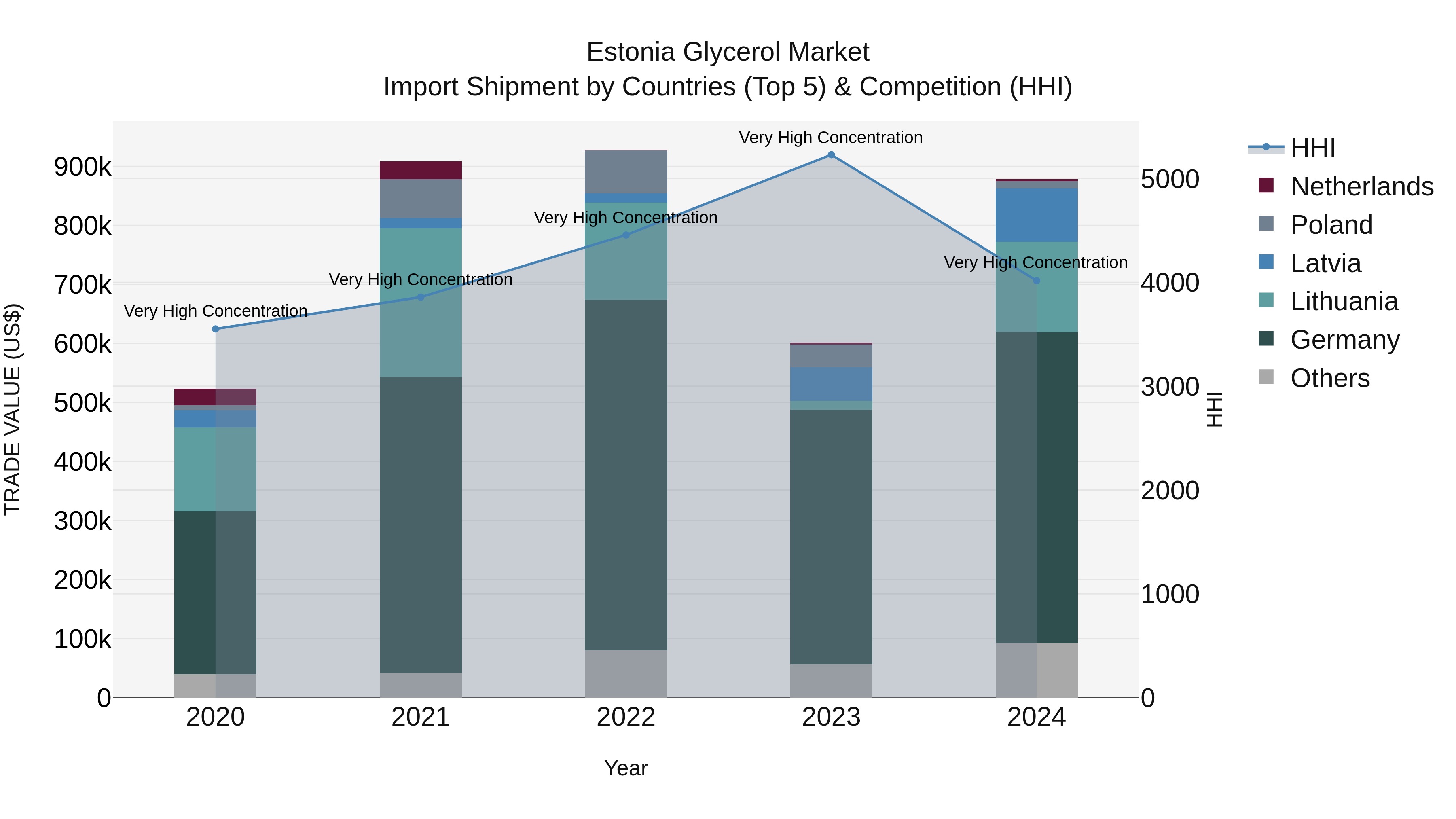
Estonia`s glycerol import market in 2024 continued to be dominated by key suppliers such as Germany, Lithuania, Latvia, Finland, and Poland. The high Herfindahl-Hirschman Index (HHI) indicates a concentrated market with limited competition. The impressive compound annual growth rate (CAGR) of 13.84% from 2020 to 2024 highlights sustained demand for glycerol in Estonia. Moreover, the notable growth rate of 46.11% from 2023 to 2024 suggests a rapid expansion in import volumes, signaling a flourishing market for glycerol in the country.
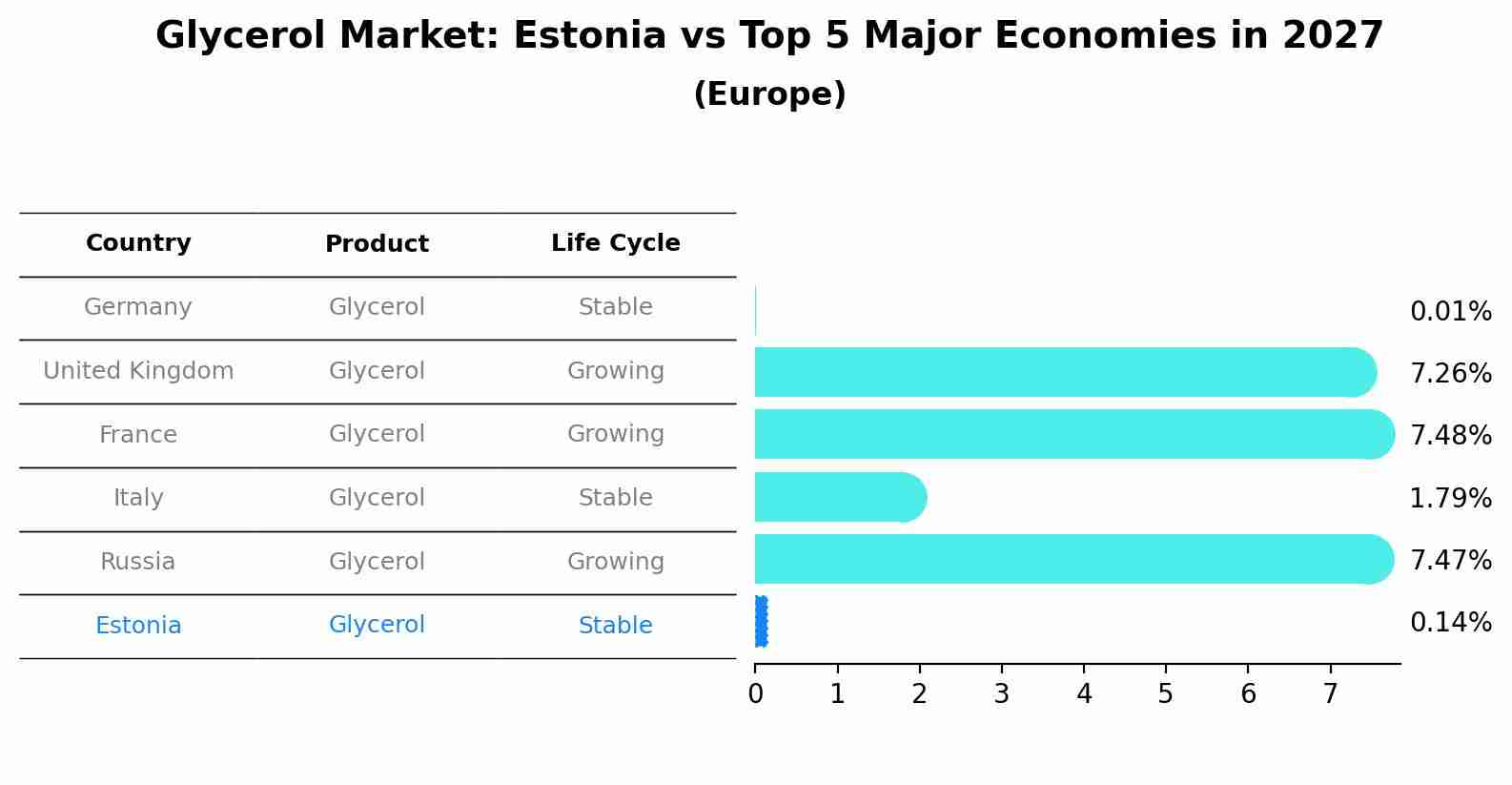
Glycerol Market: Estonia vs Top 5 Major Economies in 2027 (Europe)
By 2027, the Glycerol market in Estonia is anticipated to reach a growth rate of 0.14%, as part of an increasingly competitive Europe region, where Germany remains at the forefront, supported by United Kingdom, France, Italy and Russia, driving innovations and market adoption across sectors.
Estonia Glycerol Market Overview
The glycerol market in Estonia shares many similarities with the glycerin market but emphasizes industrial and scientific applications. Glycerol, chemically identical to glycerin, finds usage in various technical fields such as antifreeze production, resins, and explosives manufacturing. In laboratory and research contexts, glycerol is employed as a cryoprotectant and solvent, playing a critical role in biochemical and microbiological applications. Estonias push toward sustainability and bio-based solutions has also led to innovative uses of glycerol in biofuel production and biodegradable polymers. This aligns with global trends prioritizing environmentally friendly and renewable resources. Despite these opportunities, the glycerol market faces challenges related to the competition from synthetic substitutes and the need for advanced refining processes to meet high-purity demands for specific applications. Overall, Estonias industrial advancements and commitment to sustainability position the glycerol market for moderate yet consistent growth.
Drivers of the market
The Glycerol market in Estonia is driven by the growing demand for glycerol in the food, pharmaceutical, and personal care industries. Glycerol, which shares similar properties with glycerin, is used as a solvent, humectant, and preservative in a wide range of products. As the food and beverage industry in Estonia seeks cleaner, safer ingredients, the demand for glycerol is rising. Furthermore, the increasing use of glycerol in formulations for skincare, cosmetics, and medical products is supporting the growth of the glycerol market in the country.
Challenges of the market
Challenges in the glycerol market include limited applications within Estonia and competition from other chemicals in pharmaceuticals and personal care products. The reliance on imports for raw materials and high transportation costs further restrict market growth.
Government Policy of the market
Estonia encourages the production and use of glycerol through policies that focus on environmental sustainability and product safety. Regulations ensure that glycerol products meet EU quality standards, fostering its use in diverse industries such as cosmetics, food, and pharmaceuticals, while promoting sustainable sourcing practices.
Key Highlights of the Report:
- Estonia Glycerol Market Outlook
- Market Size of Estonia Glycerol Market, 2024
- Forecast of Estonia Glycerol Market, 2031
- Historical Data and Forecast of Estonia Glycerol Revenues & Volume for the Period 2021-2031
- Estonia Glycerol Market Trend Evolution
- Estonia Glycerol Market Drivers and Challenges
- Estonia Glycerol Price Trends
- Estonia Glycerol Porter`s Five Forces
- Estonia Glycerol Industry Life Cycle
- Historical Data and Forecast of Estonia Glycerol Market Revenues & Volume By Source for the Period 2021-2031
- Historical Data and Forecast of Estonia Glycerol Market Revenues & Volume By Biodiesel for the Period 2021-2031
- Historical Data and Forecast of Estonia Glycerol Market Revenues & Volume By Fatty Alcohols for the Period 2021-2031
- Historical Data and Forecast of Estonia Glycerol Market Revenues & Volume By Fatty Acids for the Period 2021-2031
- Historical Data and Forecast of Estonia Glycerol Market Revenues & Volume By Soap for the Period 2021-2031
- Historical Data and Forecast of Estonia Glycerol Market Revenues & Volume By Type for the Period 2021-2031
- Historical Data and Forecast of Estonia Glycerol Market Revenues & Volume By Crude for the Period 2021-2031
- Historical Data and Forecast of Estonia Glycerol Market Revenues & Volume By Refined for the Period 2021-2031
- Historical Data and Forecast of Estonia Glycerol Market Revenues & Volume By End-use for the Period 2021-2031
- Historical Data and Forecast of Estonia Glycerol Market Revenues & Volume By Food & Beverage for the Period 2021-2031
- Historical Data and Forecast of Estonia Glycerol Market Revenues & Volume By Pharmaceutical for the Period 2021-2031
- Historical Data and Forecast of Estonia Glycerol Market Revenues & Volume By Nutraceutical for the Period 2021-2031
- Historical Data and Forecast of Estonia Glycerol Market Revenues & Volume By Personal Care & Cosmetics for the Period 2021-2031
- Historical Data and Forecast of Estonia Glycerol Market Revenues & Volume By Industrial for the Period 2021-2031
- Historical Data and Forecast of Estonia Glycerol Market Revenues & Volume By Others for the Period 2021-2031
- Estonia Glycerol Import Export Trade Statistics
- Market Opportunity Assessment By Source
- Market Opportunity Assessment By Type
- Market Opportunity Assessment By End-use
- Estonia Glycerol Top Companies Market Share
- Estonia Glycerol Competitive Benchmarking By Technical and Operational Parameters
- Estonia Glycerol Company Profiles
- Estonia Glycerol Key Strategic Recommendations






































