Estonia High-frequency Transformer Market Top 5 Importing Countries and Market Competition (HHI) Analysis
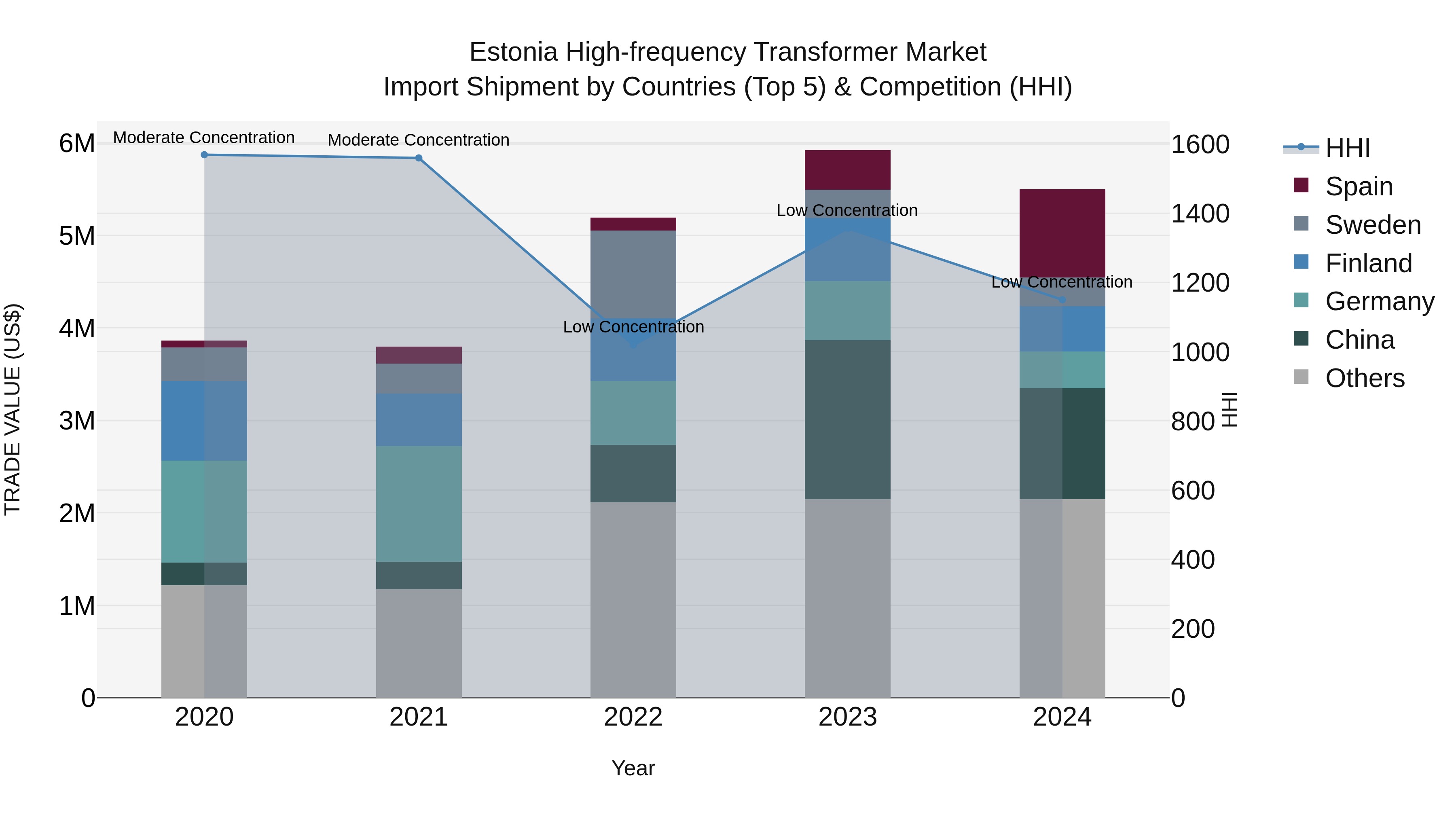
In 2024, Estonia saw a diverse range of high-frequency transformer imports with top exporters being China, Spain, Italy, Finland, and Germany. The market remains competitive and dynamic with a low Herfindahl-Hirschman Index (HHI) concentration. Despite a strong compound annual growth rate (CAGR) of 9.25% from 2020 to 2024, there was a slight decline in growth rate from 2023 to 2024 at -7.11%. This indicates a fluctuating market environment with opportunities for both local and international players to explore in the high-frequency transformer segment in Estonia.
Key Highlights of the Report:
- Estonia High-Frequency Transformer Market Outlook
- Market Size of Estonia High-Frequency Transformer Market, 2025
- Forecast of Estonia High-Frequency Transformer Market, 2032
- Historical Data and Forecast of Estonia High-Frequency Transformer Revenues & Volume for the Period 2022 - 2032F
- Estonia High-Frequency Transformer Market Trend Evolution
- Estonia High-Frequency Transformer Market Drivers and Challenges
- Estonia High-Frequency Transformer Price Trends
- Estonia High-Frequency Transformer Porter`s Five Forces
- Estonia High-Frequency Transformer Industry Life Cycle
- Historical Data and Forecast of Estonia High-Frequency Transformer Market Revenues & Volume By Application for the Period 2022 - 2032F
- Historical Data and Forecast of Estonia High-Frequency Transformer Market Revenues & Volume By Power Supplies for the Period 2022 - 2032F
- Historical Data and Forecast of Estonia High-Frequency Transformer Market Revenues & Volume By Alternative Energy Inverters for the Period 2022 - 2032F
- Historical Data and Forecast of Estonia High-Frequency Transformer Market Revenues & Volume By Electronic Switching Devices for the Period 2022 - 2032F
- Historical Data and Forecast of Estonia High-Frequency Transformer Market Revenues & Volume By LED Lighting for the Period 2022 - 2032F
- Historical Data and Forecast of Estonia High-Frequency Transformer Market Revenues & Volume By Personal Electronics for the Period 2022 - 2032F
- Historical Data and Forecast of Estonia High-Frequency Transformer Market Revenues & Volume By Power Output for the Period 2022 - 2032F
- Historical Data and Forecast of Estonia High-Frequency Transformer Market Revenues & Volume By 101 to 400W for the Period 2022 - 2032F
- Historical Data and Forecast of Estonia High-Frequency Transformer Market Revenues & Volume By 401W and Above for the Period 2022 - 2032F
- Historical Data and Forecast of Estonia High-Frequency Transformer Market Revenues & Volume By Up to 50W for the Period 2022 - 2032F
- Historical Data and Forecast of Estonia High-Frequency Transformer Market Revenues & Volume By 51 to100W for the Period 2022 - 2032F
- Historical Data and Forecast of Estonia High-Frequency Transformer Market Revenues & Volume By Vertical for the Period 2022 - 2032F
- Historical Data and Forecast of Estonia High-Frequency Transformer Market Revenues & Volume By Military and Defense for the Period 2022 - 2032F
- Historical Data and Forecast of Estonia High-Frequency Transformer Market Revenues & Volume By RF and Telecommunications for the Period 2022 - 2032F
- Historical Data and Forecast of Estonia High-Frequency Transformer Market Revenues & Volume By Manufacturing for the Period 2022 - 2032F
- Estonia High-Frequency Transformer Import Export Trade Statistics
- Market Opportunity Assessment By Application
- Market Opportunity Assessment By Power Output
- Market Opportunity Assessment By Vertical
- Estonia High-Frequency Transformer Top Companies Market Share
- Estonia High-Frequency Transformer Competitive Benchmarking By Technical and Operational Parameters
- Estonia High-Frequency Transformer Company Profiles
- Estonia High-Frequency Transformer Key Strategic Recommendations






































