Estonia Induction Motor - Market Production Statistics (2019-2025)
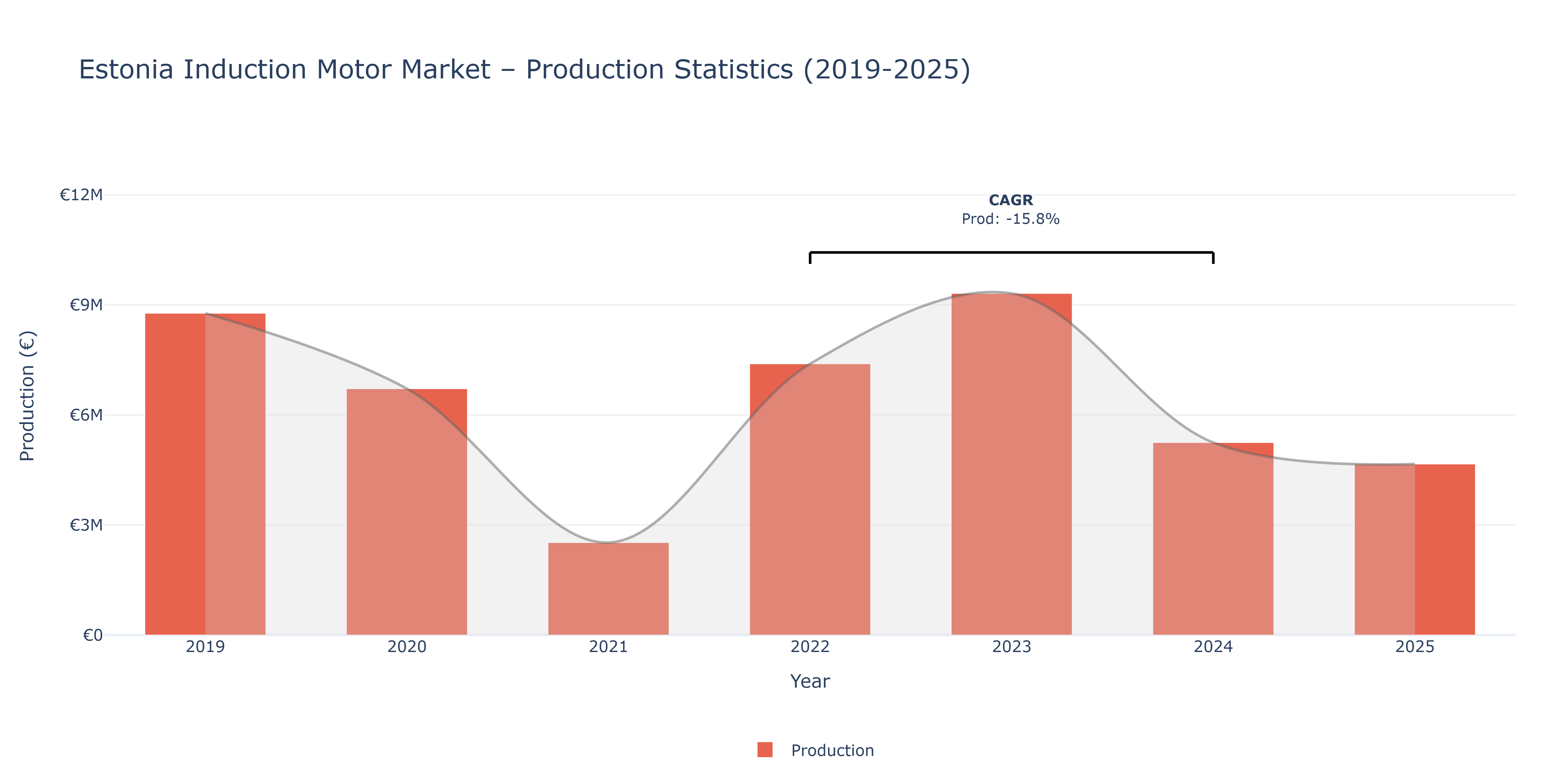
In the Estonia Induction Motor Market, the production figures have shown significant fluctuations over the years. The production started at €8.77 million in 2019, decreased to €6.71 million in 2020, and further dropped to €2.52 million in 2021. However, there was a notable recovery in 2022 with production reaching €7.39 million, followed by a peak in 2023 at €9.31 million. Subsequently, there was a decline in 2024 to €5.25 million and a further decrease to €4.66 million in 2025. The observed fluctuations can be attributed to various factors such as changes in demand, market competition, technological advancements, and economic conditions. The calculated Production CAGR of -15.75% from 2022 to 2024 indicates a negative growth trend during this period, reflecting the challenges faced by the market in those years.
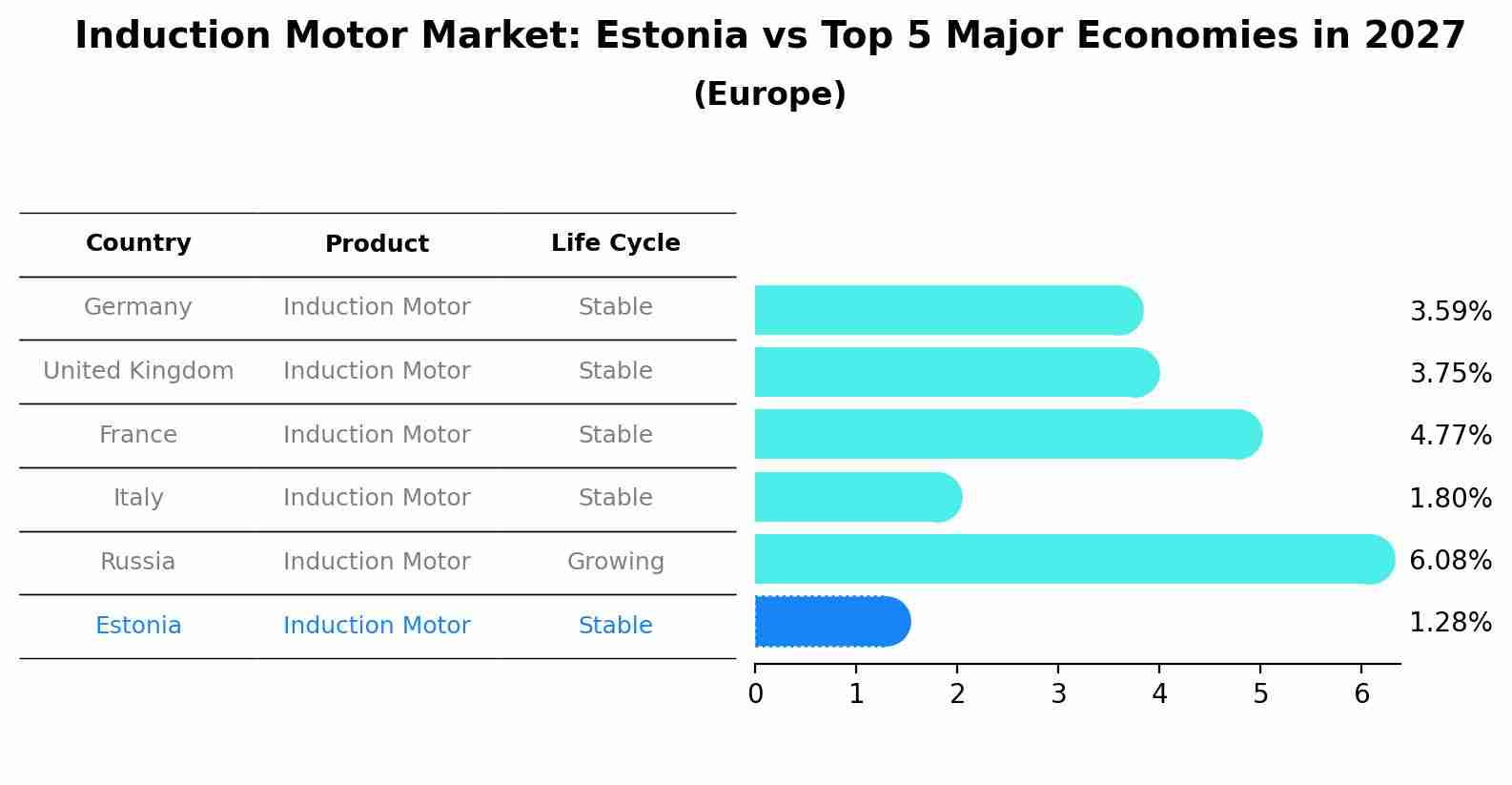
Induction Motor Market: Estonia vs Top 5 Major Economies in 2027 (Europe)
In the Europe region, the Induction Motor market in Estonia is projected to expand at a stable growth rate of 1.28% by 2027. The largest economy is Germany, followed by United Kingdom, France, Italy and Russia.
Key Highlights of the Report:
- Estonia Induction Motor Market Outlook
- Market Size of Estonia Induction Motor Market, 2025
- Forecast of Estonia Induction Motor Market, 2032
- Historical Data and Forecast of Estonia Induction Motor Revenues & Volume for the Period 2022 - 2032F
- Estonia Induction Motor Market Trend Evolution
- Estonia Induction Motor Market Drivers and Challenges
- Estonia Induction Motor Price Trends
- Estonia Induction Motor Porter`s Five Forces
- Estonia Induction Motor Industry Life Cycle
- Historical Data and Forecast of Estonia Induction Motor Market Revenues & Volume By Type for the Period 2022 - 2032F
- Historical Data and Forecast of Estonia Induction Motor Market Revenues & Volume By Single Phase for the Period 2022 - 2032F
- Historical Data and Forecast of Estonia Induction Motor Market Revenues & Volume By Three Phase for the Period 2022 - 2032F
- Historical Data and Forecast of Estonia Induction Motor Market Revenues & Volume By Application for the Period 2022 - 2032F
- Historical Data and Forecast of Estonia Induction Motor Market Revenues & Volume By Residential for the Period 2022 - 2032F
- Historical Data and Forecast of Estonia Induction Motor Market Revenues & Volume By Industrial for the Period 2022 - 2032F
- Historical Data and Forecast of Estonia Induction Motor Market Revenues & Volume By Commercial for the Period 2022 - 2032F
- Historical Data and Forecast of Estonia Induction Motor Market Revenues & Volume By Transportation for the Period 2022 - 2032F
- Historical Data and Forecast of Estonia Induction Motor Market Revenues & Volume By Others for the Period 2022 - 2032F
- Estonia Induction Motor Import Export Trade Statistics
- Market Opportunity Assessment By Type
- Market Opportunity Assessment By Application
- Estonia Induction Motor Top Companies Market Share
- Estonia Induction Motor Competitive Benchmarking By Technical and Operational Parameters
- Estonia Induction Motor Company Profiles
- Estonia Induction Motor Key Strategic Recommendations






































