Estonia Laboratory Freezers Market Top 5 Importing Countries and Market Competition (HHI) Analysis
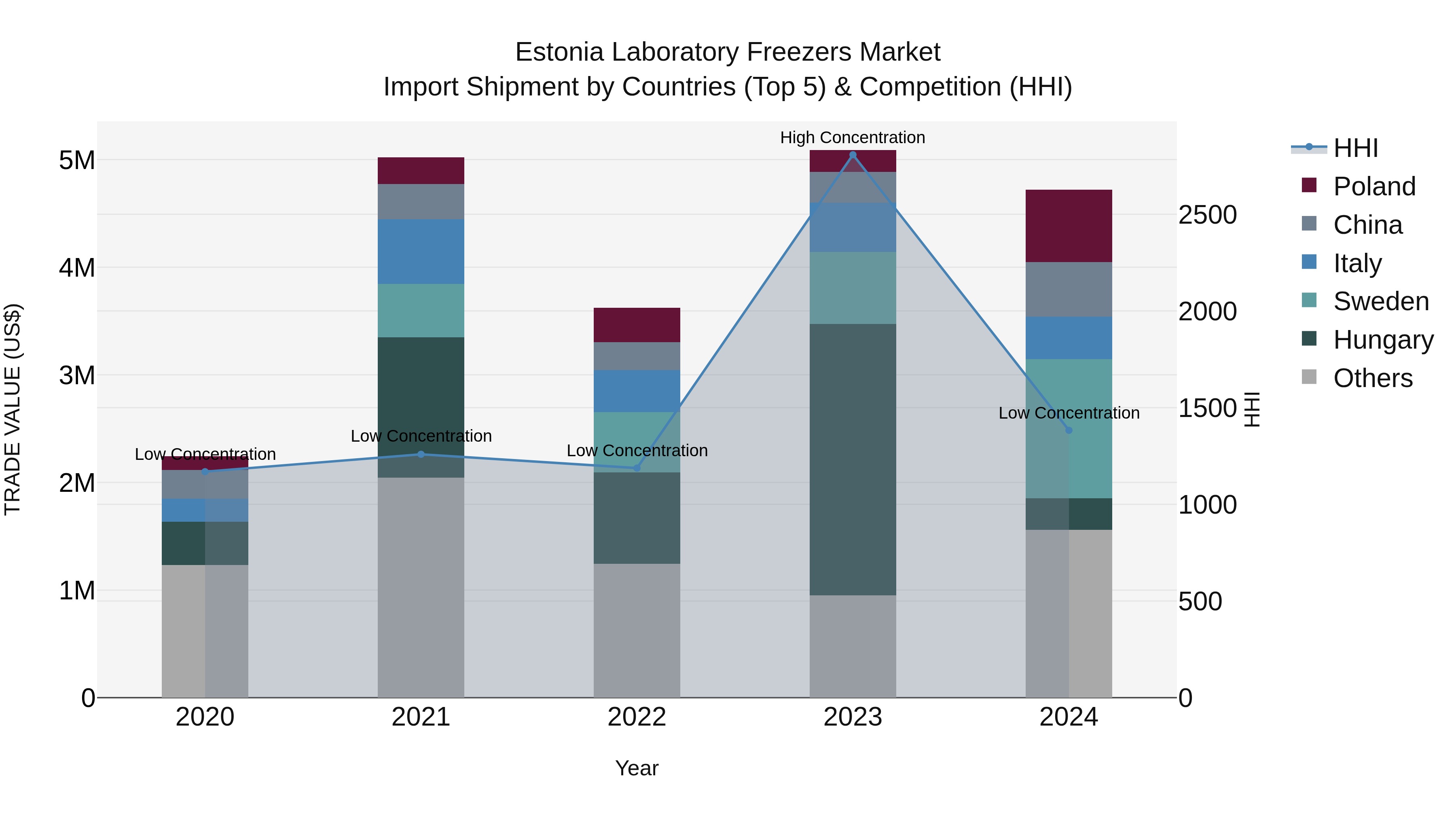
The Estonia laboratory freezers import market experienced a shift in concentration levels from high to low in 2024, reflecting a more diverse supplier base. Top exporting countries in 2024 included Sweden, Poland, China, Austria, and Italy. Despite a slight decline in growth rate from 2023 to 2024, the compound annual growth rate (CAGR) for the period 2020-2024 remained strong at 20.44%. This data suggests a dynamic and evolving market landscape for laboratory freezers in Estonia, with opportunities for both domestic and international suppliers to capture market share.
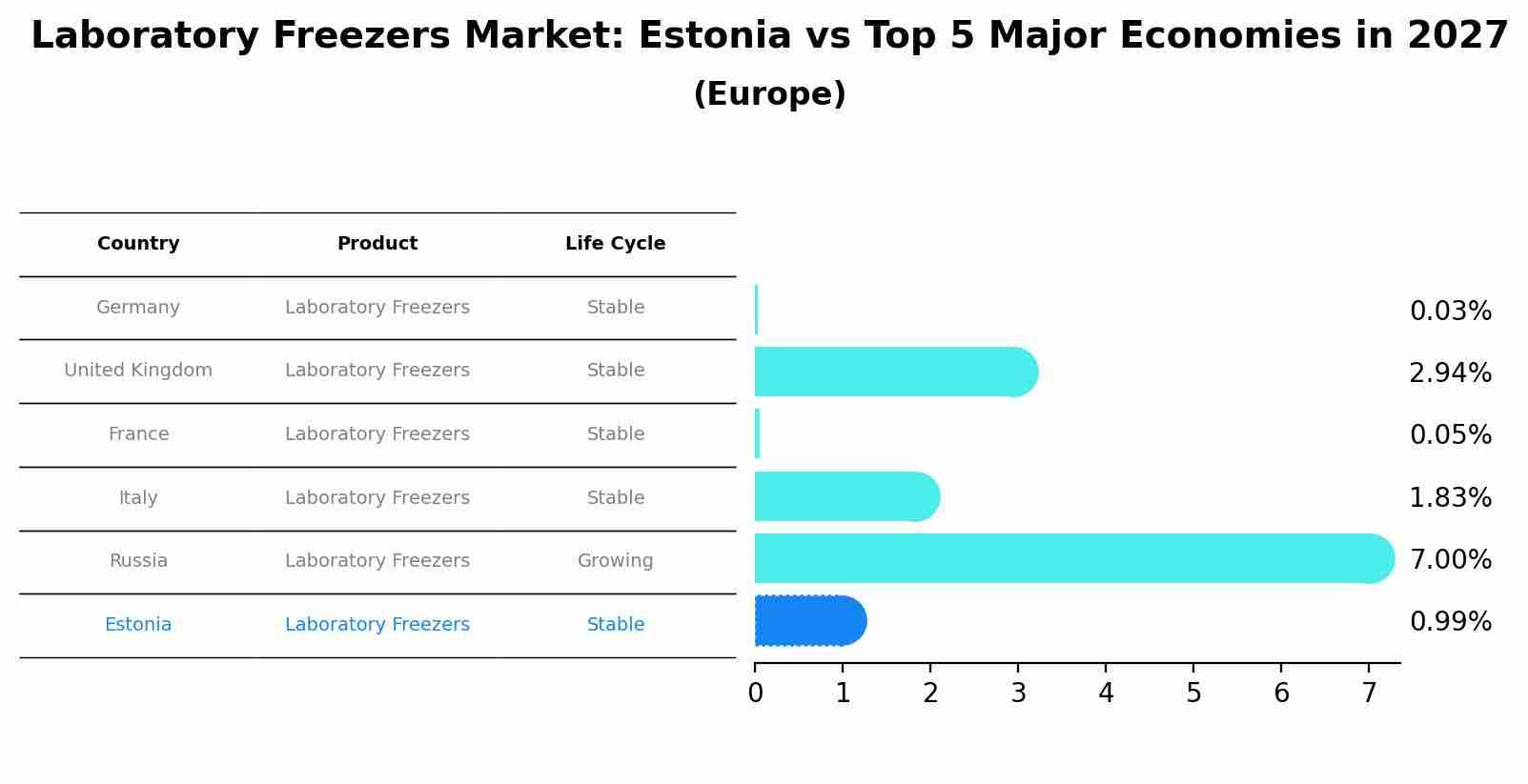
Laboratory Freezers Market: Estonia vs Top 5 Major Economies in 2027 (Europe)
The Laboratory Freezers market in Estonia is projected to grow at a stable growth rate of 0.99% by 2027, highlighting the country's increasing focus on advanced technologies within the Europe region, where Germany holds the dominant position, followed closely by United Kingdom, France, Italy and Russia, shaping overall regional demand.
Estonia Laboratory Freezers Market Overview
The laboratory freezers market in Estonia is experiencing growth as research, healthcare, and pharmaceutical sectors continue to expand. These freezers are crucial for the storage of biological samples, vaccines, and other temperature-sensitive materials. The market is driven by advancements in biotechnology, clinical research, and the increasing demand for long-term storage solutions. As Estonias healthcare and research infrastructure develops, there is a growing need for high-performance, energy-efficient laboratory freezers that provide precise temperature control. Innovations in freezer technologies and the shift toward sustainable, eco-friendly solutions are expected to further enhance market growth.
Drivers of the market
The laboratory freezers market in Estonia is expanding due to rising requirements for cold storage solutions in healthcare, pharmaceuticals, and biotechnology. The growing need for vaccine storage also supports market growth.
Challenges of the market
The laboratory freezers market in Estonia faces several challenges, primarily the high energy consumption of commercial-grade freezers, which drives operational costs up for research institutions and medical facilities. Additionally, the market is subject to technological innovation, where there is constant pressure to develop more energy-efficient, environmentally friendly, and reliable freezing solutions. Manufacturers also have to balance the need for highly specialized freezers with the demand for standard, more affordable models. The competitive landscape, where global players dominate the market, makes it difficult for local manufacturers to maintain a competitive edge.
Government Policy of the market
Estonias government policies support the development of energy-efficient and sustainable laboratory freezers used in scientific research, medical testing, and pharmaceutical applications. The government promotes innovation in freezer technology while ensuring compliance with EU standards for energy consumption, safety, and waste reduction.
Key Highlights of the Report:
- Estonia Laboratory Freezers Market Outlook
- Market Size of Estonia Laboratory Freezers Market, 2024
- Forecast of Estonia Laboratory Freezers Market, 2031
- Historical Data and Forecast of Estonia Laboratory Freezers Revenues & Volume for the Period 2021-2031
- Estonia Laboratory Freezers Market Trend Evolution
- Estonia Laboratory Freezers Market Drivers and Challenges
- Estonia Laboratory Freezers Price Trends
- Estonia Laboratory Freezers Porter`s Five Forces
- Estonia Laboratory Freezers Industry Life Cycle
- Historical Data and Forecast of Estonia Laboratory Freezers Market Revenues & Volume By Product Type for the Period 2021-2031
- Historical Data and Forecast of Estonia Laboratory Freezers Market Revenues & Volume By Cryopreservation Systems for the Period 2021-2031
- Historical Data and Forecast of Estonia Laboratory Freezers Market Revenues & Volume By Refrigerators for the Period 2021-2031
- Historical Data and Forecast of Estonia Laboratory Freezers Market Revenues & Volume By Freezers for the Period 2021-2031
- Historical Data and Forecast of Estonia Laboratory Freezers Market Revenues & Volume By End User for the Period 2021-2031
- Historical Data and Forecast of Estonia Laboratory Freezers Market Revenues & Volume By Blood Banks for the Period 2021-2031
- Historical Data and Forecast of Estonia Laboratory Freezers Market Revenues & Volume By Pharmaceutical & Biotechnology Companies for the Period 2021-2031
- Historical Data and Forecast of Estonia Laboratory Freezers Market Revenues & Volume By Academic & Research Institutes for the Period 2021-2031
- Historical Data and Forecast of Estonia Laboratory Freezers Market Revenues & Volume By Medical Laboratories for the Period 2021-2031
- Historical Data and Forecast of Estonia Laboratory Freezers Market Revenues & Volume By Hospitals for the Period 2021-2031
- Historical Data and Forecast of Estonia Laboratory Freezers Market Revenues & Volume By Pharmacies for the Period 2021-2031
- Estonia Laboratory Freezers Import Export Trade Statistics
- Market Opportunity Assessment By Product Type
- Market Opportunity Assessment By End User
- Estonia Laboratory Freezers Top Companies Market Share
- Estonia Laboratory Freezers Competitive Benchmarking By Technical and Operational Parameters
- Estonia Laboratory Freezers Company Profiles
- Estonia Laboratory Freezers Key Strategic Recommendations






































