Estonia Marble Market Top 5 Importing Countries and Market Competition (HHI) Analysis
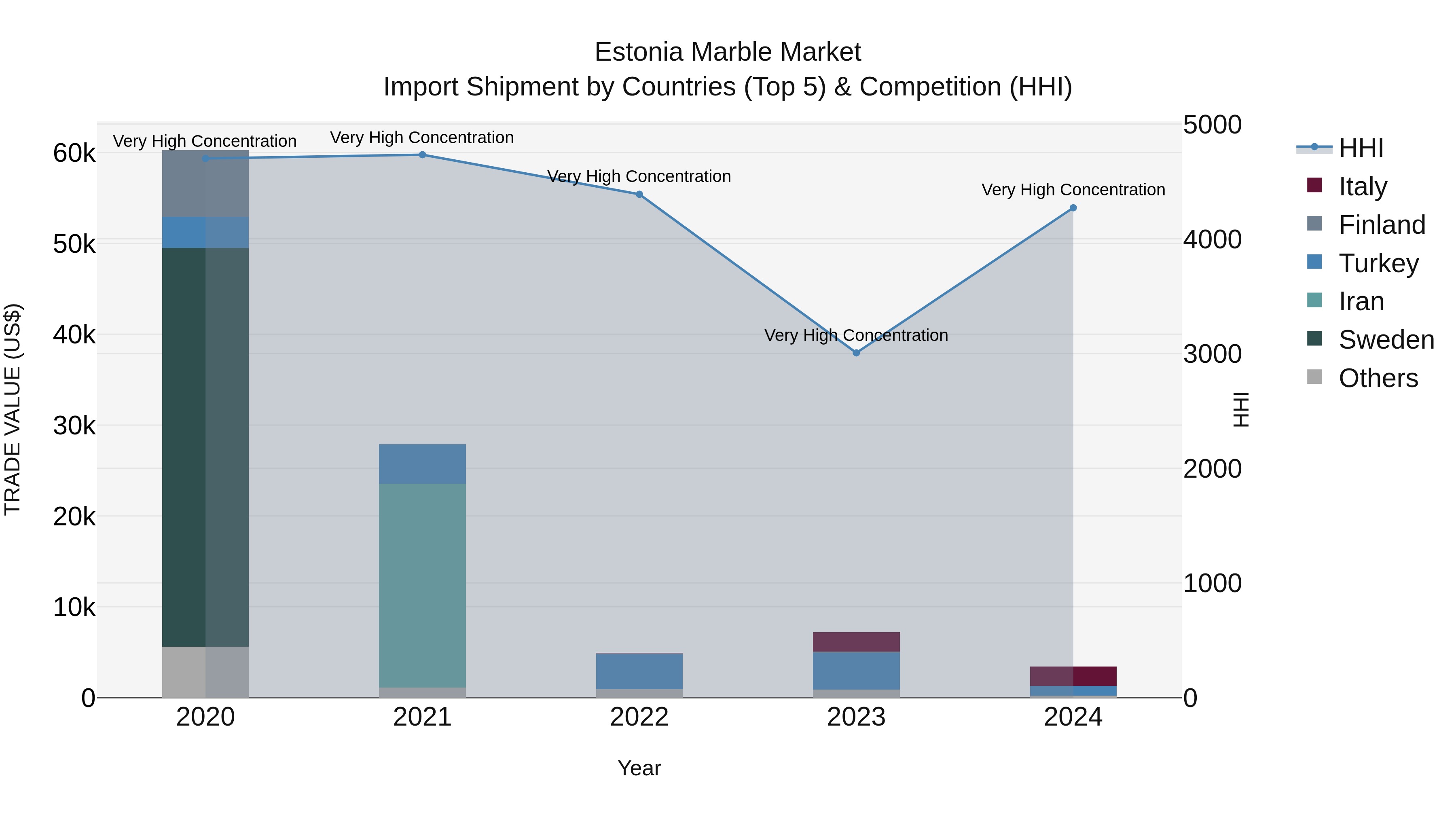
Estonia`s marble import market in 2024 continued to be dominated by top exporting countries such as Italy, Turkey, Germany, China, and Denmark. Despite a significant decline in the compound annual growth rate (CAGR) from 2020 to 2024 at -51.2%, the high concentration of the Herfindahl-Hirschman Index (HHI) suggests a relatively concentrated market. The negative growth rate in 2024 further indicates challenges faced by the industry, possibly due to economic factors or shifts in consumer preferences. Monitoring these trends will be crucial for stakeholders in the marble import sector in Estonia.
Marble Market: Estonia vs Top 5 Major Economies in 2027 (Europe)
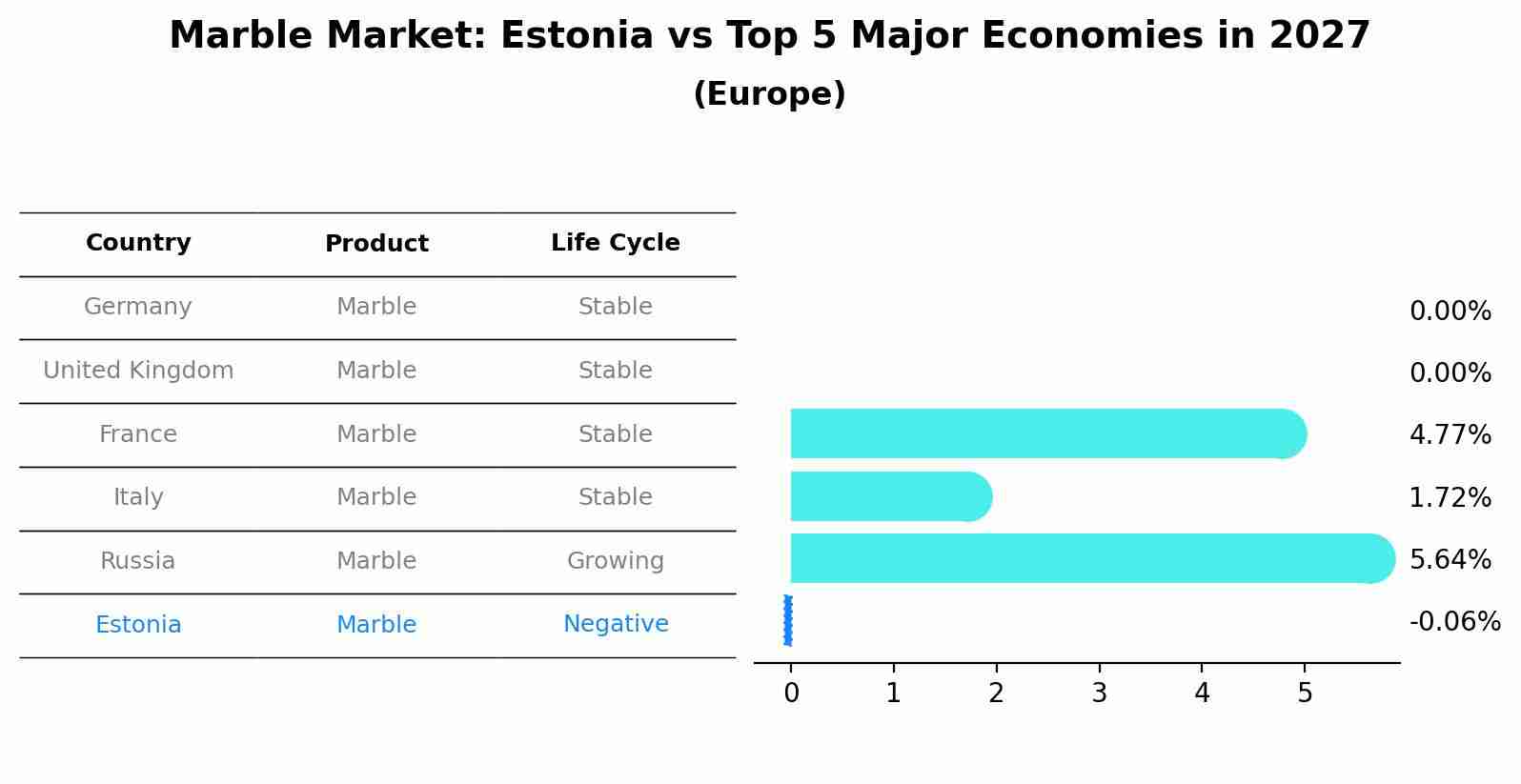
The Marble market in Estonia is projected to grow at a negative growth rate of -0.06% by 2027, highlighting the country's increasing focus on advanced technologies within the Europe region, where Germany holds the dominant position, followed closely by United Kingdom, France, Italy and Russia, shaping overall regional demand.
Key Highlights of the Report:
- Estonia Marble Market Outlook
- Market Size of Estonia Marble Market, 2025
- Forecast of Estonia Marble Market, 2032
- Historical Data and Forecast of Estonia Marble Revenues & Volume for the Period 2022 - 2032F
- Estonia Marble Market Trend Evolution
- Estonia Marble Market Drivers and Challenges
- Estonia Marble Price Trends
- Estonia Marble Porter`s Five Forces
- Estonia Marble Industry Life Cycle
- Historical Data and Forecast of Estonia Marble Market Revenues & Volume By Colour Type for the Period 2022 - 2032F
- Historical Data and Forecast of Estonia Marble Market Revenues & Volume By White for the Period 2022 - 2032F
- Historical Data and Forecast of Estonia Marble Market Revenues & Volume By Black for the Period 2022 - 2032F
- Historical Data and Forecast of Estonia Marble Market Revenues & Volume By Yellow for the Period 2022 - 2032F
- Historical Data and Forecast of Estonia Marble Market Revenues & Volume By Red for the Period 2022 - 2032F
- Historical Data and Forecast of Estonia Marble Market Revenues & Volume By Others for the Period 2022 - 2032F
- Historical Data and Forecast of Estonia Marble Market Revenues & Volume By Application for the Period 2022 - 2032F
- Historical Data and Forecast of Estonia Marble Market Revenues & Volume By Building & Construction for the Period 2022 - 2032F
- Historical Data and Forecast of Estonia Marble Market Revenues & Volume By Statues and Monuments for the Period 2022 - 2032F
- Historical Data and Forecast of Estonia Marble Market Revenues & Volume By Furniture for the Period 2022 - 2032F
- Historical Data and Forecast of Estonia Marble Market Revenues & Volume By Others for the Period 2022 - 2032F
- Estonia Marble Import Export Trade Statistics
- Market Opportunity Assessment By Colour Type
- Market Opportunity Assessment By Application
- Estonia Marble Top Companies Market Share
- Estonia Marble Competitive Benchmarking By Technical and Operational Parameters
- Estonia Marble Company Profiles
- Estonia Marble Key Strategic Recommendations






































