Estonia Membranes Market Top 5 Importing Countries and Market Competition (HHI) Analysis
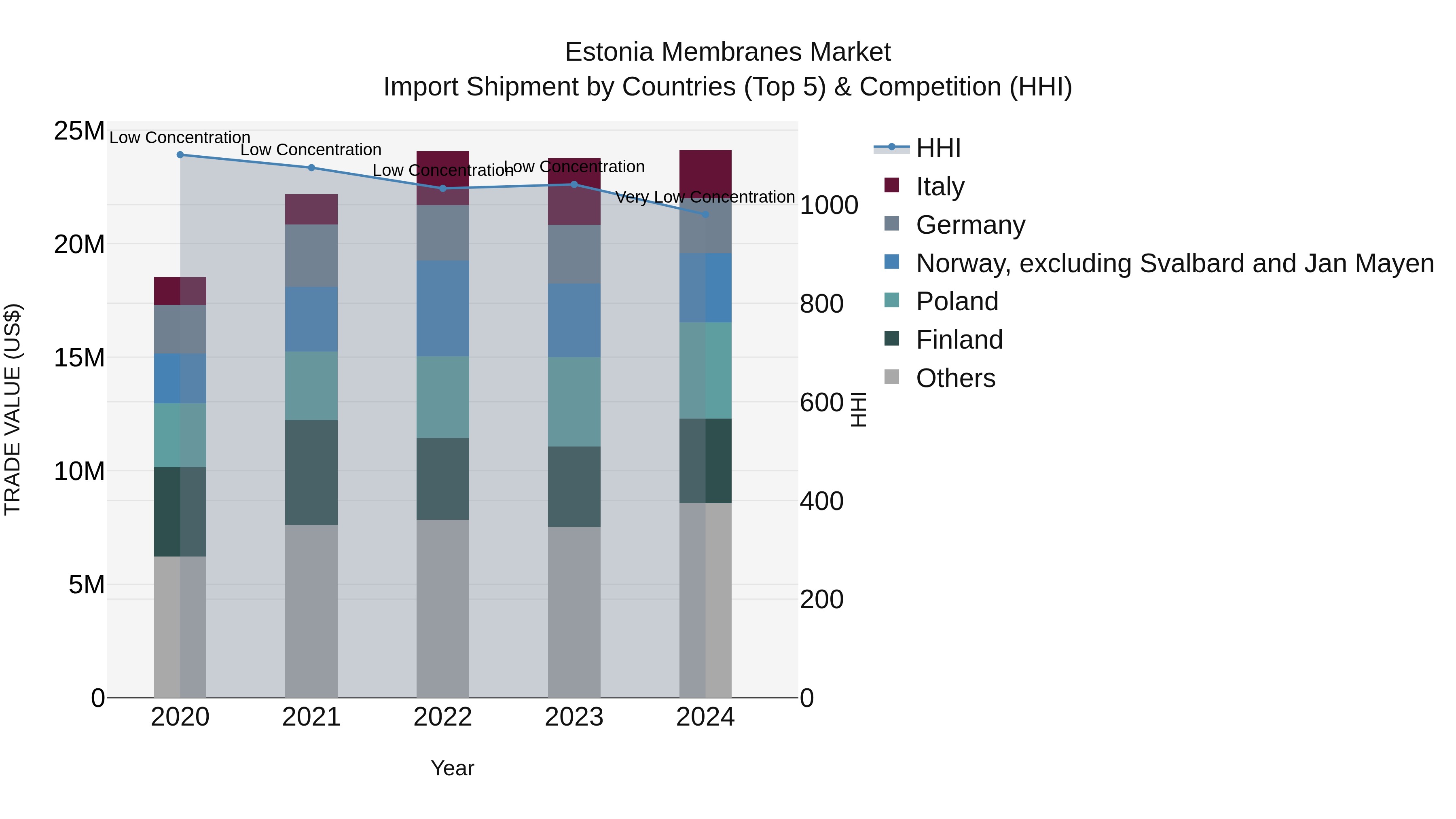
Estonia`s membrane import market saw a steady growth with a CAGR of 6.81% from 2020 to 2024. In 2024, the top countries exporting to Estonia were Poland, Finland, Norway, Germany, and Italy. The market concentration, as measured by HHI, decreased from low to very low in 2024, indicating a more balanced distribution of imports among different countries. A modest growth rate of 1.45% from 2023 to 2024 suggests a stable and gradually expanding market for membrane imports in Estonia.
Key Highlights of the Report:
- Estonia Membranes Market Outlook
- Market Size of Estonia Membranes Market, 2025
- Forecast of Estonia Membranes Market, 2032
- Historical Data and Forecast of Estonia Membranes Revenues & Volume for the Period 2022 - 2032F
- Estonia Membranes Market Trend Evolution
- Estonia Membranes Market Drivers and Challenges
- Estonia Membranes Price Trends
- Estonia Membranes Porter`s Five Forces
- Estonia Membranes Industry Life Cycle
- Historical Data and Forecast of Estonia Membranes Market Revenues & Volume By Material for the Period 2022 - 2032F
- Historical Data and Forecast of Estonia Membranes Market Revenues & Volume By Polymeric for the Period 2022 - 2032F
- Historical Data and Forecast of Estonia Membranes Market Revenues & Volume By Ceramic for the Period 2022 - 2032F
- Historical Data and Forecast of Estonia Membranes Market Revenues & Volume By Technology for the Period 2022 - 2032F
- Historical Data and Forecast of Estonia Membranes Market Revenues & Volume By RO for the Period 2022 - 2032F
- Historical Data and Forecast of Estonia Membranes Market Revenues & Volume By MF for the Period 2022 - 2032F
- Historical Data and Forecast of Estonia Membranes Market Revenues & Volume By UF for the Period 2022 - 2032F
- Historical Data and Forecast of Estonia Membranes Market Revenues & Volume By NF for the Period 2022 - 2032F
- Historical Data and Forecast of Estonia Membranes Market Revenues & Volume By Application for the Period 2022 - 2032F
- Historical Data and Forecast of Estonia Membranes Market Revenues & Volume By Water & Wastewater Treatment for the Period 2022 - 2032F
- Historical Data and Forecast of Estonia Membranes Market Revenues & Volume By Industrial Processing for the Period 2022 - 2032F
- Estonia Membranes Import Export Trade Statistics
- Market Opportunity Assessment By Material
- Market Opportunity Assessment By Technology
- Market Opportunity Assessment By Application
- Estonia Membranes Top Companies Market Share
- Estonia Membranes Competitive Benchmarking By Technical and Operational Parameters
- Estonia Membranes Company Profiles
- Estonia Membranes Key Strategic Recommendations






































