Estonia Particle Board Market Size (2020-2030)
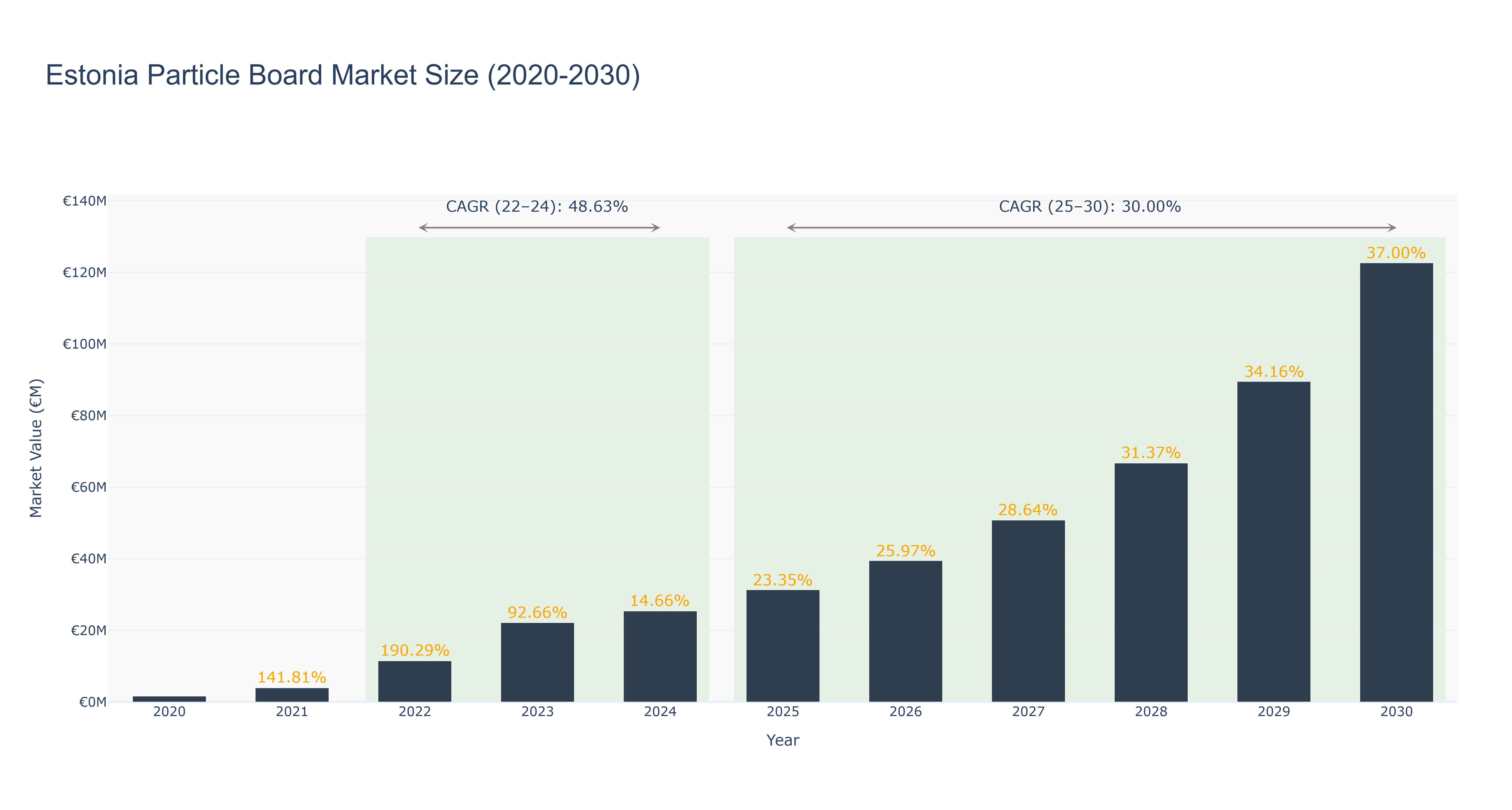
Estonia Particle Board Market has shown a remarkable growth trajectory in recent years. The market size surged from €1.64 million in 2020 to €25.42 million in 2024, experiencing a notable 48.63% CAGR. Subsequently, the market is forecasted to continue its upward trend, with an expected size of €122.68 million by 2030, driven by a steady 30.0% CAGR from 2025 onwards. The market's rapid expansion can be attributed to increasing demand for sustainable construction materials and the growing trend towards eco-friendly practices in the building industry. Looking ahead, Estonia is set to embark on a national initiative to promote the use of particle board in residential and commercial construction projects, further boosting market growth and solidifying its position as a key player in the particle board industry.
Estonia Particle Board Market: Production & Trade Performance (2019-2025)
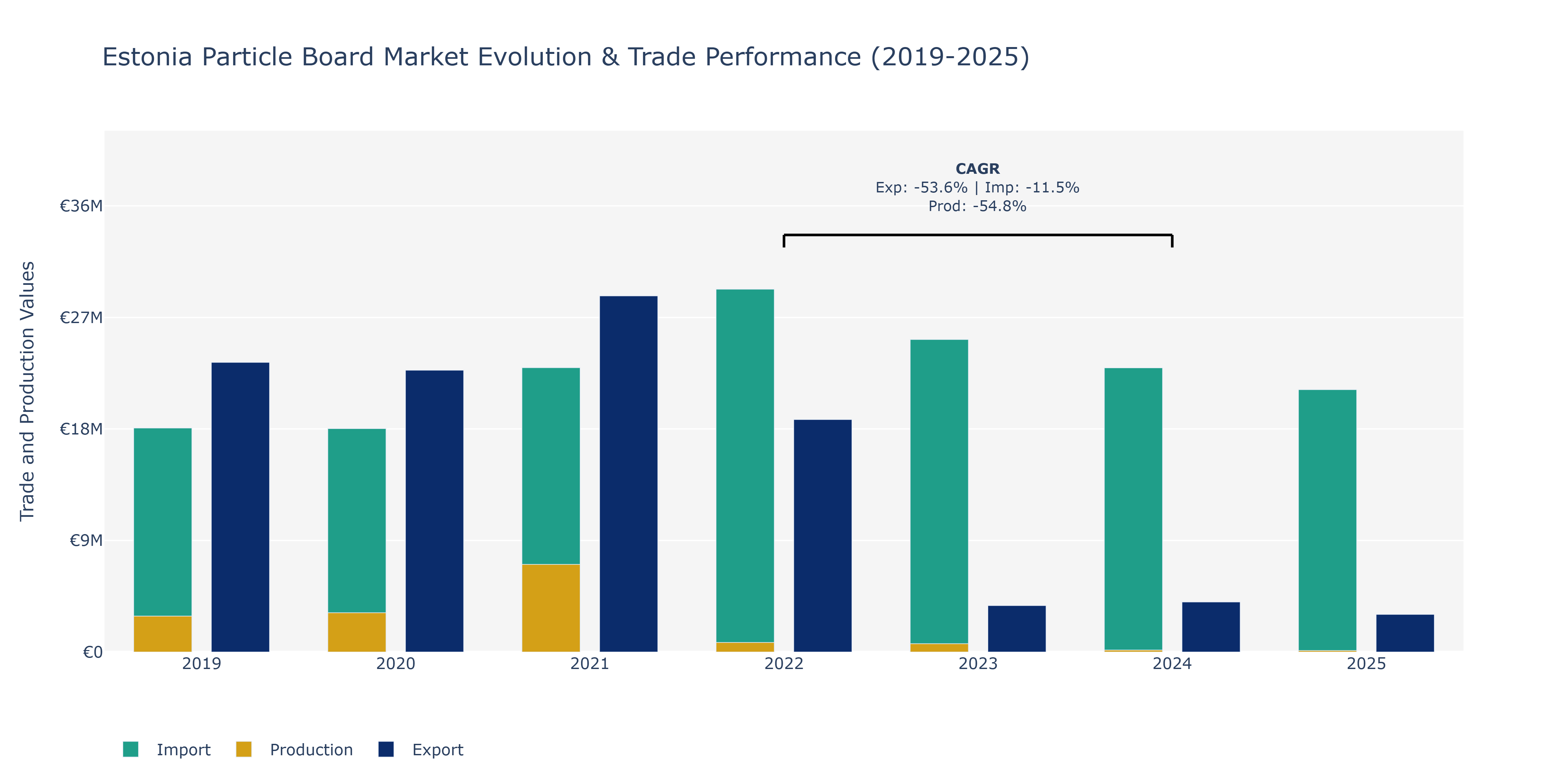
Between 2019 and 2025, the Estonia Particle Board Market witnessed diverse trends in Exports, Imports, and Production. Exports peaked at €28.74 million in 2021, reflecting a notable surge from previous years and subsequently decreased in 2022, rebounding slightly in 2025 to around €3.04 million. Imports followed a similar trajectory, reaching €29.28 million in 2022 before declining to approximately €21.18 million in 2025. Production, on the other hand, fluctuated drastically, from €7.69 million in 2022 to €118.03 million in 2025. The decline in Exports and Imports post-2021 can be attributed to global economic uncertainties impacting demand and supply chains. Meanwhile, the sharp decrease in Production can be linked to market saturation, prompting manufacturers to recalibrate operations for sustainability. To maintain competitiveness, stakeholders may consider diversifying export markets and investing in advanced production technologies to enhance efficiency and quality amidst evolving market conditions.
Key Highlights of the Report:
- Estonia Particle Board Market Outlook
- Market Size of Estonia Particle Board Market, 2025
- Forecast of Estonia Particle Board Market, 2032
- Historical Data and Forecast of Estonia Particle Board Revenues & Volume for the Period 2022 - 2032F
- Estonia Particle Board Market Trend Evolution
- Estonia Particle Board Market Drivers and Challenges
- Estonia Particle Board Price Trends
- Estonia Particle Board Porter`s Five Forces
- Estonia Particle Board Industry Life Cycle
- Historical Data and Forecast of Estonia Particle Board Market Revenues & Volume By Type for the Period 2022 - 2032F
- Historical Data and Forecast of Estonia Particle Board Market Revenues & Volume By Standard Chipboard for the Period 2022 - 2032F
- Historical Data and Forecast of Estonia Particle Board Market Revenues & Volume By Melamine Veneered Chipboard for the Period 2022 - 2032F
- Historical Data and Forecast of Estonia Particle Board Market Revenues & Volume By Flooring Grade Chipboard for the Period 2022 - 2032F
- Historical Data and Forecast of Estonia Particle Board Market Revenues & Volume By Wood Veneered Chipboard for the Period 2022 - 2032F
- Historical Data and Forecast of Estonia Particle Board Market Revenues & Volume By Plastic Veneered Chipboard for the Period 2022 - 2032F
- Historical Data and Forecast of Estonia Particle Board Market Revenues & Volume By Other for the Period 2022 - 2032F
- Historical Data and Forecast of Estonia Particle Board Market Revenues & Volume By Application for the Period 2022 - 2032F
- Historical Data and Forecast of Estonia Particle Board Market Revenues & Volume By Construction for the Period 2022 - 2032F
- Historical Data and Forecast of Estonia Particle Board Market Revenues & Volume By Furniture for the Period 2022 - 2032F
- Historical Data and Forecast of Estonia Particle Board Market Revenues & Volume By Infrastructure for the Period 2022 - 2032F
- Historical Data and Forecast of Estonia Particle Board Market Revenues & Volume By Other for the Period 2022 - 2032F
- Estonia Particle Board Import Export Trade Statistics
- Market Opportunity Assessment By Type
- Market Opportunity Assessment By Application
- Estonia Particle Board Top Companies Market Share
- Estonia Particle Board Competitive Benchmarking By Technical and Operational Parameters
- Estonia Particle Board Company Profiles
- Estonia Particle Board Key Strategic Recommendations






































