Estonia Polymer Emulsion Market Top 5 Importing Countries and Market Competition (HHI) Analysis
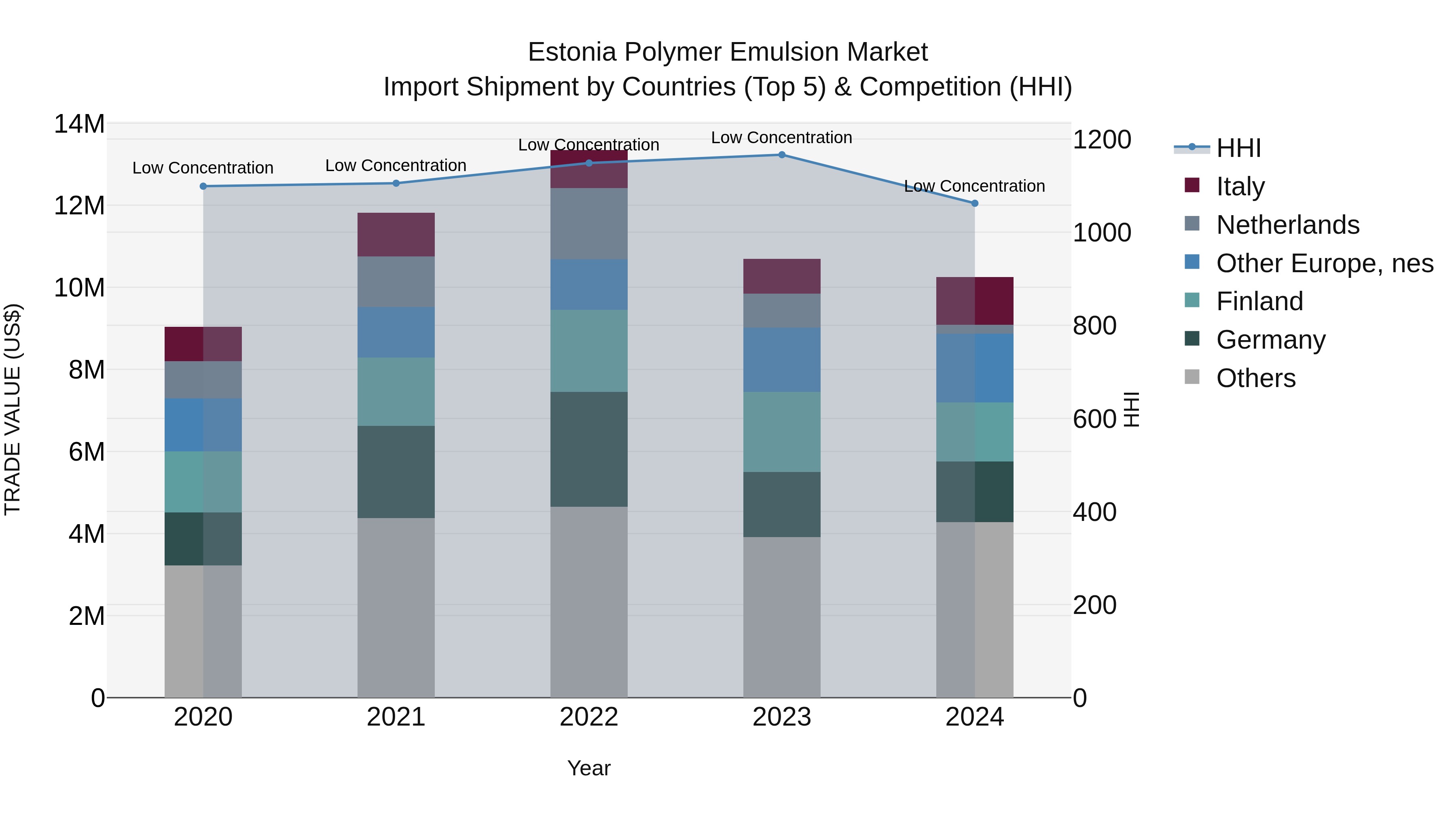
Estonia`s polymer emulsion import market in 2024 saw a diverse range of top exporting countries, including Other Europe, Germany, Finland, Metropolitan France, and Italy. Despite this variety, the market maintained low concentration levels, as indicated by the Herfindahl-Hirschman Index (HHI). The compound annual growth rate (CAGR) from 2020 to 2024 stood at a steady 3.19%, showcasing consistent growth. However, a slight decline was observed in the growth rate from 2023 to 2024, with a -4.15% decrease. This data suggests a stable yet slightly fluctuating market trend for polymer emulsion imports in Estonia.
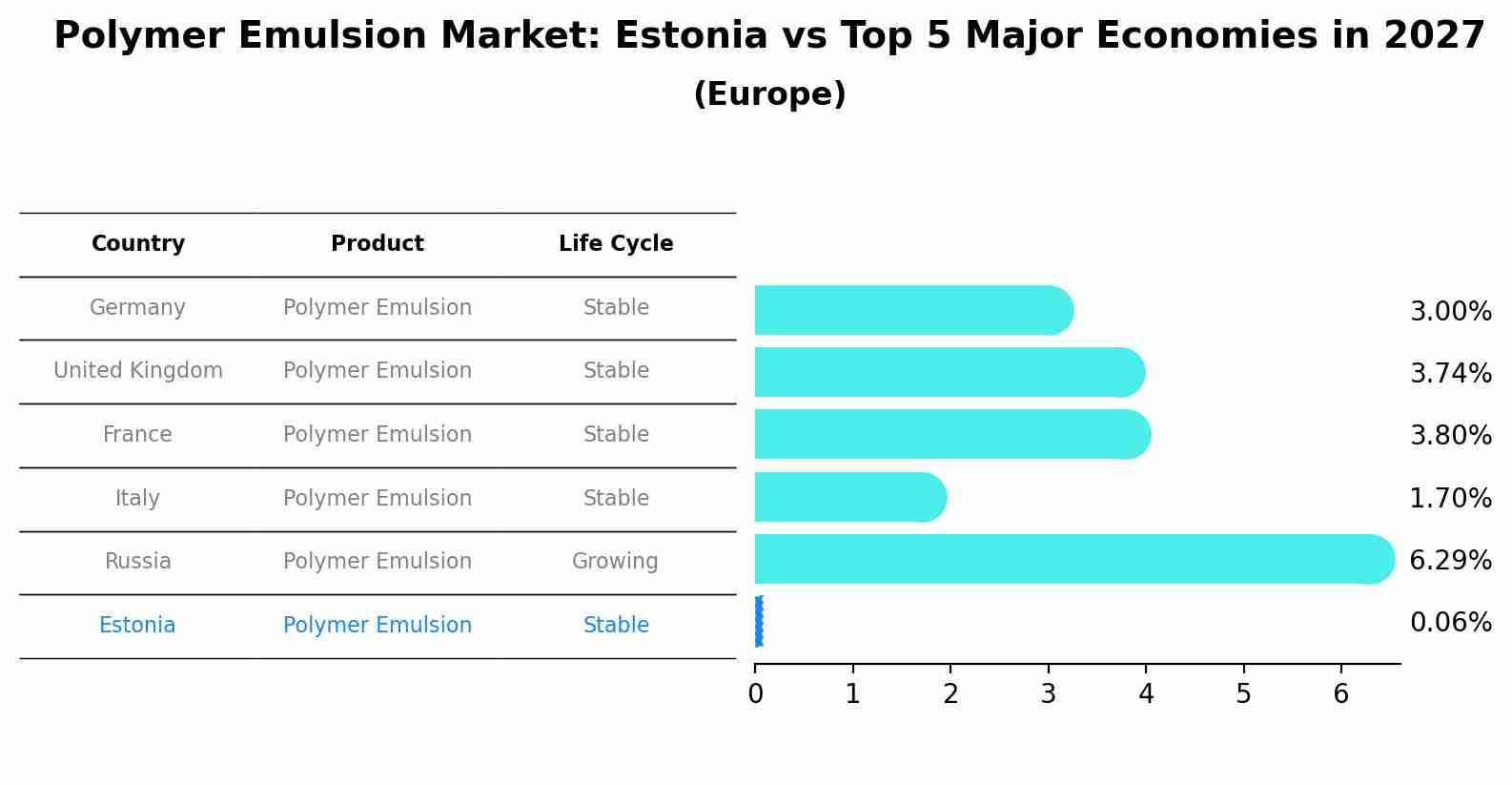
Polymer Emulsion Market: Estonia vs Top 5 Major Economies in 2027 (Europe)
Estonia's Polymer Emulsion market is anticipated to experience a stable growth rate of 0.06% by 2027, reflecting trends observed in the largest economy Germany, followed by United Kingdom, France, Italy and Russia.
Estonia Polymer Emulsion Market Overview
The polymer emulsion market in Estonia is expanding, driven by applications in paints, coatings, adhesives, and textiles. Polymer emulsions are used for their excellent adhesion, flexibility, and weather resistance properties. As industries focus on sustainability and high-performance coatings, the demand for polymer emulsions in Estonia is expected to increase.
Drivers of the market
The polymer emulsion market in Estonia is growing due to the increasing demand for water-based coatings, adhesives, and paints. Polymer emulsions offer low volatile organic compound (VOC) emissions and are used in environmentally friendly applications. The demand for polymer emulsions is driven by the construction, automotive, and consumer goods industries as they shift toward more sustainable and non-toxic materials. As Estonia focuses on reducing environmental impact, the market for polymer emulsions in eco-friendly applications is expected to continue expanding.
Challenges of the market
The polymer emulsion market in Estonia faces challenges related to cost pressures, sustainability, and market dynamics. Polymer emulsions are widely used in paints, adhesives, and coatings; however, they are dependent on petrochemical raw materials, and price volatility in the oil market affects production costs. Furthermore, the increasing focus on reducing environmental impacts is pushing the industry to adopt more eco-friendly and low-VOC alternatives. Manufacturers must address these challenges by innovating with sustainable materials and processes, while still meeting performance standards and keeping costs competitive in a market that is increasingly demanding greener solutions.
Government Policy of the market
Estonias polymer emulsion market is influenced by policies that encourage the use of water-based emulsions in coatings, adhesives, and construction materials. The government promotes the development of more sustainable polymer emulsions and supports the use of renewable raw materials in their production.
Key Highlights of the Report:
- Estonia Polymer Emulsion Market Outlook
- Market Size of Estonia Polymer Emulsion Market, 2024
- Forecast of Estonia Polymer Emulsion Market, 2031
- Historical Data and Forecast of Estonia Polymer Emulsion Revenues & Volume for the Period 2021-2031
- Estonia Polymer Emulsion Market Trend Evolution
- Estonia Polymer Emulsion Market Drivers and Challenges
- Estonia Polymer Emulsion Price Trends
- Estonia Polymer Emulsion Porter`s Five Forces
- Estonia Polymer Emulsion Industry Life Cycle
- Historical Data and Forecast of Estonia Polymer Emulsion Market Revenues & Volume By Type for the Period 2021-2031
- Historical Data and Forecast of Estonia Polymer Emulsion Market Revenues & Volume By Acrylic Polymer Emulsion for the Period 2021-2031
- Historical Data and Forecast of Estonia Polymer Emulsion Market Revenues & Volume By Vinyl Acetate Polymer Emulsion for the Period 2021-2031
- Historical Data and Forecast of Estonia Polymer Emulsion Market Revenues & Volume By SB Latex for the Period 2021-2031
- Historical Data and Forecast of Estonia Polymer Emulsion Market Revenues & Volume By Others for the Period 2021-2031
- Historical Data and Forecast of Estonia Polymer Emulsion Market Revenues & Volume By Application for the Period 2021-2031
- Historical Data and Forecast of Estonia Polymer Emulsion Market Revenues & Volume By Paints & Coatings for the Period 2021-2031
- Historical Data and Forecast of Estonia Polymer Emulsion Market Revenues & Volume By Adhesives & Sealants for the Period 2021-2031
- Historical Data and Forecast of Estonia Polymer Emulsion Market Revenues & Volume By Paper & Paperboard for the Period 2021-2031
- Historical Data and Forecast of Estonia Polymer Emulsion Market Revenues & Volume By Others for the Period 2021-2031
- Historical Data and Forecast of Estonia Polymer Emulsion Market Revenues & Volume By End-users for the Period 2021-2031
- Historical Data and Forecast of Estonia Polymer Emulsion Market Revenues & Volume By Building & Construction for the Period 2021-2031
- Historical Data and Forecast of Estonia Polymer Emulsion Market Revenues & Volume By Automotive for the Period 2021-2031
- Historical Data and Forecast of Estonia Polymer Emulsion Market Revenues & Volume By Chemicals for the Period 2021-2031
- Historical Data and Forecast of Estonia Polymer Emulsion Market Revenues & Volume By Textile & Coatings for the Period 2021-2031
- Historical Data and Forecast of Estonia Polymer Emulsion Market Revenues & Volume By Others for the Period 2021-2031
- Estonia Polymer Emulsion Import Export Trade Statistics
- Market Opportunity Assessment By Type
- Market Opportunity Assessment By Application
- Market Opportunity Assessment By End-users
- Estonia Polymer Emulsion Top Companies Market Share
- Estonia Polymer Emulsion Competitive Benchmarking By Technical and Operational Parameters
- Estonia Polymer Emulsion Company Profiles
- Estonia Polymer Emulsion Key Strategic Recommendations






































