Estonia Portable Generator Market Top 5 Importing Countries and Market Competition (HHI) Analysis
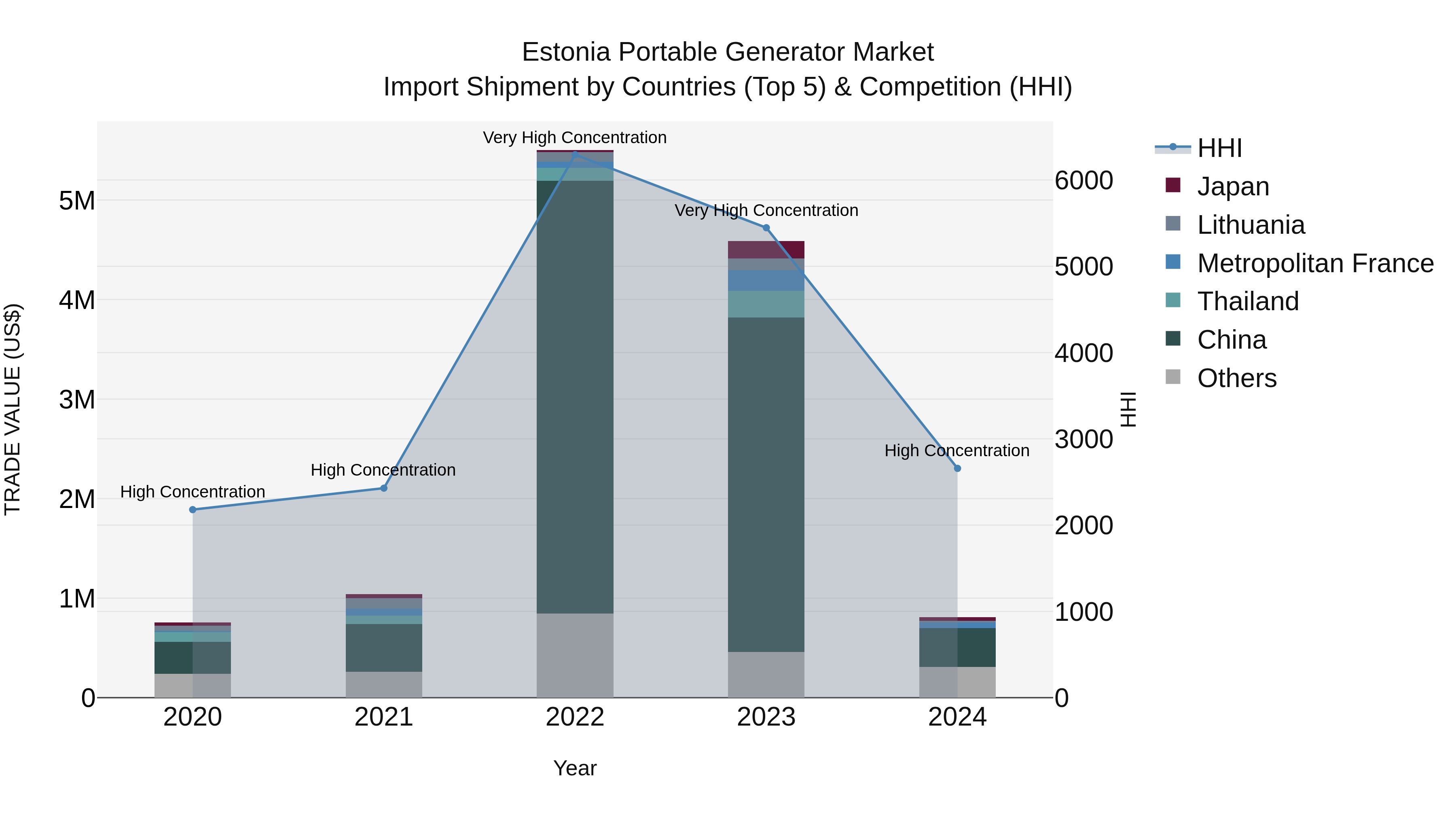
Estonia`s import shipments of portable generators in 2024 continued to be dominated by key players such as China, Germany, Finland, UAE, and Metropolitan France. Despite a decrease in the growth rate from 2023 to 2024, the industry experienced a modest compound annual growth rate of 1.73% from 2020 to 2024. The high concentration levels observed in 2023 persisted in 2024, indicating a competitive market landscape. Monitoring shifts in supplier dynamics and market trends will be crucial for stakeholders looking to capitalize on opportunities in the portable generator sector in Estonia.
Estonia Portable Generator Market Overview
The portable generator market in Estonia is expanding as consumers and businesses alike seek reliable, mobile power solutions. These generators are widely used for backup power during outages, construction projects, and outdoor activities. With the increasing reliance on electricity in both urban and rural settings, the demand for portable generators in Estonia is expected to rise, driven by the need for uninterrupted power supply during emergencies and outdoor use.
Drivers of the market
Portable generators are used in construction, outdoor events, and emergency backup power applications. The market for portable generators in Estonia is growing due to the increasing demand for reliable and flexible power sources. The rise in outdoor recreational activities and the need for backup power solutions in residential and commercial sectors are key drivers.
Challenges of the market
The portable generator market in Estonia faces challenges in terms of environmental regulations, technological advancements, and competition. As demand for portable power sources grows, especially during emergencies or outdoor activities, there is increased pressure for generators to become more energy-efficient and eco-friendly. Many existing portable generators run on fossil fuels, which are becoming less popular due to environmental concerns. The development of hybrid and battery-powered generators is an ongoing trend, but these alternatives are often more expensive and require further advancements to meet the energy needs of consumers.
Government Policy of the market
Estonias policies on the portable generator market emphasize energy efficiency, reliability, and sustainability. The government supports the development of environmentally friendly generator technologies, particularly those that use renewable energy sources. Estonias commitment to energy security and renewable energy solutions helps drive demand for portable generators, especially in remote areas and off-grid locations. Regulatory standards ensure that portable generators meet emissions and safety requirements.
Key Highlights of the Report:
- Estonia Portable Generator Market Outlook
- Market Size of Estonia Portable Generator Market, 2024
- Forecast of Estonia Portable Generator Market, 2031
- Historical Data and Forecast of Estonia Portable Generator Revenues & Volume for the Period 2021-2031
- Estonia Portable Generator Market Trend Evolution
- Estonia Portable Generator Market Drivers and Challenges
- Estonia Portable Generator Price Trends
- Estonia Portable Generator Porter`s Five Forces
- Estonia Portable Generator Industry Life Cycle
- Historical Data and Forecast of Estonia Portable Generator Market Revenues & Volume By Application for the Period 2021-2031
- Historical Data and Forecast of Estonia Portable Generator Market Revenues & Volume By Emergency for the Period 2021-2031
- Historical Data and Forecast of Estonia Portable Generator Market Revenues & Volume By Prime/Continuous for the Period 2021-2031
- Historical Data and Forecast of Estonia Portable Generator Market Revenues & Volume By Fuel for the Period 2021-2031
- Historical Data and Forecast of Estonia Portable Generator Market Revenues & Volume By Gasoline for the Period 2021-2031
- Historical Data and Forecast of Estonia Portable Generator Market Revenues & Volume By Diesel for the Period 2021-2031
- Historical Data and Forecast of Estonia Portable Generator Market Revenues & Volume By Natural Gas for the Period 2021-2031
- Historical Data and Forecast of Estonia Portable Generator Market Revenues & Volume By Others for the Period 2021-2031
- Historical Data and Forecast of Estonia Portable Generator Market Revenues & Volume By Power Rating for the Period 2021-2031
- Historical Data and Forecast of Estonia Portable Generator Market Revenues & Volume By Below 5 kW for the Period 2021-2031
- Historical Data and Forecast of Estonia Portable Generator Market Revenues & Volume By 5 ??? 10 kW for the Period 2021-2031
- Historical Data and Forecast of Estonia Portable Generator Market Revenues & Volume By 10 ??? 20 kW for the Period 2021-2031
- Estonia Portable Generator Import Export Trade Statistics
- Market Opportunity Assessment By Application
- Market Opportunity Assessment By Fuel
- Market Opportunity Assessment By Power Rating
- Estonia Portable Generator Top Companies Market Share
- Estonia Portable Generator Competitive Benchmarking By Technical and Operational Parameters
- Estonia Portable Generator Company Profiles
- Estonia Portable Generator Key Strategic Recommendations






































