Estonia Razor Blade Market Size Growth Rate
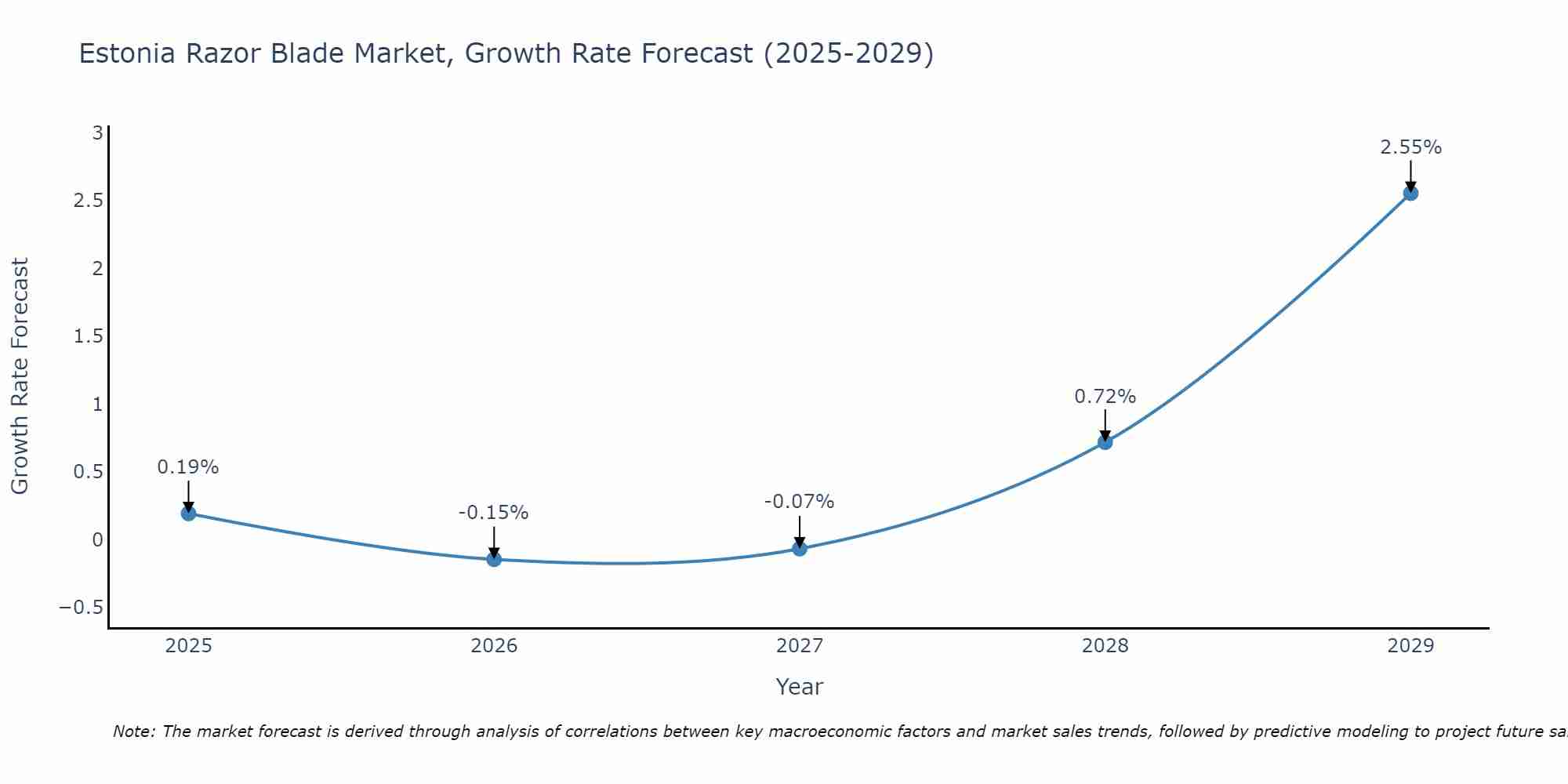
The Estonia Razor Blade Market is projected to witness mixed growth rate patterns during 2025 to 2029. From 0.19% in 2025, the growth rate steadily ascends to 2.55% in 2029.
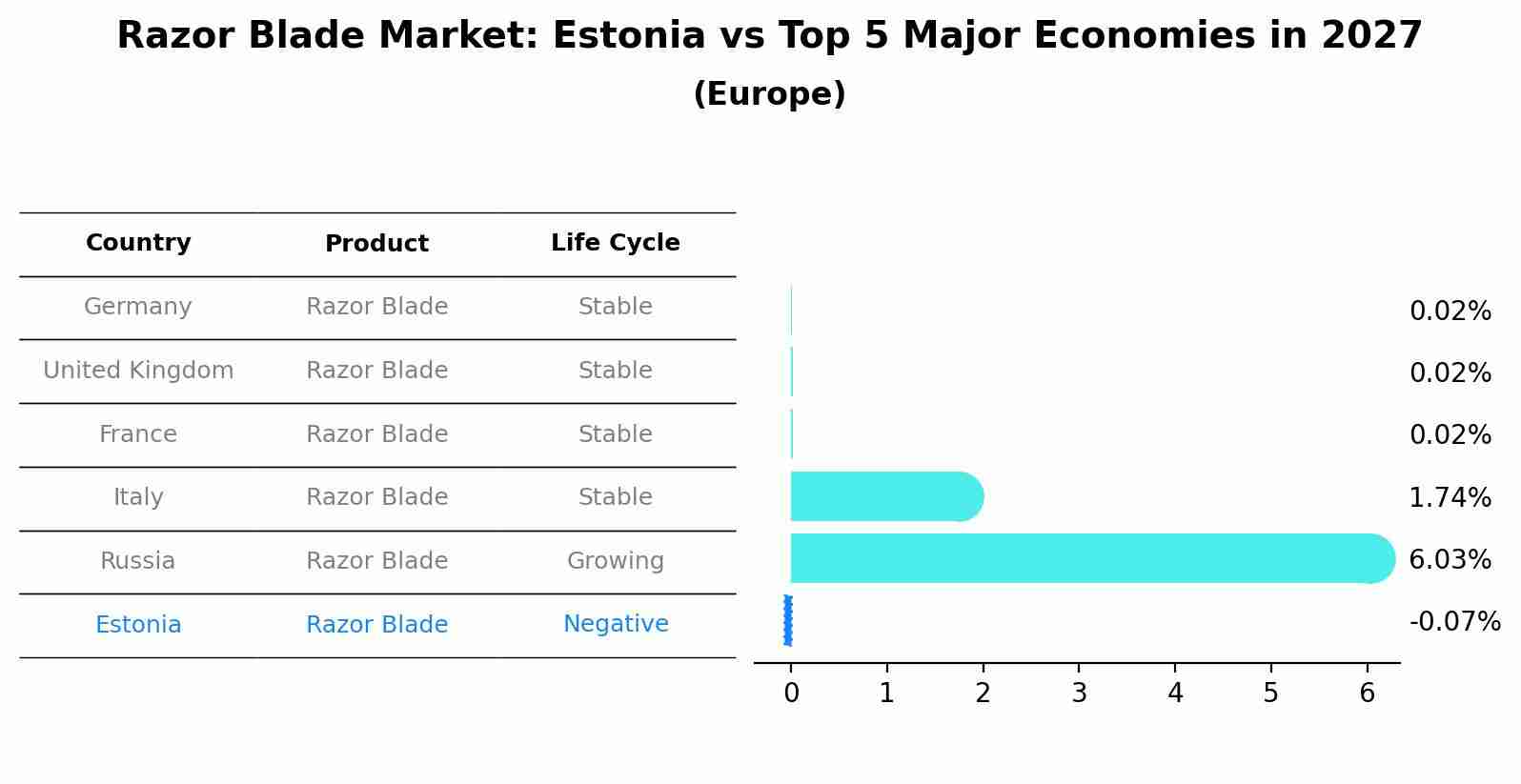
Razor Blade Market: Estonia vs Top 5 Major Economies in 2027 (Europe)
By 2027, Estonia's Razor Blade market is forecasted to achieve a negative growth rate of -0.07%, with Germany leading the Europe region, followed by United Kingdom, France, Italy and Russia.
Estonia Razor Blade Market Overview
The razor blade market in Estonia is driven by consumer demand for personal grooming products, as well as innovations in shaving technology. Estonias population has embraced modern shaving solutions, with both disposable and reusable razor blades being widely used. With increasing competition among global brands and the presence of local manufacturers, the market is characterized by a wide variety of products catering to different consumer preferences, from basic razors to advanced shaving systems. As personal care becomes more important to consumers, the demand for high-quality razor blades continues to grow in Estonia.
Drivers of the market
The razor blade market in Estonia is primarily driven by the growing demand for grooming products, particularly in the male and female personal care segments. As disposable income increases and the grooming habits of consumers evolve, the need for high-quality and durable razor blades continues to rise. Furthermore, innovations in razor blade designs, such as improved ergonomics and multi-blade technology, are boosting the market. The increasing popularity of personal care and self-grooming products is expected to sustain the growth of this market in Estonia.
Challenges of the market
The Estonia Razor Blade Market faces challenges related to competition from electric razors and disposable razor systems, which offer convenience and lower long-term costs for consumers. While razor blades are a traditional choice for many, they are increasingly viewed as less convenient compared to newer grooming technologies. Additionally, the market is impacted by price sensitivity, as consumers often seek budget-friendly options, putting pressure on manufacturers to reduce costs without sacrificing quality. Moreover, the need for constant product innovation, to offer sharper, longer-lasting blades, and improved ergonomic designs, requires significant investment from manufacturers.
Government Policy of the market
In the razor blade market, Estonias government focuses on quality standards and sustainable manufacturing practices. Policies incentivize companies to adopt eco-friendly production techniques and explore recyclable materials, aligning with broader environmental goals.
Key Highlights of the Report:
- Estonia Razor Blade Market Outlook
- Market Size of Estonia Razor Blade Market, 2024
- Forecast of Estonia Razor Blade Market, 2031
- Historical Data and Forecast of Estonia Razor Blade Revenues & Volume for the Period 2021-2031
- Estonia Razor Blade Market Trend Evolution
- Estonia Razor Blade Market Drivers and Challenges
- Estonia Razor Blade Price Trends
- Estonia Razor Blade Porter`s Five Forces
- Estonia Razor Blade Industry Life Cycle
- Historical Data and Forecast of Estonia Razor Blade Market Revenues & Volume By Type for the Period 2021-2031
- Historical Data and Forecast of Estonia Razor Blade Market Revenues & Volume By Single Edge for the Period 2021-2031
- Historical Data and Forecast of Estonia Razor Blade Market Revenues & Volume By Double Edge for the Period 2021-2031
- Historical Data and Forecast of Estonia Razor Blade Market Revenues & Volume By Blade Material for the Period 2021-2031
- Historical Data and Forecast of Estonia Razor Blade Market Revenues & Volume By Carbon Steel for the Period 2021-2031
- Historical Data and Forecast of Estonia Razor Blade Market Revenues & Volume By Stainless Steel for the Period 2021-2031
- Historical Data and Forecast of Estonia Razor Blade Market Revenues & Volume By End User for the Period 2021-2031
- Historical Data and Forecast of Estonia Razor Blade Market Revenues & Volume By Men for the Period 2021-2031
- Historical Data and Forecast of Estonia Razor Blade Market Revenues & Volume By Women for the Period 2021-2031
- Historical Data and Forecast of Estonia Razor Blade Market Revenues & Volume By Distribution Channel for the Period 2021-2031
- Historical Data and Forecast of Estonia Razor Blade Market Revenues & Volume By Supermarkets/Hypermarkets for the Period 2021-2031
- Historical Data and Forecast of Estonia Razor Blade Market Revenues & Volume By Departmental Stores for the Period 2021-2031
- Historical Data and Forecast of Estonia Razor Blade Market Revenues & Volume By Convenience Stores for the Period 2021-2031
- Historical Data and Forecast of Estonia Razor Blade Market Revenues & Volume By Online for the Period 2021-2031
- Estonia Razor Blade Import Export Trade Statistics
- Market Opportunity Assessment By Type
- Market Opportunity Assessment By Blade Material
- Market Opportunity Assessment By End User
- Market Opportunity Assessment By Distribution Channel
- Estonia Razor Blade Top Companies Market Share
- Estonia Razor Blade Competitive Benchmarking By Technical and Operational Parameters
- Estonia Razor Blade Company Profiles
- Estonia Razor Blade Key Strategic Recommendations






































