Ethiopia Cellulose Fiber Market Size Growth Rate
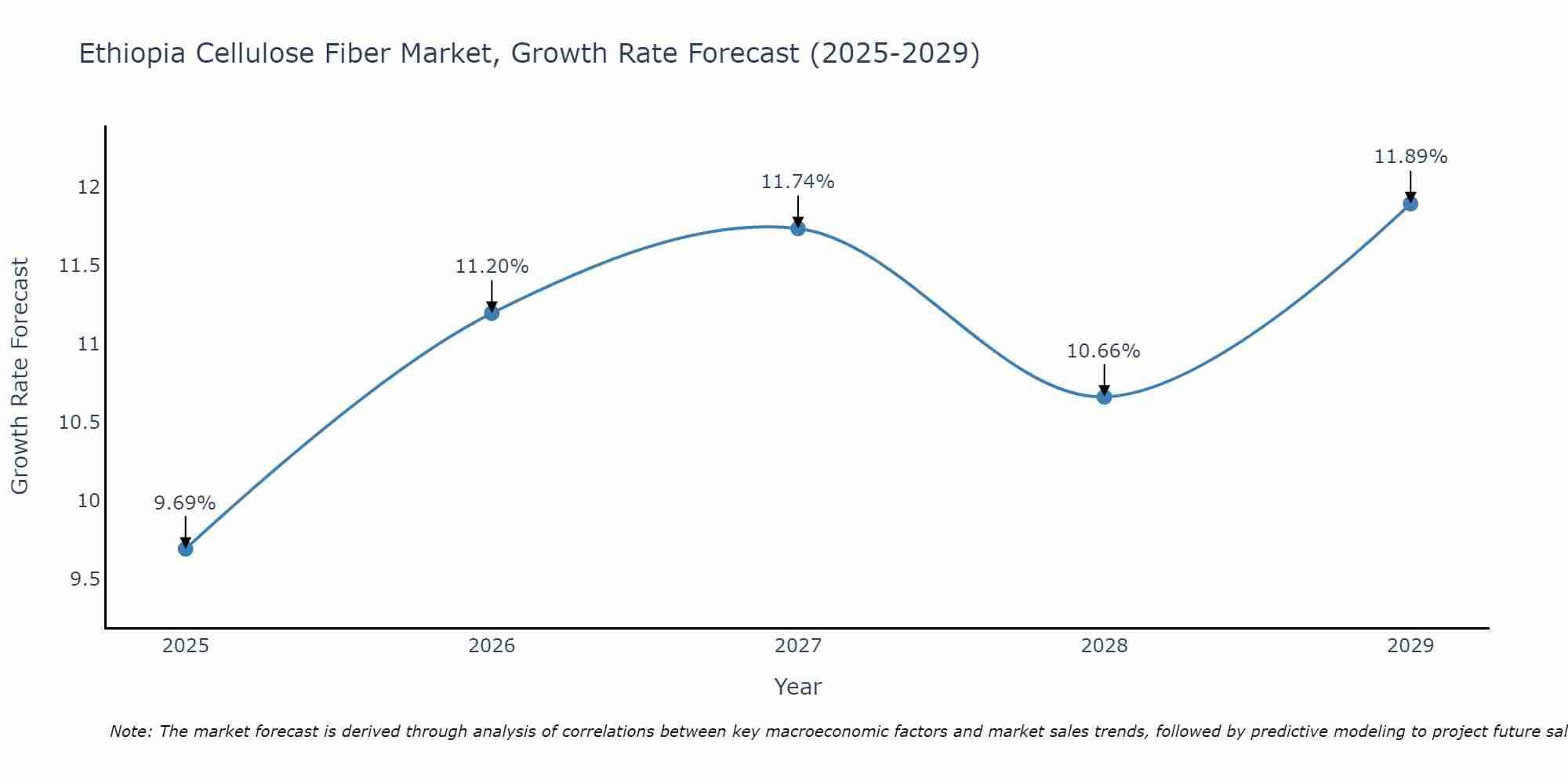
The Ethiopia Cellulose Fiber Market is projected to witness mixed growth rate patterns during 2025 to 2029. From 9.69% in 2025, the growth rate steadily ascends to 11.89% in 2029.
Ethiopia Cellulose Fiber Market Overview
The cellulose fiber market in Ethiopia is on the rise, supported by the growing demand for natural, eco-friendly materials in textiles, automotive, and other industries. Cellulose fibers, such as rayon and lyocell, are used as sustainable alternatives to synthetic fibers, and their use is increasing due to consumer preference for environmentally friendly products. As Ethiopia`s textile industry develops, the demand for cellulose fibers is expected to grow.
Drivers of the market
Ethiopia`s cellulose fiber market is growing due to increasing demand for sustainable and biodegradable materials in the textile and paper industries. With global trends favoring eco-friendly alternatives, cellulose fibers are being used in clothing, home textiles, and specialty paper products. Government incentives to promote sustainable industries and advancements in local fiber production are contributing to the expansion of this market.
Challenges of the market
The cellulose fiber market in Ethiopia faces challenges related to the limited availability of raw materials, as the country lacks large-scale production of cellulose-rich crops like wood and cotton. Additionally, there is a lack of processing capacity to convert raw materials into cellulose fiber, resulting in a reliance on imports. The market is also affected by high production costs and the lack of advanced technology to improve fiber quality and production efficiency. Additionally, environmental concerns related to deforestation could pose regulatory challenges to the expansion of the cellulose fiber industry.
Government Policy of the market
The Ethiopian government may encourage the growth of the cellulose fiber market through policies that support sustainable forestry practices and the development of local fiber manufacturing industries. Cellulose fibers are used in textiles, packaging, and medical applications, and the government may aim to increase local production of these fibers while fostering export opportunities. Policies may also support R&D in new cellulose fiber technologies.
Key Highlights of the Report:
- Ethiopia Cellulose Fiber Market Outlook
- Market Size of Ethiopia Cellulose Fiber Market, 2024
- Forecast of Ethiopia Cellulose Fiber Market, 2031
- Historical Data and Forecast of Ethiopia Cellulose Fiber Revenues & Volume for the Period 2021-2031
- Ethiopia Cellulose Fiber Market Trend Evolution
- Ethiopia Cellulose Fiber Market Drivers and Challenges
- Ethiopia Cellulose Fiber Price Trends
- Ethiopia Cellulose Fiber Porter`s Five Forces
- Ethiopia Cellulose Fiber Industry Life Cycle
- Historical Data and Forecast of Ethiopia Cellulose Fiber Market Revenues & Volume By Fiber Type for the Period 2021-2031
- Historical Data and Forecast of Ethiopia Cellulose Fiber Market Revenues & Volume By Introduction for the Period 2021-2031
- Historical Data and Forecast of Ethiopia Cellulose Fiber Market Revenues & Volume By Natural Cellulose Fibers for the Period 2021-2031
- Historical Data and Forecast of Ethiopia Cellulose Fiber Market Revenues & Volume By Man-made Cellulose Fibers for the Period 2021-2031
- Historical Data and Forecast of Ethiopia Cellulose Fiber Market Revenues & Volume By Others for the Period 2021-2031
- Historical Data and Forecast of Ethiopia Cellulose Fiber Market Revenues & Volume By Applications for the Period 2021-2031
- Historical Data and Forecast of Ethiopia Cellulose Fiber Market Revenues & Volume By Introduction for the Period 2021-2031
- Historical Data and Forecast of Ethiopia Cellulose Fiber Market Revenues & Volume By Apparel for the Period 2021-2031
- Historical Data and Forecast of Ethiopia Cellulose Fiber Market Revenues & Volume By Home Textile for the Period 2021-2031
- Historical Data and Forecast of Ethiopia Cellulose Fiber Market Revenues & Volume By Industrial for the Period 2021-2031
- Historical Data and Forecast of Ethiopia Cellulose Fiber Market Revenues & Volume By Others for the Period 2021-2031
- Ethiopia Cellulose Fiber Import Export Trade Statistics
- Market Opportunity Assessment By Fiber Type
- Market Opportunity Assessment By Applications
- Ethiopia Cellulose Fiber Top Companies Market Share
- Ethiopia Cellulose Fiber Competitive Benchmarking By Technical and Operational Parameters
- Ethiopia Cellulose Fiber Company Profiles
- Ethiopia Cellulose Fiber Key Strategic Recommendations






































