Ethiopia Ethyl Alcohol Market Growth Rate Analysis (2025 - 2031)
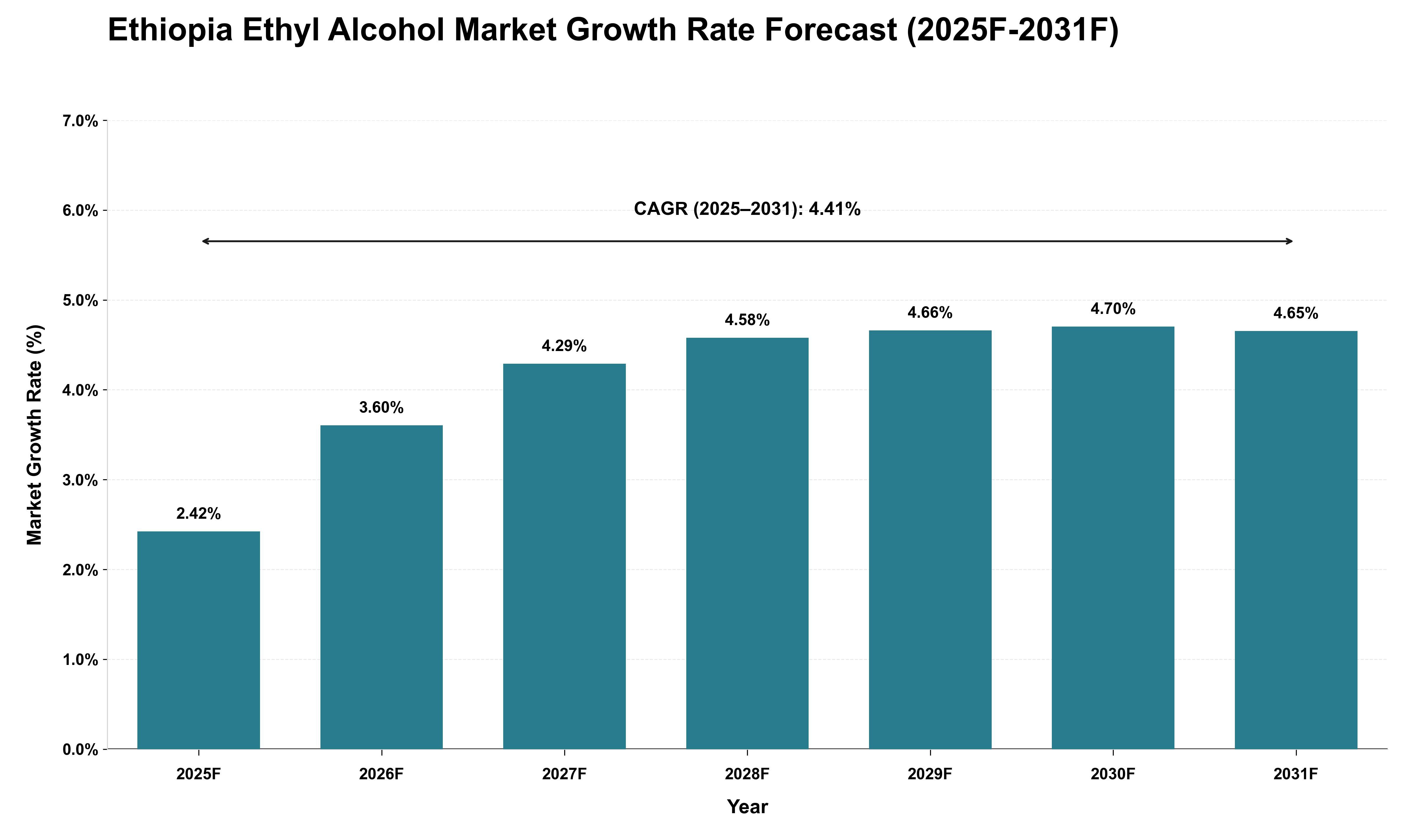
The forecasted growth trajectory for the Ethiopian ethyl alcohol market will exhibit a notable acceleration, particularly from 2025 to 2030, where the annual growth rates will rise from 2.42% to a peak of 4.70%. This upward trend reflects an increasing demand driven by both domestic consumption and export opportunities, influenced by the anticipated availability of raw materials such as sugarcane and molasses, which are critical for production. As global prices for these inputs stabilize or decline due to improved agricultural yields or supply chain efficiencies, Ethiopia's import dependencies may lessen, enhancing local production capabilities. The slight deceleration in growth observed in 2031 suggests potential market adjustments as producers align with evolving consumer preferences and regulatory frameworks. Overall, the projected CAGR of 4.41% underscores a robust outlook for the sector amidst these macroeconomic dynamics.
Key Highlights of the Report:
- Ethiopia Ethyl Alcohol Market Outlook
- Market Size of Ethiopia Ethyl Alcohol Market, 2024
- Forecast of Ethiopia Ethyl Alcohol Market, 2031
- Historical Data and Forecast of Ethiopia Ethyl Alcohol Revenues & Volume for the Period 2021-2031
- Ethiopia Ethyl Alcohol Market Trend Evolution
- Ethiopia Ethyl Alcohol Market Drivers and Challenges
- Ethiopia Ethyl Alcohol Price Trends
- Ethiopia Ethyl Alcohol Porter`s Five Forces
- Ethiopia Ethyl Alcohol Industry Life Cycle
- Historical Data and Forecast of Ethiopia Ethyl Alcohol Market Revenues & Volume By Grade for the Period 2021-2031
- Historical Data and Forecast of Ethiopia Ethyl Alcohol Market Revenues & Volume By Food Grade for the Period 2021-2031
- Historical Data and Forecast of Ethiopia Ethyl Alcohol Market Revenues & Volume By Industrial Grade for the Period 2021-2031
- Historical Data and Forecast of Ethiopia Ethyl Alcohol Market Revenues & Volume By Pharmaceutical Grade for the Period 2021-2031
- Historical Data and Forecast of Ethiopia Ethyl Alcohol Market Revenues & Volume By Lab Grade for the Period 2021-2031
- Historical Data and Forecast of Ethiopia Ethyl Alcohol Market Revenues & Volume By End-user Industry for the Period 2021-2031
- Historical Data and Forecast of Ethiopia Ethyl Alcohol Market Revenues & Volume By Automotive and Transportation for the Period 2021-2031
- Historical Data and Forecast of Ethiopia Ethyl Alcohol Market Revenues & Volume By Food and Beverage for the Period 2021-2031
- Historical Data and Forecast of Ethiopia Ethyl Alcohol Market Revenues & Volume By Pharmaceutical for the Period 2021-2031
- Historical Data and Forecast of Ethiopia Ethyl Alcohol Market Revenues & Volume By Cosmetics and Personal Care (Includes hand-Sanitizer) for the Period 2021-2031
- Historical Data and Forecast of Ethiopia Ethyl Alcohol Market Revenues & Volume By Other End-user Industries for the Period 2021-2031
- Ethiopia Ethyl Alcohol Import Export Trade Statistics
- Market Opportunity Assessment By Grade
- Market Opportunity Assessment By End-user Industry
- Ethiopia Ethyl Alcohol Top Companies Market Share
- Ethiopia Ethyl Alcohol Competitive Benchmarking By Technical and Operational Parameters
- Ethiopia Ethyl Alcohol Company Profiles
- Ethiopia Ethyl Alcohol Key Strategic Recommendations






































