Ethiopia Ophthalmic Equipment Market Growth Rate Analysis (2025 - 2031)
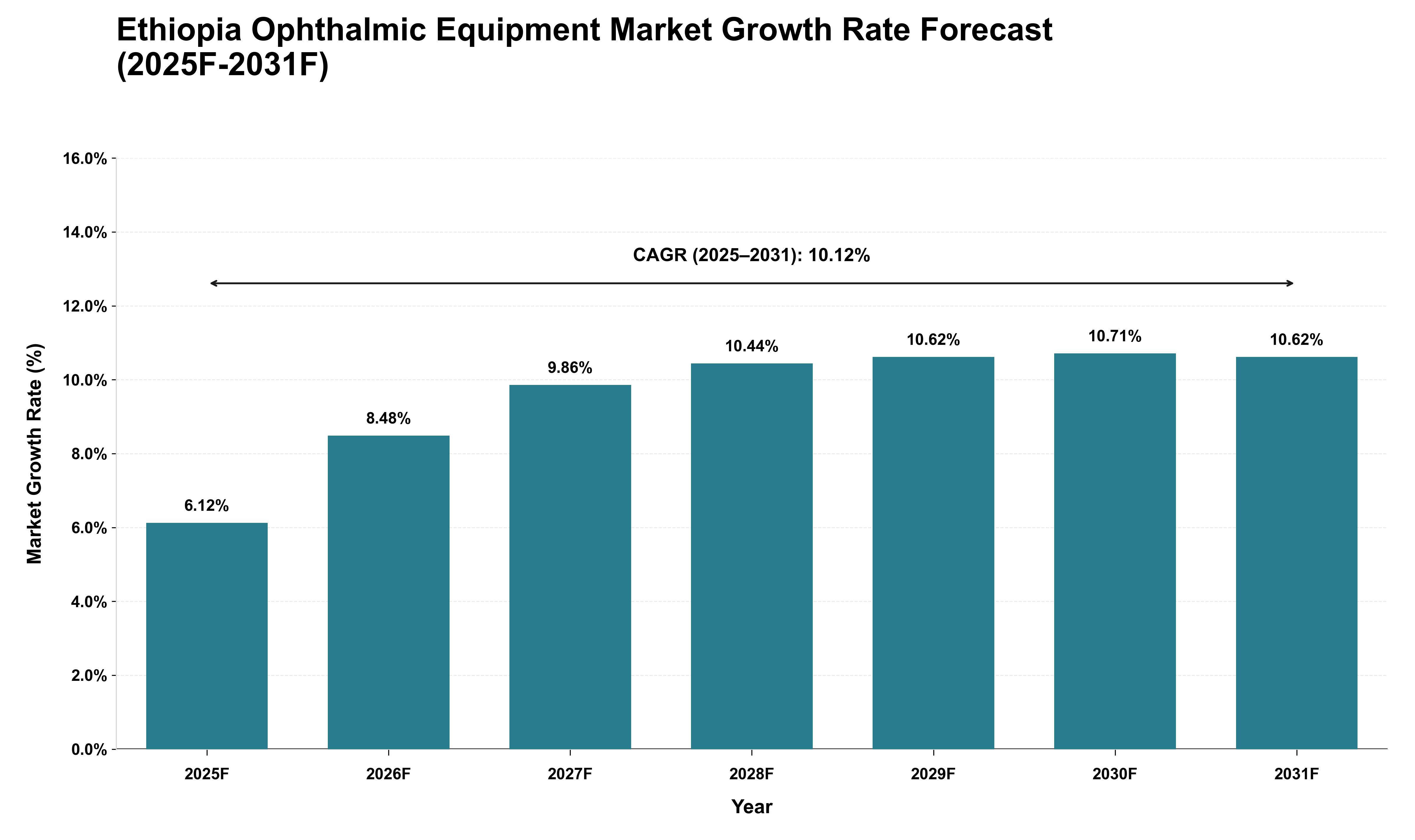
The Ethiopian ophthalmic equipment market is projected to experience a compound annual growth rate of 10.12% from 2025 to 2031, reflecting a robust trajectory driven by increasing healthcare investments and rising awareness of eye health. The initial growth phase in 2025 at 6.12% will likely be influenced by the ongoing expansion of healthcare infrastructure and the gradual integration of advanced medical technologies. As the market matures, annual growth rates are expected to accelerate, peaking at 10.71% in 2030, suggesting a positive response to both domestic demand and potential import dependencies for high-quality equipment. This trend will be supported by cyclical factors such as demographic shifts towards an aging population and increased prevalence of vision-related disorders, which will necessitate enhanced ophthalmic services. By 2031, sustained growth at approximately 10.62% indicates a solidified position within the broader healthcare sector amidst evolving economic conditions in Ethiopia.
Key Highlights of the Report:
- Ethiopia Ophthalmic Equipment Market Outlook
- Market Size of Ethiopia Ophthalmic Equipment Market, 2024
- Forecast of Ethiopia Ophthalmic Equipment Market, 2031
- Historical Data and Forecast of Ethiopia Ophthalmic Equipment Revenues & Volume for the Period 2021-2031
- Ethiopia Ophthalmic Equipment Market Trend Evolution
- Ethiopia Ophthalmic Equipment Market Drivers and Challenges
- Ethiopia Ophthalmic Equipment Price Trends
- Ethiopia Ophthalmic Equipment Porter`s Five Forces
- Ethiopia Ophthalmic Equipment Industry Life Cycle
- Historical Data and Forecast of Ethiopia Ophthalmic Equipment Market Revenues & Volume By Product Type for the Period 2021-2031
- Historical Data and Forecast of Ethiopia Ophthalmic Equipment Market Revenues & Volume By Diagnostics & Monitoring Devices for the Period 2021-2031
- Historical Data and Forecast of Ethiopia Ophthalmic Equipment Market Revenues & Volume By Surgical Instruments for the Period 2021-2031
- Historical Data and Forecast of Ethiopia Ophthalmic Equipment Market Revenues & Volume By Vision Care Products for the Period 2021-2031
- Historical Data and Forecast of Ethiopia Ophthalmic Equipment Market Revenues & Volume By End-User for the Period 2021-2031
- Historical Data and Forecast of Ethiopia Ophthalmic Equipment Market Revenues & Volume By Consumers for the Period 2021-2031
- Historical Data and Forecast of Ethiopia Ophthalmic Equipment Market Revenues & Volume By Hospitals for the Period 2021-2031
- Historical Data and Forecast of Ethiopia Ophthalmic Equipment Market Revenues & Volume By Specialty Clinics and Ambulatory Surgery Centers for the Period 2021-2031
- Historical Data and Forecast of Ethiopia Ophthalmic Equipment Market Revenues & Volume By Other End Users for the Period 2021-2031
- Ethiopia Ophthalmic Equipment Import Export Trade Statistics
- Market Opportunity Assessment By Product Type
- Market Opportunity Assessment By End-User
- Ethiopia Ophthalmic Equipment Top Companies Market Share
- Ethiopia Ophthalmic Equipment Competitive Benchmarking By Technical and Operational Parameters
- Ethiopia Ophthalmic Equipment Company Profiles
- Ethiopia Ophthalmic Equipment Key Strategic Recommendations






































