Ethiopia Sunglasses Market Growth Rate Analysis (2025 - 2031)
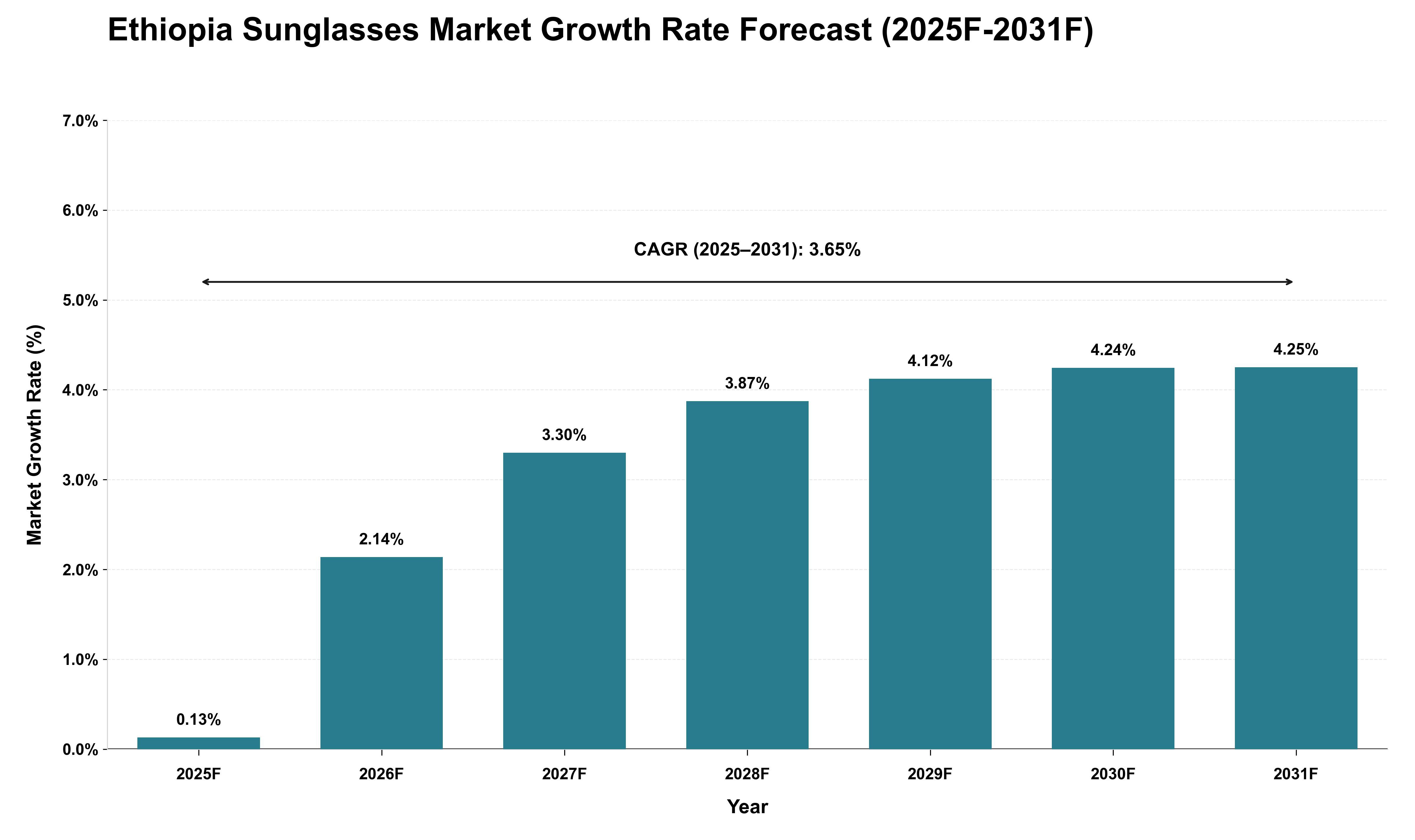
The Ethiopian sunglasses market is projected to experience a compound annual growth rate of 3.65% from 2025 to 2031, reflecting a gradual increase in demand driven by several macroeconomic factors. The initial growth of 0.13% in 2025 will likely be influenced by the availability and pricing of raw materials, particularly plastics and lenses, which are essential for production. As global supply chains stabilize and import dependencies shift, the market will see an uptick in growth rates, peaking at 4.25% in 2031. This trend suggests that as local manufacturing capabilities improve and consumer awareness regarding UV protection rises, the demand for sunglasses will increase significantly. Additionally, fluctuations in raw material costs may impact pricing strategies, but overall economic conditions are expected to favor a steady rise in consumption patterns throughout this period.
Key Highlights of the Report:
- Ethiopia Sunglasses Market Outlook
- Market Size of Ethiopia Sunglasses Market, 2024
- Forecast of Ethiopia Sunglasses Market, 2031
- Historical Data and Forecast of Ethiopia Sunglasses Revenues & Volume for the Period 2021-2031
- Ethiopia Sunglasses Market Trend Evolution
- Ethiopia Sunglasses Market Drivers and Challenges
- Ethiopia Sunglasses Price Trends
- Ethiopia Sunglasses Porter`s Five Forces
- Ethiopia Sunglasses Industry Life Cycle
- Historical Data and Forecast of Ethiopia Sunglasses Market Revenues & Volume By Product Type for the Period 2021-2031
- Historical Data and Forecast of Ethiopia Sunglasses Market Revenues & Volume By Polarized for the Period 2021-2031
- Historical Data and Forecast of Ethiopia Sunglasses Market Revenues & Volume By Non-polarized for the Period 2021-2031
- Historical Data and Forecast of Ethiopia Sunglasses Market Revenues & Volume By End-Users for the Period 2021-2031
- Historical Data and Forecast of Ethiopia Sunglasses Market Revenues & Volume By Women for the Period 2021-2031
- Historical Data and Forecast of Ethiopia Sunglasses Market Revenues & Volume By Men for the Period 2021-2031
- Historical Data and Forecast of Ethiopia Sunglasses Market Revenues & Volume By Unisex for the Period 2021-2031
- Historical Data and Forecast of Ethiopia Sunglasses Market Revenues & Volume By Distribution Channel for the Period 2021-2031
- Historical Data and Forecast of Ethiopia Sunglasses Market Revenues & Volume By Online for the Period 2021-2031
- Historical Data and Forecast of Ethiopia Sunglasses Market Revenues & Volume By Offline for the Period 2021-2031
- Ethiopia Sunglasses Import Export Trade Statistics
- Market Opportunity Assessment By Product Type
- Market Opportunity Assessment By End-Users
- Market Opportunity Assessment By Distribution Channel
- Ethiopia Sunglasses Top Companies Market Share
- Ethiopia Sunglasses Competitive Benchmarking By Technical and Operational Parameters
- Ethiopia Sunglasses Company Profiles
- Ethiopia Sunglasses Key Strategic Recommendations






































