Ethiopia Synthetic Rope Market Growth Rate Analysis (2025 - 2031)
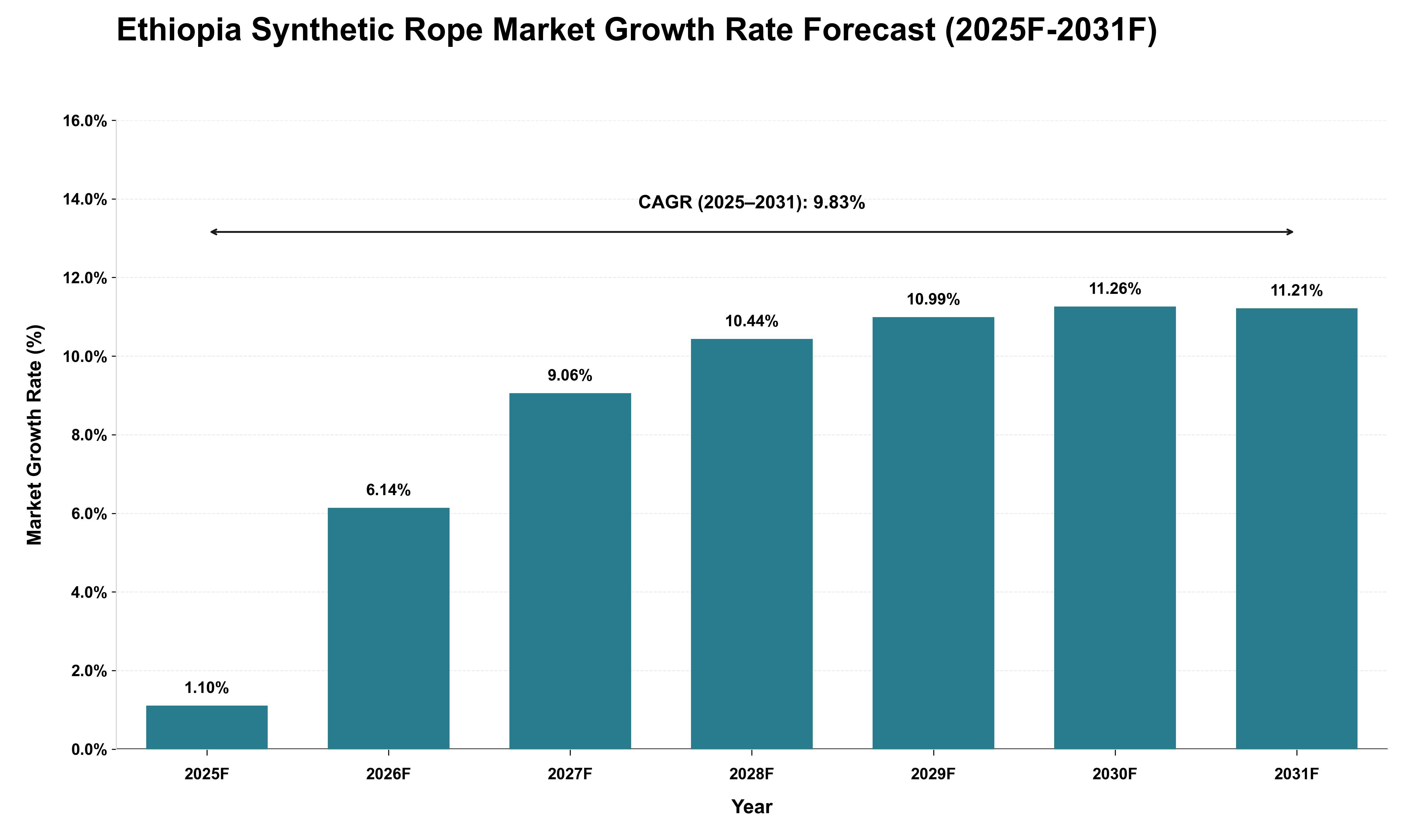
The Ethiopian synthetic rope market will experience robust growth driven by evolving regulatory frameworks and trade policies that favor domestic manufacturing and import diversification. As the government implements initiatives to enhance local production capabilities, the market is projected to grow at a compound annual growth rate (CAGR) of 9.83% from 2025 to 2031. Initial growth in 2025 will be modest at 1.10%, reflecting transitional adjustments in policy implementation; however, as these regulations take effect, annual growth rates will accelerate significantly, peaking at approximately 11.26% in 2030. This upward trajectory will be supported by increasing demand across various sectors such as construction and agriculture, alongside a strategic shift towards reducing import dependencies on synthetic materials. By 2031, sustained investment in infrastructure and favorable trade conditions will solidify Ethiopia's position as a competitive player in the regional synthetic rope market.
Key Highlights of the Report:
- Ethiopia Synthetic Rope Market Outlook
- Market Size of Ethiopia Synthetic Rope Market, 2024
- Forecast of Ethiopia Synthetic Rope Market, 2031
- Historical Data and Forecast of Ethiopia Synthetic Rope Revenues & Volume for the Period 2021-2031
- Ethiopia Synthetic Rope Market Trend Evolution
- Ethiopia Synthetic Rope Market Drivers and Challenges
- Ethiopia Synthetic Rope Price Trends
- Ethiopia Synthetic Rope Porter`s Five Forces
- Ethiopia Synthetic Rope Industry Life Cycle
- Historical Data and Forecast of Ethiopia Synthetic Rope Market Revenues & Volume By Material for the Period 2021-2031
- Historical Data and Forecast of Ethiopia Synthetic Rope Market Revenues & Volume By Polypropylene for the Period 2021-2031
- Historical Data and Forecast of Ethiopia Synthetic Rope Market Revenues & Volume By Polyester for the Period 2021-2031
- Historical Data and Forecast of Ethiopia Synthetic Rope Market Revenues & Volume By Nylon for the Period 2021-2031
- Historical Data and Forecast of Ethiopia Synthetic Rope Market Revenues & Volume By Polyethylene for the Period 2021-2031
- Historical Data and Forecast of Ethiopia Synthetic Rope Market Revenues & Volume By Specialty Fibers for the Period 2021-2031
- Historical Data and Forecast of Ethiopia Synthetic Rope Market Revenues & Volume By End Use Industry for the Period 2021-2031
- Historical Data and Forecast of Ethiopia Synthetic Rope Market Revenues & Volume By Marine & Fishing for the Period 2021-2031
- Historical Data and Forecast of Ethiopia Synthetic Rope Market Revenues & Volume By Oil & Gas for the Period 2021-2031
- Historical Data and Forecast of Ethiopia Synthetic Rope Market Revenues & Volume By Sports & Leisure for the Period 2021-2031
- Historical Data and Forecast of Ethiopia Synthetic Rope Market Revenues & Volume By Construction for the Period 2021-2031
- Historical Data and Forecast of Ethiopia Synthetic Rope Market Revenues & Volume By Others for the Period 2021-2031
- Ethiopia Synthetic Rope Import Export Trade Statistics
- Market Opportunity Assessment By Material
- Market Opportunity Assessment By End Use Industry
- Ethiopia Synthetic Rope Top Companies Market Share
- Ethiopia Synthetic Rope Competitive Benchmarking By Technical and Operational Parameters
- Ethiopia Synthetic Rope Company Profiles
- Ethiopia Synthetic Rope Key Strategic Recommendations






































