Fiji Bricks and Blocks Market Growth Rate Analysis (2025 - 2031)
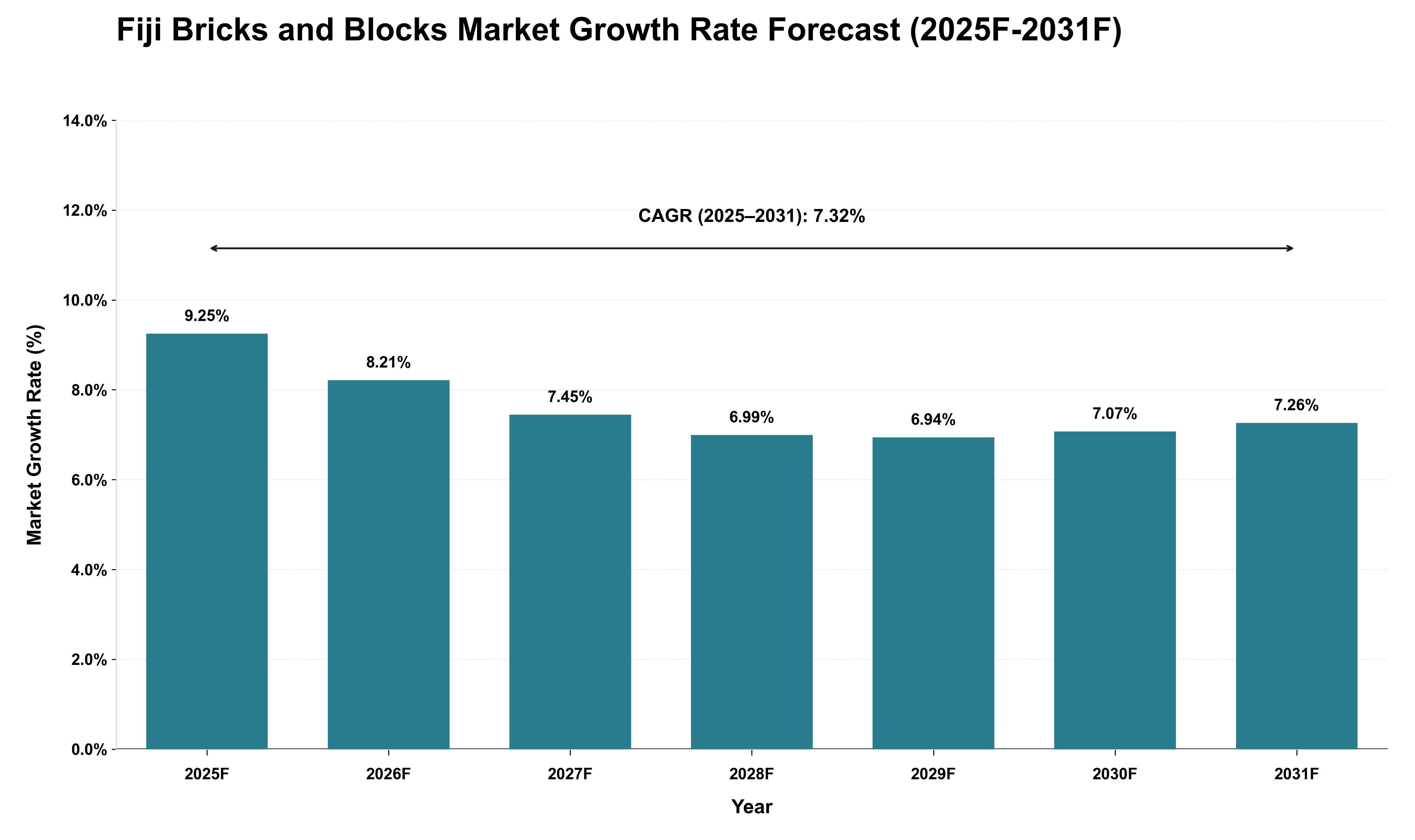
The forecasted growth trajectory for the Fiji bricks and blocks market will exhibit a notable deceleration from 9.25% in 2025 to 7.26% by 2031, reflecting a gradual shift in demand dynamics influenced by regulatory and trade policy factors. As import dependencies evolve, potential tariff adjustments or changes in trade agreements could impact pricing structures and availability of raw materials, thereby affecting production costs and market competitiveness. The anticipated cyclical trends suggest that while initial growth rates may be robust due to infrastructure investments and construction activities, subsequent years will likely see a moderation as supply chains stabilize and local production capabilities are enhanced. This deceleration aligns with broader economic indicators that typically accompany periods of regulatory adjustment, where businesses recalibrate strategies in response to shifting policy landscapes, ultimately shaping the long-term outlook for this asset class within the Fijian economy.
Key Highlights of the Report:
- Fiji Bricks and Blocks Market Outlook
- Market Size of Fiji Bricks and Blocks Market, 2024
- Forecast of Fiji Bricks and Blocks Market, 2031
- Historical Data and Forecast of Fiji Bricks and Blocks Revenues & Volume for the Period 2021-2031
- Fiji Bricks and Blocks Market Trend Evolution
- Fiji Bricks and Blocks Market Drivers and Challenges
- Fiji Bricks and Blocks Price Trends
- Fiji Bricks and Blocks Porter`s Five Forces
- Fiji Bricks and Blocks Industry Life Cycle
- Historical Data and Forecast of Fiji Bricks and Blocks Market Revenues & Volume By Type for the Period 2021-2031
- Historical Data and Forecast of Fiji Bricks and Blocks Market Revenues & Volume By Clay Bricks for the Period 2021-2031
- Historical Data and Forecast of Fiji Bricks and Blocks Market Revenues & Volume By Concrete Bricks and Blocks for the Period 2021-2031
- Historical Data and Forecast of Fiji Bricks and Blocks Market Revenues & Volume By Calcium Silicate Bricks for the Period 2021-2031
- Historical Data and Forecast of Fiji Bricks and Blocks Market Revenues & Volume By Autoclaved Aerated Concrete for the Period 2021-2031
- Historical Data and Forecast of Fiji Bricks and Blocks Market Revenues & Volume By Others for the Period 2021-2031
- Historical Data and Forecast of Fiji Bricks and Blocks Market Revenues & Volume By Applications for the Period 2021-2031
- Historical Data and Forecast of Fiji Bricks and Blocks Market Revenues & Volume By Building for the Period 2021-2031
- Historical Data and Forecast of Fiji Bricks and Blocks Market Revenues & Volume By Path for the Period 2021-2031
- Historical Data and Forecast of Fiji Bricks and Blocks Market Revenues & Volume By Parterre for the Period 2021-2031
- Historical Data and Forecast of Fiji Bricks and Blocks Market Revenues & Volume By Other for the Period 2021-2031
- Fiji Bricks and Blocks Import Export Trade Statistics
- Market Opportunity Assessment By Type
- Market Opportunity Assessment By Applications
- Fiji Bricks and Blocks Top Companies Market Share
- Fiji Bricks and Blocks Competitive Benchmarking By Technical and Operational Parameters
- Fiji Bricks and Blocks Company Profiles
- Fiji Bricks and Blocks Key Strategic Recommendations






































