Handicraft Market: Fiji vs Top 5 Major Economies in 2027 (Asia)
The Handicraft market in Fiji is projected to grow at a stable growth rate of 3.37% by 2027, within the Asia region led by China, along with other countries like India, Japan, Australia and South Korea, collectively shaping a dynamic and evolving market environment driven by innovation and increasing adoption of emerging technologies.
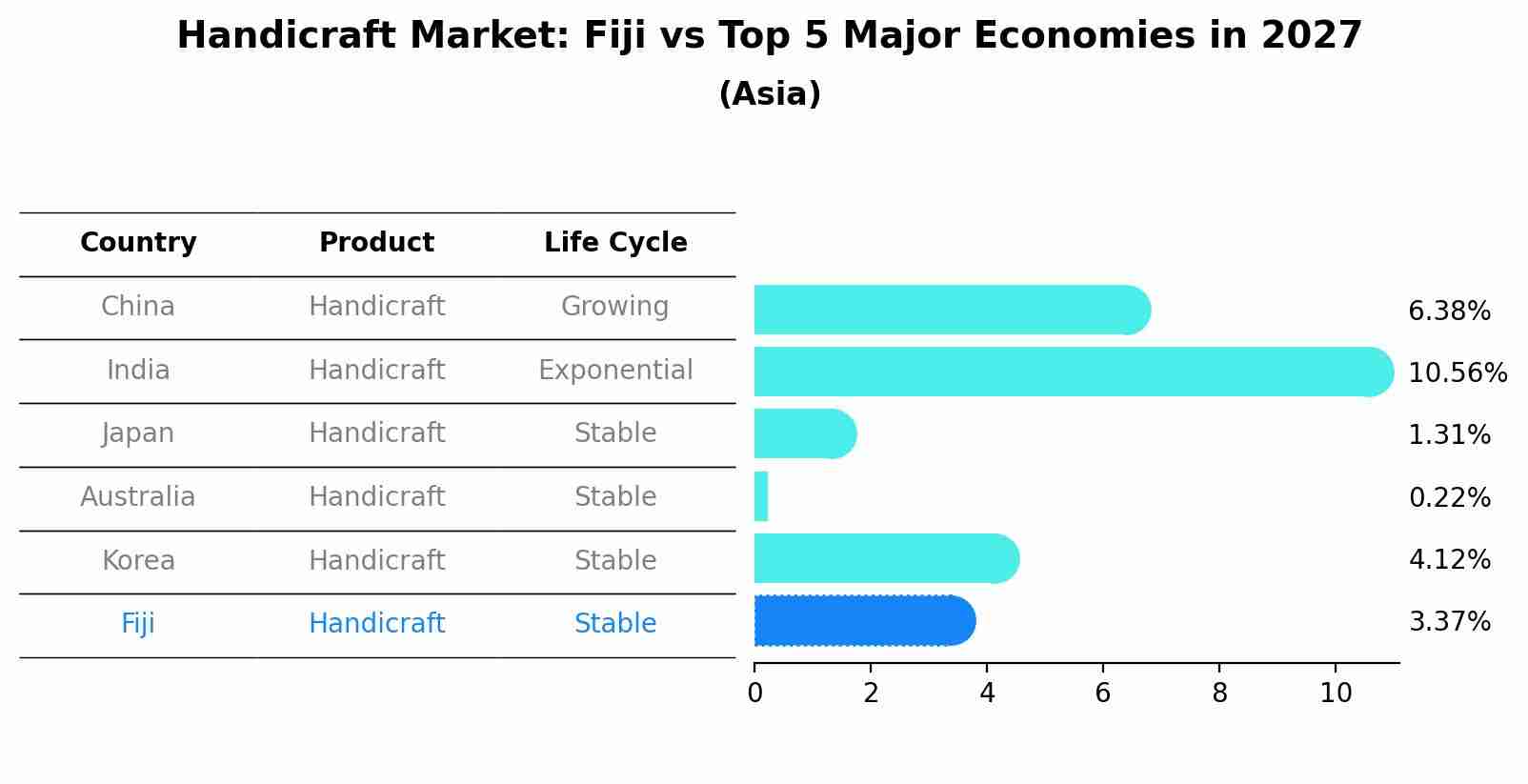
Fiji Handicraft Market Growth Rate
According to 6Wresearch internal database and industry insights, the Fiji Handicraft Market is growing at a compound annual growth rate (CAGR) of 5.80% during the forecast period (2026-2032).
Five-Years Growth Trajectory of the Fiji Handicraft Market with Core Drivers
Below mentioned are the evaluation of year-wise growth rate along with key drivers:
| Years | Est. Annual Growth in % | Growth Drivers |
| 2021 | 4.2 | Rising demand for unique, handmade products in global markets. |
| 2022 | 4.5 | Increasing interest in culturally rich and sustainable handicrafts. |
| 2023 | 5 | Expanding export opportunities to Asia and North America. |
| 2024 | 5.3 | Growth in the tourism sector driving demand for souvenirs and gifts. |
| 2025 | 5.6 | Rise in consumer preference for ethical and sustainable products. |
Topics Covered in the Fiji Handicraft Market Report
The Fiji Handicraft Market report thoroughly covers the market by product type, distribution channel, and end-use. The market report provides an unbiased and detailed analysis of ongoing market trends, opportunities/high growth areas, and market drivers, which would help stakeholders devise and align their market strategies according to the current and future market dynamics.
Fiji Handicraft Market Highlights
| Report Name | Fiji Handicraft Market |
| Forecast period | 2065-2032 |
| CAGR | 5.80% |
| Growing Sector | Export |
Fiji Handicraft Market Synopsis
The Fiji Handicraft Market is growing rapidly. The market growth is driven by the rising demand for unique, beautiful, and sustainable products. The market demand is also driven by cultural appreciation and eco-conscious consumerism. There is a higher demand for Fijian handicrafts by countries like New Zealand, the United States, and Australia. Also, the growing tourism in Fiji is propelling this industry growth as people buy handicraft products as a mark of souvenir.
Evaluation of Growth Drivers in the Fiji Handicraft Market
Below mentioned are some growth drivers and their impact on market dynamics:
| Drivers | Primary Segments Affected | Why It Matters |
| Export Demand & Cultural Appreciation | Product Types (Woodware, Art Metal Ware, etc.) | Increases Fiji’s export profile and uniqueness. |
| Tourism Growth | Distribution Channels (Specialty Stores, Online Stores) | Boost the demand for souvenirs and gifts. |
| Consumer Preference for Ethical Products | Product Types (Handprinted Textiles, Imitation Jewelry) | Meets increasing consumer demand for sustainability. |
| Government Support for Local Crafts | All Segments | Bolsters local crafts and export capacity. |
| Innovation in Product Designs | Product Types (Sculptures, Embroidered Goods, etc.) | Attracts global consumers with fresh offerings. |
The Fiji Handicraft Market is projected to grow significantly, at a CAGR of 5.80% during the forecast period of 2026 to 2032. Key drivers of this industry include increasing demand for exports from foreign countries and increased tourism in Fiji. Moreover, growing gifting culture among youth is expected to boost up the sales of handcrafted products of Fiji. There is also higher support from the government to boost the sales of handcrafted products of small artisans. Beautiful designs and embroidered clothing and sculptures are expected to attract a lot of customers towards the industry. Growing e-commerce retail platforms are also expected to fuel this industry growth by providing ease of home delivery services and multiple product options.
Evaluation of Restraints in the Fiji Handicraft Market
Below mentioned are some major restraints and their influence on market dynamics:
| Restraints | Primary Segments Affected | What This Means |
| High Production Costs | Product Types (Woodware, Art Metal Ware, etc.) | Makes the products pricing higher. |
| Limited Raw Materials | Product Types (Sculptures, Imitation Jewellery, etc.) | It creates supply challenges and hamper market growth. |
| Competition from Mass-Produced Goods | Product Types (Handprinted Textiles, Embroidered Goods) | This reduces the demand for handmade products. |
| Lack of Modernization in Production | All Segments | Hampers market growth by limiting production efficiency. |
| Cultural Sensitivity | Distribution Channels (Mass Retailers, Departmental Stores) | Reduce reach in certain regions. |
Fiji Handicraft Market Challenges
The market faces a number of challenges in its path of growth. These challenges mainly include high competition from machine-made souvenirs. Also, the production of handmade goods is time-consuming, and producers may find difficulties in selling them to the youth generation. Furthermore, cultural sensitivity in many regions hampers this industry expansion.
Fiji Handicraft Market Trends
Some major trends contributing to the growth of the Fiji Handicraft Market are:
- Increased Export Opportunities: are there for the Fiji handmade products within countries like North America and Australia.
- Rising Popularity of Ethical Products: the people highly prefers ethically made beautiful handcrafted products for gifting.
- Tourism-Driven Demand: is gaining more traction as people really value the souvenirs for taking back home for keeping memories.
Investment Opportunities in the Fiji Handicraft Market
Here are some investment opportunities in the Fiji Handicraft Industry:
- Expansion of Export Channels: Build stronger trade partnerships to expand exports, particularly to North America and Oceania.
- Sustainable Product Development: is improving this industry growth as consumer are becoming more eco-conscious.
- E-commerce Platforms: are growing this industry by providing with ease of accessibility and home delivery services.
Top 5 Leading Players in the Fiji Handicraft Market
Here are some top companies contributing to the Fiji Handicraft Market Share:
1. Fiji Arts & Crafts Ltd.
| Company Name | Fiji Arts & Crafts Ltd. |
|---|---|
| Established Year | 1995 |
| Headquarters | Suva, Fiji |
| Official Website | Click Here |
Fiji Arts & Crafts Ltd. is one of the leading companies in the Fijian handicraft market, known for its wide range of handmade woodware, woven goods, and art metal ware. They focus on ethical production methods and sustainability.
2. The Fiji Handicraft Shop
| Company Name | The Fiji Handicraft Shop |
|---|---|
| Established Year | 2000 |
| Headquarters | Nadi, Fiji |
| Official Website | Click Here |
Specializing in handcrafted textiles, wooden carvings, and imitation jewelry, The Fiji Handicraft Shop is one of the top retailers of Fijian crafts, both locally and internationally.
3. Pacific Island Creations
| Company Name | Pacific Island Creations |
|---|---|
| Established Year | 2003 |
| Headquarters | Lautoka, Fiji |
| Official Website | Click Here |
Pacific Island Creations is known for its unique designs in handprinted textiles, carved wooden products, and woven bags, attracting both tourists and collectors worldwide.
4. Sasa Handicrafts
| Company Name | Sasa Handicrafts |
|---|---|
| Established Year | 2008 |
| Headquarters | Suva, Fiji |
| Official Website | Click Here |
Sasa Handicrafts is a prominent manufacturer of embroidered goods, scarves, and traditional Fijian art metalware. The company exports to North America and Europe.
5. Fijian Craft Traders
| Company Name | Fijian Craft Traders |
|---|---|
| Established Year | 2010 |
| Headquarters | Nadi, Fiji |
| Official Website | Click Here |
Fijian Craft Traders is a well-known producer and exporter of Fijian handicrafts, focusing on sustainable production methods and direct-to-consumer retail.
Government Regulations Introduced in the Fiji Handicraft Market
According to Fijian government data, it has introduced several policies to support the handicraft market, including programs that promote sustainable production and fair trade practices. The Fiji Trade and Investment Board (FTIB) offers financial assistance and marketing support for local artisans. Furthermore, the government supports the "Made in Fiji" label to help boost the global appeal of Fijian crafts and improve export standards.
Future Insights of the Fiji Handicraft Market
The Fiji handicraft industry is going to have robust growth. The market is going to be driven by increased demand for crafts that are eco-friendly, beautiful, and unique. Also, Fiji's growing tourism and export are expected to fuel this industry growth. Moreover, the market's continuous focus on sustainability and eco-friendly practices will fuel this market expansion. Additionally, we can see rising internet penetration has developed the demand for purchasing from e-commerce platforms, which will be very beneficial for this industry's further penetration.
Market Segmentation Analysis
The report offers a comprehensive study of the following market segments and their leading categories.
Woodware to Dominate the Market – By Product Type
According to Guneet Kaur, senior research analyst, 6Wresearch, woodware is anticipated to dominate the Fijian handicraft market. This is mainly due to them having cultural significance and global appeal. Further, Fijian woodware products, such as carved wooden figurines, utensils, and sculptures, are highly valued.
Mass Retailers to Dominate the Market – By Distribution Channel
Mass retailers are leading in the market. As mass retailers are providing with the handcrafted products to larger consumer base. Also, these retailers have wide variety of product offering which are highly preferred by consumers.
Residential End-Use to Dominate the Market – By End-Use
The residential segment is the largest in the Fijian handicraft market, with consumers preferring unique, handmade items for personal use and home décor. The growing demand for customized, eco-friendly products is a key factor driving this trend.
Key Attractiveness of the Report
- 10 Years Market Numbers.
- Historical Data Starting from 2022 to 2025.
- Base Year: 2025
- Forecast Data until 2032.
- Key Performance Indicators Impacting the Market.
- Major Upcoming Developments and Projects.
Key Highlights of the Report:
- Fiji Handicraft Market Outlook
- Market Size of Fiji Handicraft Market, 2025
- Forecast of Fiji Handicraft Market, 2032
- Historical Data and Forecast of Fiji Handicraft Revenues & Volume for the Period 2022-2032
- Fiji Handicraft Market Trend Evolution
- Fiji Handicraft Market Drivers and Challenges
- Fiji Handicraft Price Trends
- Fiji Handicraft Porter`s Five Forces
- Fiji Handicraft Industry Life Cycle
- Historical Data and Forecast of Fiji Handicraft Market Revenues & Volume By Product Type for the Period 2022-2032
- Historical Data and Forecast of Fiji Handicraft Market Revenues & Volume By Woodware for the Period 2022-2032
- Historical Data and Forecast of Fiji Handicraft Market Revenues & Volume By Art metal Ware for the Period 2022-2032
- Historical Data and Forecast of Fiji Handicraft Market Revenues & Volume By Handprinted Textiles and Scarves for the Period 2022-2032
- Historical Data and Forecast of Fiji Handicraft Market Revenues & Volume By Embroidered and Crocheted Goods for the Period 2022-2032
- Historical Data and Forecast of Fiji Handicraft Market Revenues & Volume By Zari and Zari Goods for the Period 2022-2032
- Historical Data and Forecast of Fiji Handicraft Market Revenues & Volume By Imitation Jewelry for the Period 2022-2032
- Historical Data and Forecast of Fiji Handicraft Market Revenues & Volume By Sculptures for the Period 2022-2032
- Historical Data and Forecast of Fiji Woodware Handicraft Market Revenues & Volume By Others for the Period 2022-2032
- Historical Data and Forecast of Fiji Handicraft Market Revenues & Volume By Distribution Channel for the Period 2022-2032
- Historical Data and Forecast of Fiji Handicraft Market Revenues & Volume By Mass Retailers for the Period 2022-2032
- Historical Data and Forecast of Fiji Handicraft Market Revenues & Volume By Departmental Stores for the Period 2022-2032
- Historical Data and Forecast of Fiji Handicraft Market Revenues & Volume By Independent Retailers for the Period 2022-2032
- Historical Data and Forecast of Fiji Handicraft Market Revenues & Volume By Specialty Stores for the Period 2022-2032
- Historical Data and Forecast of Fiji Handicraft Market Revenues & Volume By Online Stores for the Period 2022-2032
- Historical Data and Forecast of Fiji Handicraft Market Revenues & Volume By Others for the Period 2022-2032
- Historical Data and Forecast of Fiji Handicraft Market Revenues & Volume By End-use for the Period 2022-2032
- Historical Data and Forecast of Fiji Handicraft Market Revenues & Volume By Residential for the Period 2022-2032
- Historical Data and Forecast of Fiji Handicraft Market Revenues & Volume By Commercial for the Period 2022-2032
- Fiji Handicraft Import Export Trade Statistics
- Market Opportunity Assessment By Product Type
- Market Opportunity Assessment By Distribution Channel
- Market Opportunity Assessment By End-use
- Fiji Handicraft Top Companies Market Share
- Fiji Handicraft Competitive Benchmarking By Technical and Operational Parameters
- Fiji Handicraft Company Profiles
- Fiji Handicraft Key Strategic Recommendations
Market Covered
The report subsequently covers the market by the following segments and subsegments:
By Product Type
- Woodware
- Art Metal Ware
- Handprinted Textiles and Scarves
- Embroidered and Crocheted Goods
- Zari and Zari Goods
- Imitation Jewelry
- Sculptures
- Others
By Distribution Channel
- Mass Retailers
- Departmental Stores
- Independent Retailers
- Specialty Stores
- Online Stores
- Others
By End-use
- Residential
- Commercial






































