Fiji Laboratory Freezers Market Top 5 Importing Countries and Market Competition (HHI) Analysis
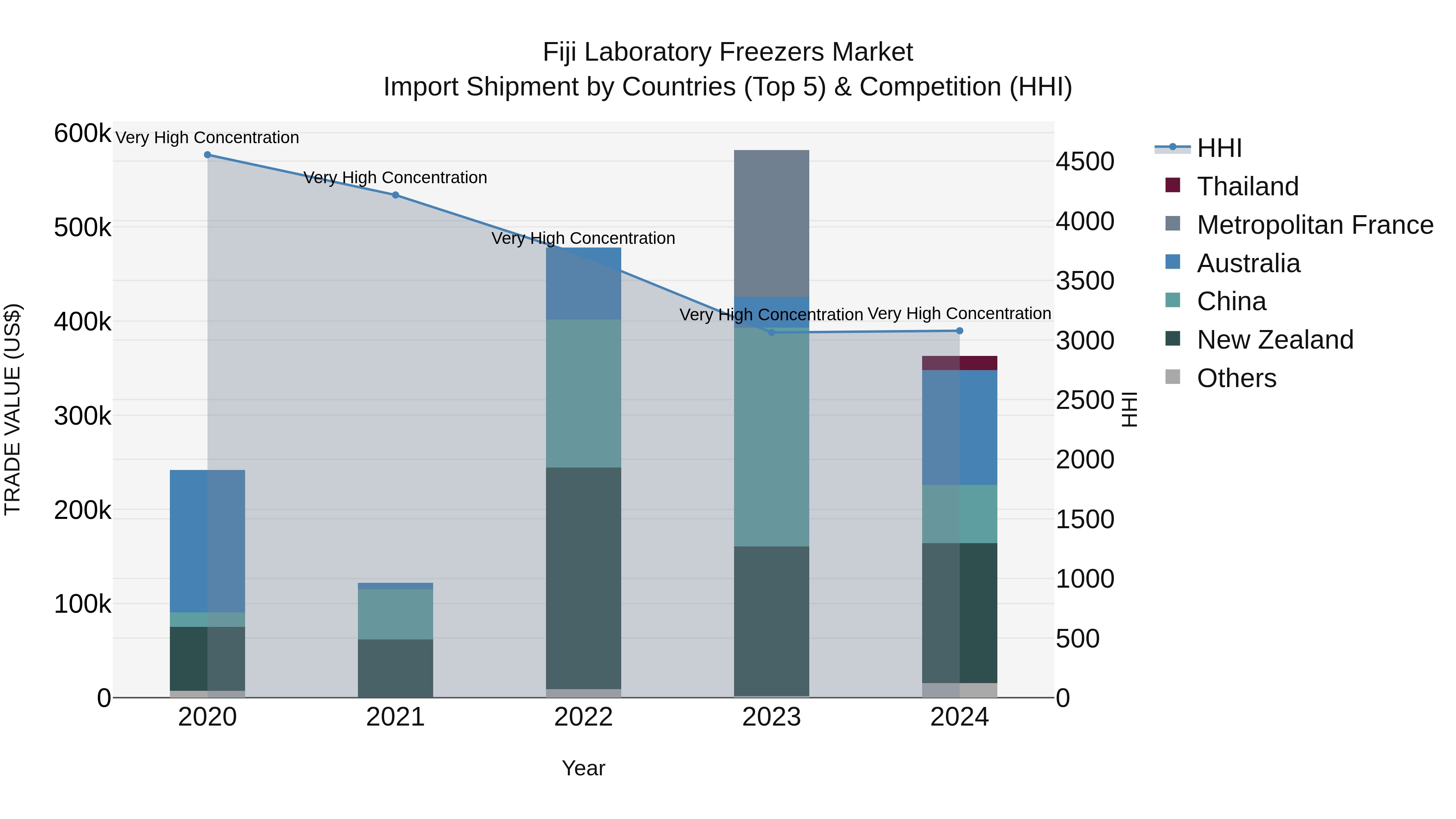
In 2024, Fiji saw a significant increase in laboratory freezers import shipments, with top exporters being New Zealand, Australia, China, Thailand, and Hong Kong. Despite the high concentration of market share reflected in the Herfindahl-Hirschman Index (HHI), the industry experienced a strong compound annual growth rate (CAGR) of 10.71% from 2020 to 2024. However, there was a notable decrease in growth rate from 2023 to 2024 at -37.58%, indicating a potential shift in market dynamics that importers and manufacturers should closely monitor.
Laboratory Freezers Market: Fiji vs Top 5 Major Economies in 2027 (Asia)
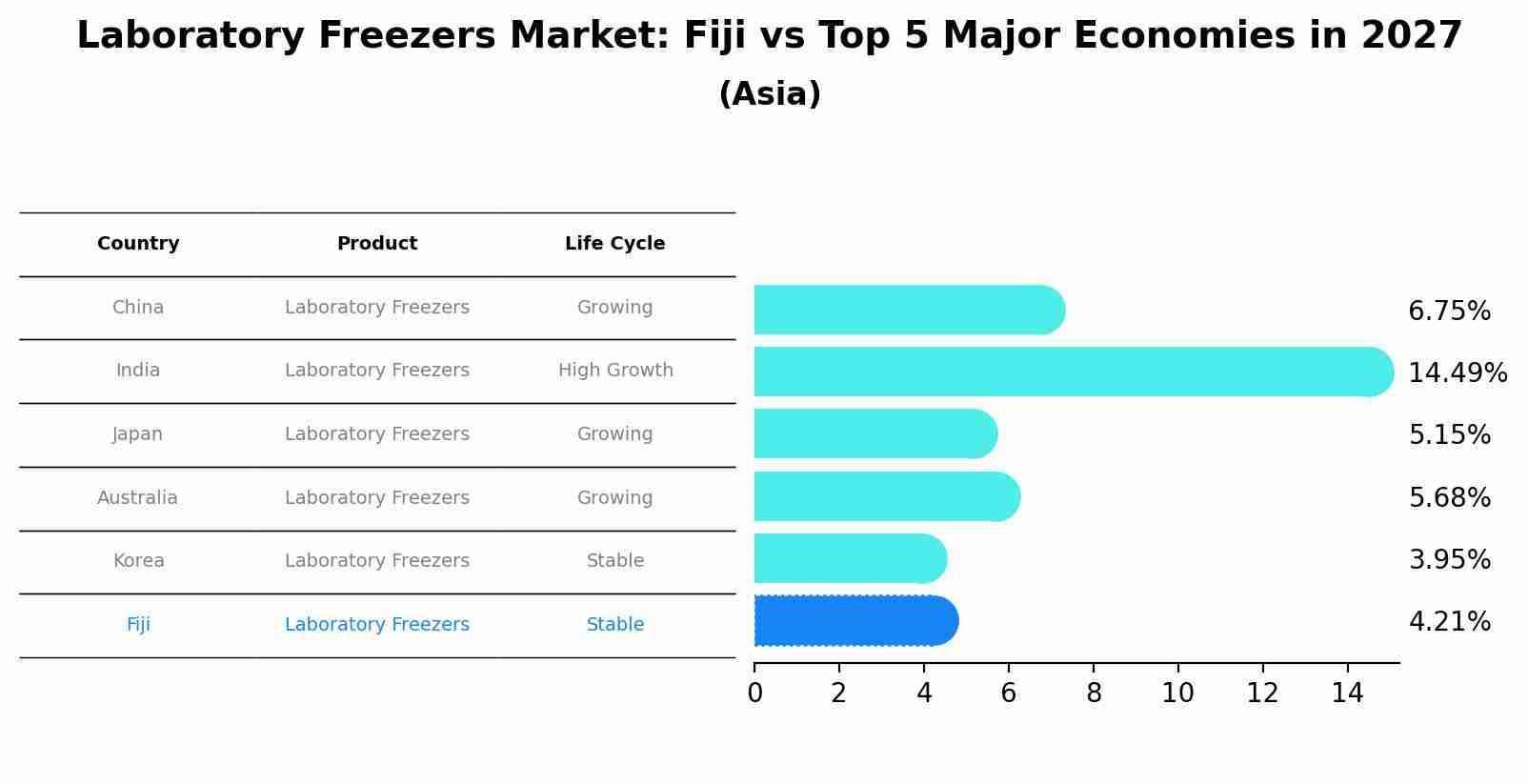
The Laboratory Freezers market in Fiji is projected to grow at a stable growth rate of 4.21% by 2027, highlighting the country's increasing focus on advanced technologies within the Asia region, where China holds the dominant position, followed closely by India, Japan, Australia and South Korea, shaping overall regional demand.
Fiji Laboratory Freezers Market Overview
The laboratory freezers market in Fiji is growing due to the increasing demand for cold storage solutions in scientific research, healthcare, and pharmaceuticals. Laboratory freezers are used for the storage of biological samples, vaccines, and chemicals. As research and healthcare sectors in Fiji continue to develop, the need for reliable and efficient laboratory freezers is expected to rise.
Drivers of the market
The Fiji laboratory freezers market is driven by the increasing need for temperature-controlled storage in research, healthcare, and pharmaceutical laboratories. As the demand for the safe storage of biological samples, vaccines, and reagents grows, so does the need for reliable and high-quality laboratory freezers. The growth in the biotech and pharmaceutical industries in Fiji, coupled with the rising healthcare demands, is further driving the need for advanced storage solutions, including ultra-low temperature freezers.
Challenges of the market
The laboratory freezers market in Fiji faces challenges due to the high cost of importing these specialized appliances, which are essential for storing samples in scientific and medical settings. The relatively small size of Fiji`s healthcare, research, and pharmaceutical sectors limits the demand for laboratory freezers. Additionally, the high import taxes and shipping fees on large and sensitive equipment further drive up prices, making these products less affordable for smaller institutions and businesses. The lack of local suppliers and maintenance services also poses a challenge for customers.
Government Policy of the market
The government of Fiji supports the growth of the laboratory freezers market, especially in sectors such as biotechnology, healthcare, and food safety. Policies focus on ensuring that laboratory freezers meet energy efficiency and safety standards. The government offers financial incentives to businesses that adopt eco-friendly technologies in freezer production and encourage sustainable refrigeration practices to minimize environmental impact.
Key Highlights of the Report:
- Fiji Laboratory Freezers Market Outlook
- Market Size of Fiji Laboratory Freezers Market, 2024
- Forecast of Fiji Laboratory Freezers Market, 2031
- Historical Data and Forecast of Fiji Laboratory Freezers Revenues & Volume for the Period 2021-2031
- Fiji Laboratory Freezers Market Trend Evolution
- Fiji Laboratory Freezers Market Drivers and Challenges
- Fiji Laboratory Freezers Price Trends
- Fiji Laboratory Freezers Porter`s Five Forces
- Fiji Laboratory Freezers Industry Life Cycle
- Historical Data and Forecast of Fiji Laboratory Freezers Market Revenues & Volume By Product Type for the Period 2021-2031
- Historical Data and Forecast of Fiji Laboratory Freezers Market Revenues & Volume By Cryopreservation Systems for the Period 2021-2031
- Historical Data and Forecast of Fiji Laboratory Freezers Market Revenues & Volume By Refrigerators for the Period 2021-2031
- Historical Data and Forecast of Fiji Laboratory Freezers Market Revenues & Volume By Freezers for the Period 2021-2031
- Historical Data and Forecast of Fiji Laboratory Freezers Market Revenues & Volume By End User for the Period 2021-2031
- Historical Data and Forecast of Fiji Laboratory Freezers Market Revenues & Volume By Blood Banks for the Period 2021-2031
- Historical Data and Forecast of Fiji Laboratory Freezers Market Revenues & Volume By Pharmaceutical & Biotechnology Companies for the Period 2021-2031
- Historical Data and Forecast of Fiji Laboratory Freezers Market Revenues & Volume By Academic & Research Institutes for the Period 2021-2031
- Historical Data and Forecast of Fiji Laboratory Freezers Market Revenues & Volume By Medical Laboratories for the Period 2021-2031
- Historical Data and Forecast of Fiji Laboratory Freezers Market Revenues & Volume By Hospitals for the Period 2021-2031
- Historical Data and Forecast of Fiji Laboratory Freezers Market Revenues & Volume By Pharmacies for the Period 2021-2031
- Fiji Laboratory Freezers Import Export Trade Statistics
- Market Opportunity Assessment By Product Type
- Market Opportunity Assessment By End User
- Fiji Laboratory Freezers Top Companies Market Share
- Fiji Laboratory Freezers Competitive Benchmarking By Technical and Operational Parameters
- Fiji Laboratory Freezers Company Profiles
- Fiji Laboratory Freezers Key Strategic Recommendations






































