Fiji Processed Food Market Size Growth Rate
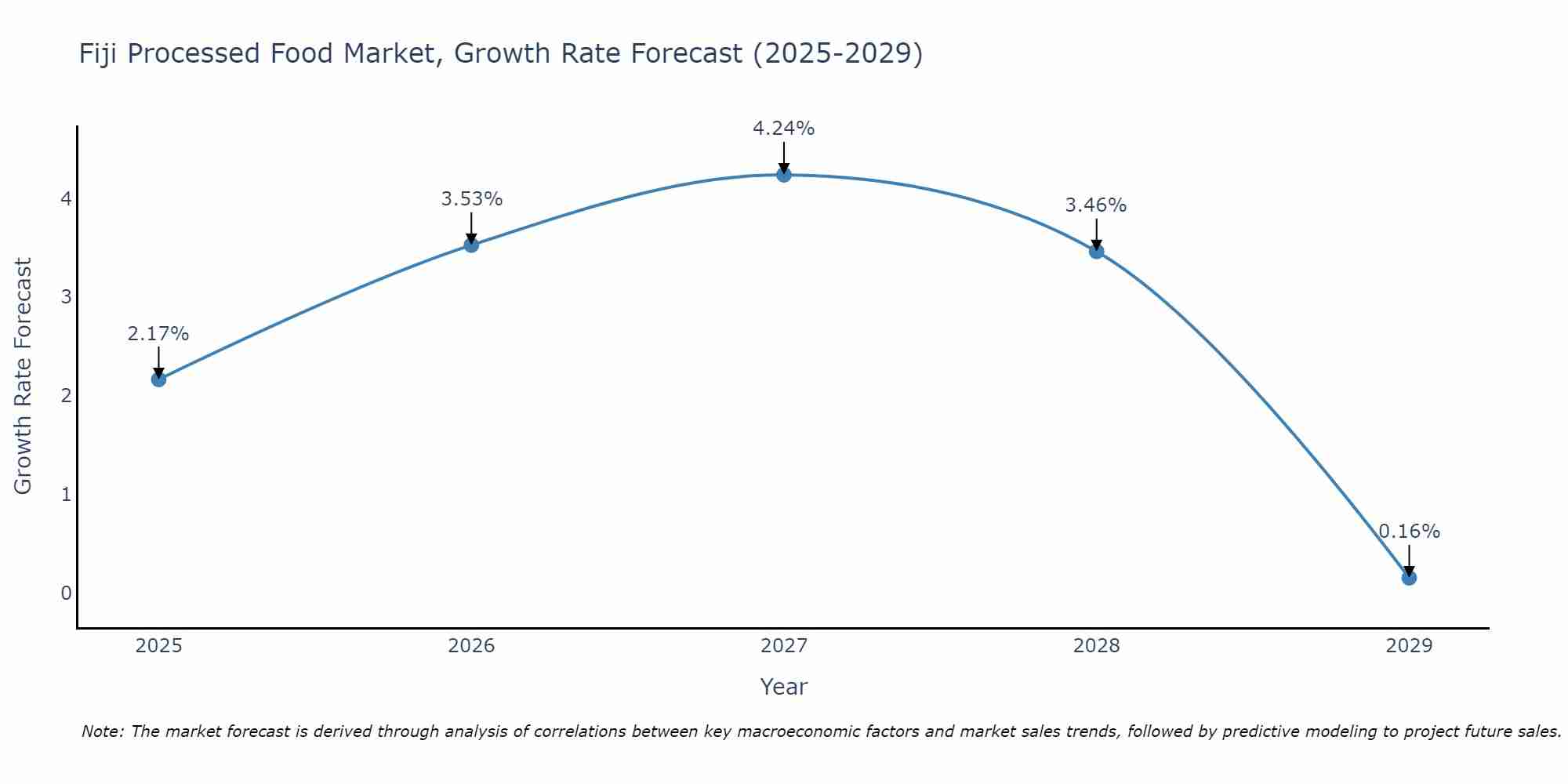
The Fiji Processed Food Market is projected to witness mixed growth rate patterns during 2025 to 2029. Starting at 2.17% in 2025, the market peaks at 4.24% in 2027, and settles at 0.16% by 2029.
Processed Food Market: Fiji vs Top 5 Major Economies in 2027 (Asia)
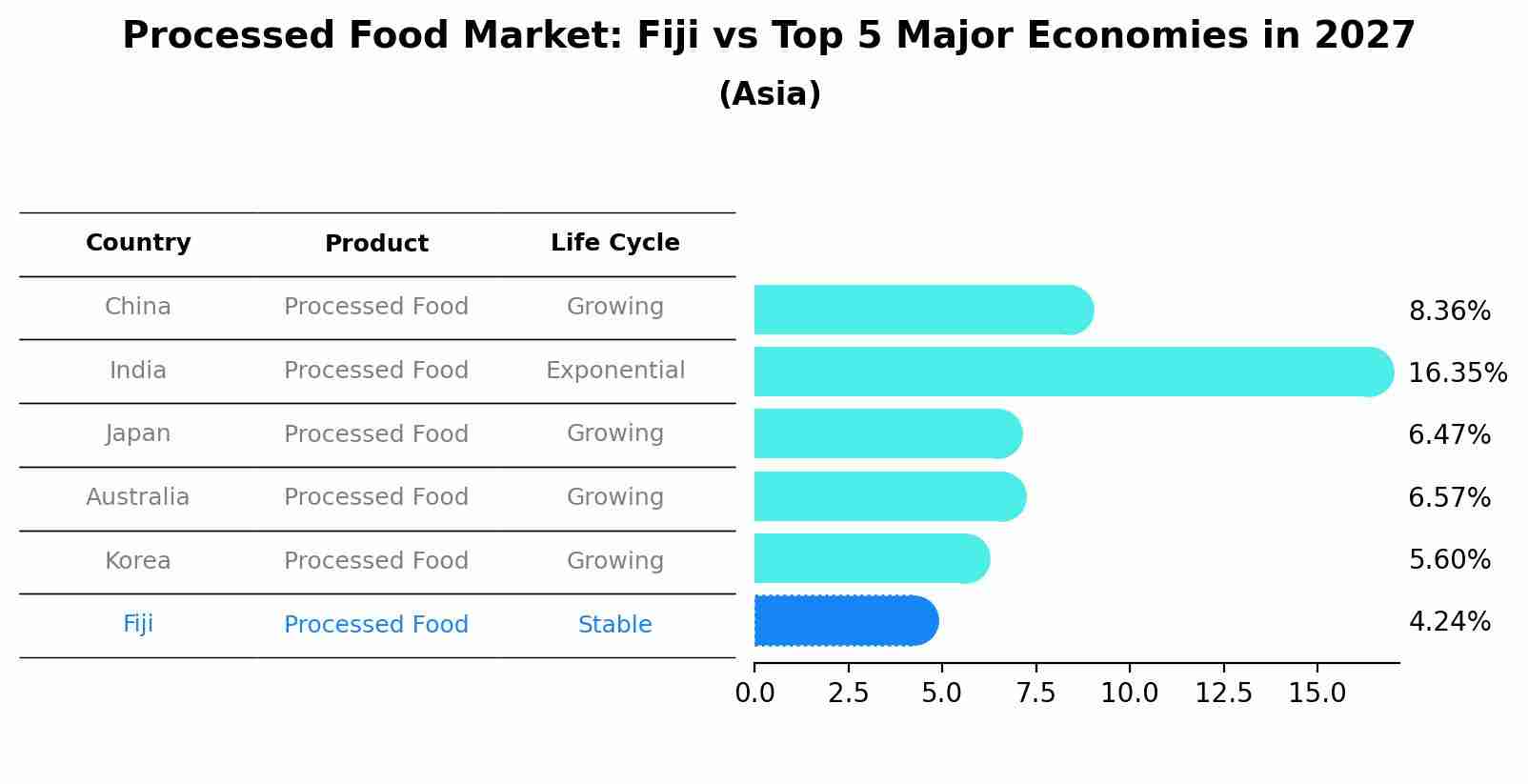
In the Asia region, the Processed Food market in Fiji is projected to expand at a stable growth rate of 4.24% by 2027. The largest economy is China, followed by India, Japan, Australia and South Korea.
Fiji Processed Food Market Overview
The processed food market in Fiji is expanding as the demand for convenient, ready-to-eat, and shelf-stable food products increases. Urbanization, busy lifestyles, and a growing middle class are contributing to a shift towards packaged and processed food consumption. With a diverse population and increasing influence from international food trends, Fijis processed food market is poised for growth, with key segments including snacks, dairy, meat, and frozen foods.
Drivers of the market
The processed food market in Fiji is expanding due to changing lifestyles, urbanization, and the growing demand for convenience foods. As consumers increasingly seek time-saving solutions, processed foods, which offer easy preparation and longer shelf life, have become a staple in many households. Additionally, the growing middle class and higher disposable incomes are fueling the demand for premium and packaged food products. Innovations in food processing technologies that improve the nutritional value and taste of processed foods are also contributing to the markets growth.
Challenges of the market
The processed food market in Fiji is constrained by limited local production capabilities and a relatively small consumer base. Although processed food products are in demand, particularly in urban areas, the market is still relatively underdeveloped. The high cost of importing raw materials and finished products, coupled with limited local food processing capacity, drives up prices. Furthermore, consumer preferences in Fiji are gradually shifting towards fresher and healthier food options, which can further limit the growth of the processed food market.
Government Policy of the market
Fiji`s processed food market is shaped by policies promoting food security and value-added production. Government support for local food processing industries, along with incentives for export-oriented businesses, creates a favorable market environment.
Key Highlights of the Report:
- Fiji Processed Food Market Outlook
- Market Size of Fiji Processed Food Market, 2024
- Forecast of Fiji Processed Food Market, 2031
- Historical Data and Forecast of Fiji Processed Food Revenues & Volume for the Period 2021-2031
- Fiji Processed Food Market Trend Evolution
- Fiji Processed Food Market Drivers and Challenges
- Fiji Processed Food Price Trends
- Fiji Processed Food Porter`s Five Forces
- Fiji Processed Food Industry Life Cycle
- Historical Data and Forecast of Fiji Processed Food Market Revenues & Volume By Process for the Period 2021-2031
- Historical Data and Forecast of Fiji Processed Food Market Revenues & Volume By Minimally for the Period 2021-2031
- Historical Data and Forecast of Fiji Processed Food Market Revenues & Volume By Highly for the Period 2021-2031
- Historical Data and Forecast of Fiji Processed Food Market Revenues & Volume By Product type for the Period 2021-2031
- Historical Data and Forecast of Fiji Processed Food Market Revenues & Volume By Plant based for the Period 2021-2031
- Historical Data and Forecast of Fiji Processed Food Market Revenues & Volume By Fruits for the Period 2021-2031
- Historical Data and Forecast of Fiji Processed Food Market Revenues & Volume By Vegetables for the Period 2021-2031
- Historical Data and Forecast of Fiji Processed Food Market Revenues & Volume By Legumes for the Period 2021-2031
- Historical Data and Forecast of Fiji Processed Food Market Revenues & Volume By Extracted foods for the Period 2021-2031
- Historical Data and Forecast of Fiji Processed Food Market Revenues & Volume By Others for the Period 2021-2031
- Historical Data and Forecast of Fiji Processed Food Market Revenues & Volume By Animal based for the Period 2021-2031
- Historical Data and Forecast of Fiji Processed Food Market Revenues & Volume By Milk for the Period 2021-2031
- Historical Data and Forecast of Fiji Processed Food Market Revenues & Volume By Application for the Period 2021-2031
- Historical Data and Forecast of Fiji Processed Food Market Revenues & Volume By Baked foods for the Period 2021-2031
- Historical Data and Forecast of Fiji Processed Food Market Revenues & Volume By Baby food for the Period 2021-2031
- Historical Data and Forecast of Fiji Processed Food Market Revenues & Volume By Breakfast Cereal for the Period 2021-2031
- Historical Data and Forecast of Fiji Processed Food Market Revenues & Volume By Biscuits for the Period 2021-2031
- Historical Data and Forecast of Fiji Processed Food Market Revenues & Volume By Cheese for the Period 2021-2031
- Historical Data and Forecast of Fiji Processed Food Market Revenues & Volume By Chocolate confectionary for the Period 2021-2031
- Historical Data and Forecast of Fiji Processed Food Market Revenues & Volume By Ice creams for the Period 2021-2031
- Historical Data and Forecast of Fiji Processed Food Market Revenues & Volume By Instant Noodles for the Period 2021-2031
- Fiji Processed Food Import Export Trade Statistics
- Market Opportunity Assessment By Process
- Market Opportunity Assessment By Product type
- Market Opportunity Assessment By Application
- Fiji Processed Food Top Companies Market Share
- Fiji Processed Food Competitive Benchmarking By Technical and Operational Parameters
- Fiji Processed Food Company Profiles
- Fiji Processed Food Key Strategic Recommendations






































