Finland Artificial Flowers Market Size (2020-2030)
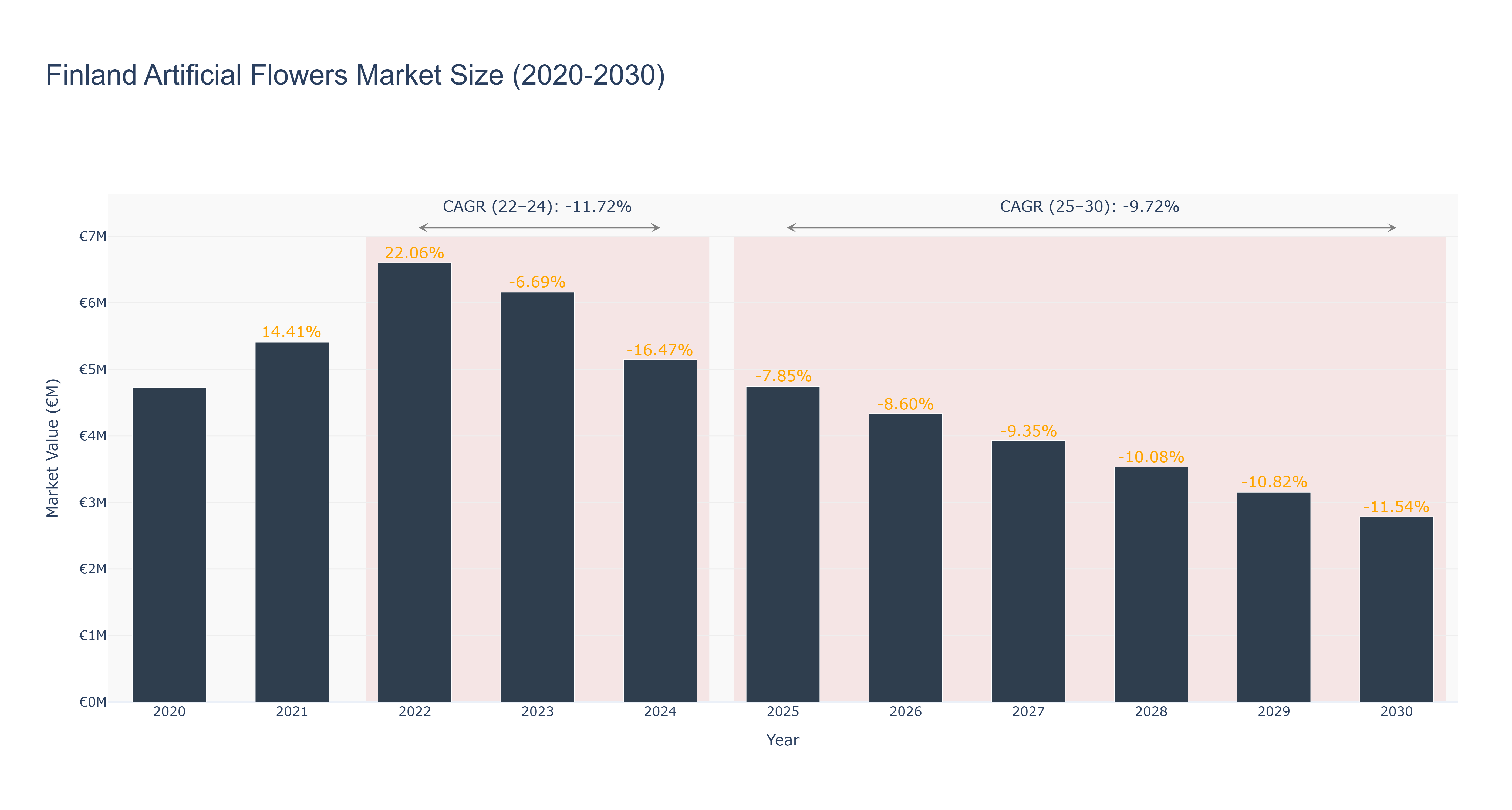
The Finland Artificial Flowers Market has shown a declining trend in recent years. The peak market size was €6.60 million in 2022, followed by a decrease to €5.14 million in 2024. The forecasted market size is expected to further decrease to €2.79 million by 2030, with a CAGR of -9.72% from 2025 to 2030. The market experienced a sharp decline post-2022 due to changing consumer preferences towards more sustainable and eco-friendly options. To counter this trend, industry players are focusing on product innovation using biodegradable materials and adopting digital marketing strategies to reach a wider audience. In the near future, Finland is planning to invest in research and development for artificial flower technology to enhance product quality and sustainability, aiming to revitalize the market and attract environmentally conscious consumers.
Finland Artificial Flowers Market: Production & Trade Performance (2019-2025)
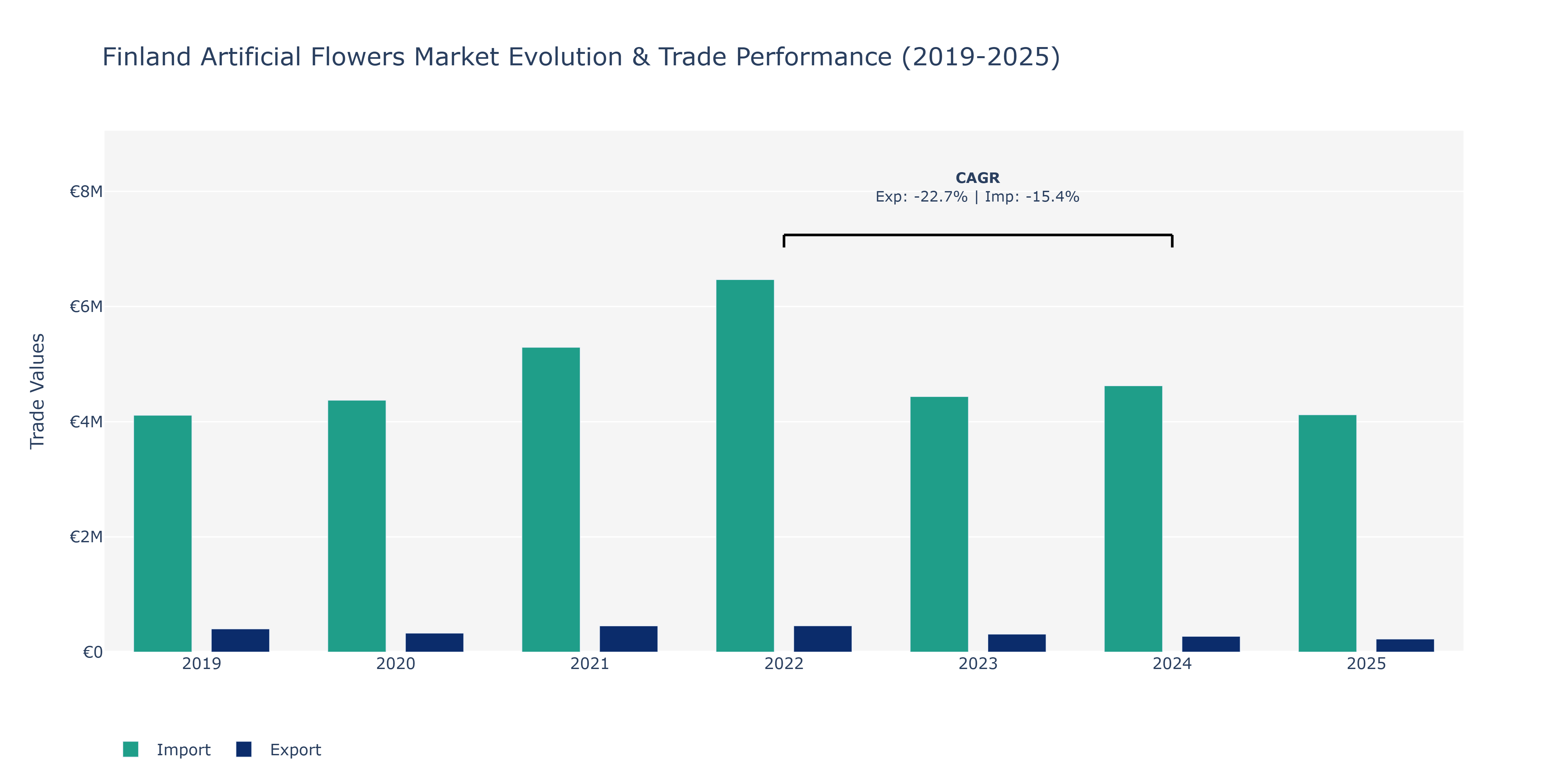
In the Finland Artificial Flowers Market, exports exhibited a fluctuating pattern from 2019 to 2025. Starting at €400.67 thousand in 2019, exports dropped to €271.74 thousand in 2024 before slightly recovering to €225.72 thousand in 2025. This decline can be attributed to various factors such as changing consumer preferences, global economic conditions, and supply chain disruptions. Imports, on the other hand, saw a steady increase over the same period, rising from €4.11 million in 2019 to €5.29 million in 2021, and reaching €6.47 million in 2022. This upward trend in imports could be driven by increased demand for artificial flowers in Finland, possibly due to a growing interest in home decor or events decoration. The market dynamics suggest a shift in trade balances and highlight the importance of understanding local market trends to make informed business decisions in the artificial flowers industry.
Key Highlights of the Report:
- Finland Artificial Flowers Market Outlook
- Market Size of Finland Artificial Flowers Market, 2024
- Forecast of Finland Artificial Flowers Market, 2031
- Historical Data and Forecast of Finland Artificial Flowers Revenues & Volume for the Period 2021-2031
- Finland Artificial Flowers Market Trend Evolution
- Finland Artificial Flowers Market Drivers and Challenges
- Finland Artificial Flowers Price Trends
- Finland Artificial Flowers Porter`s Five Forces
- Finland Artificial Flowers Industry Life Cycle
- Historical Data and Forecast of Finland Artificial Flowers Market Revenues & Volume By Material Type for the Period 2021-2031
- Historical Data and Forecast of Finland Artificial Flowers Market Revenues & Volume By Clay & Porcelain for the Period 2021-2031
- Historical Data and Forecast of Finland Artificial Flowers Market Revenues & Volume By Cotton & Silk for the Period 2021-2031
- Historical Data and Forecast of Finland Artificial Flowers Market Revenues & Volume By Leather & Nylon for the Period 2021-2031
- Historical Data and Forecast of Finland Artificial Flowers Market Revenues & Volume By Paper & Wax for the Period 2021-2031
- Historical Data and Forecast of Finland Artificial Flowers Market Revenues & Volume By Plastic & Polyester for the Period 2021-2031
- Historical Data and Forecast of Finland Artificial Flowers Market Revenues & Volume By Application for the Period 2021-2031
- Historical Data and Forecast of Finland Artificial Flowers Market Revenues & Volume By Commercial for the Period 2021-2031
- Historical Data and Forecast of Finland Artificial Flowers Market Revenues & Volume By Residential for the Period 2021-2031
- Finland Artificial Flowers Import Export Trade Statistics
- Market Opportunity Assessment By Material Type
- Market Opportunity Assessment By Application
- Finland Artificial Flowers Top Companies Market Share
- Finland Artificial Flowers Competitive Benchmarking By Technical and Operational Parameters
- Finland Artificial Flowers Company Profiles
- Finland Artificial Flowers Key Strategic Recommendations






































