Finland Automotive Shock Absorber Market Size (2020-2030)
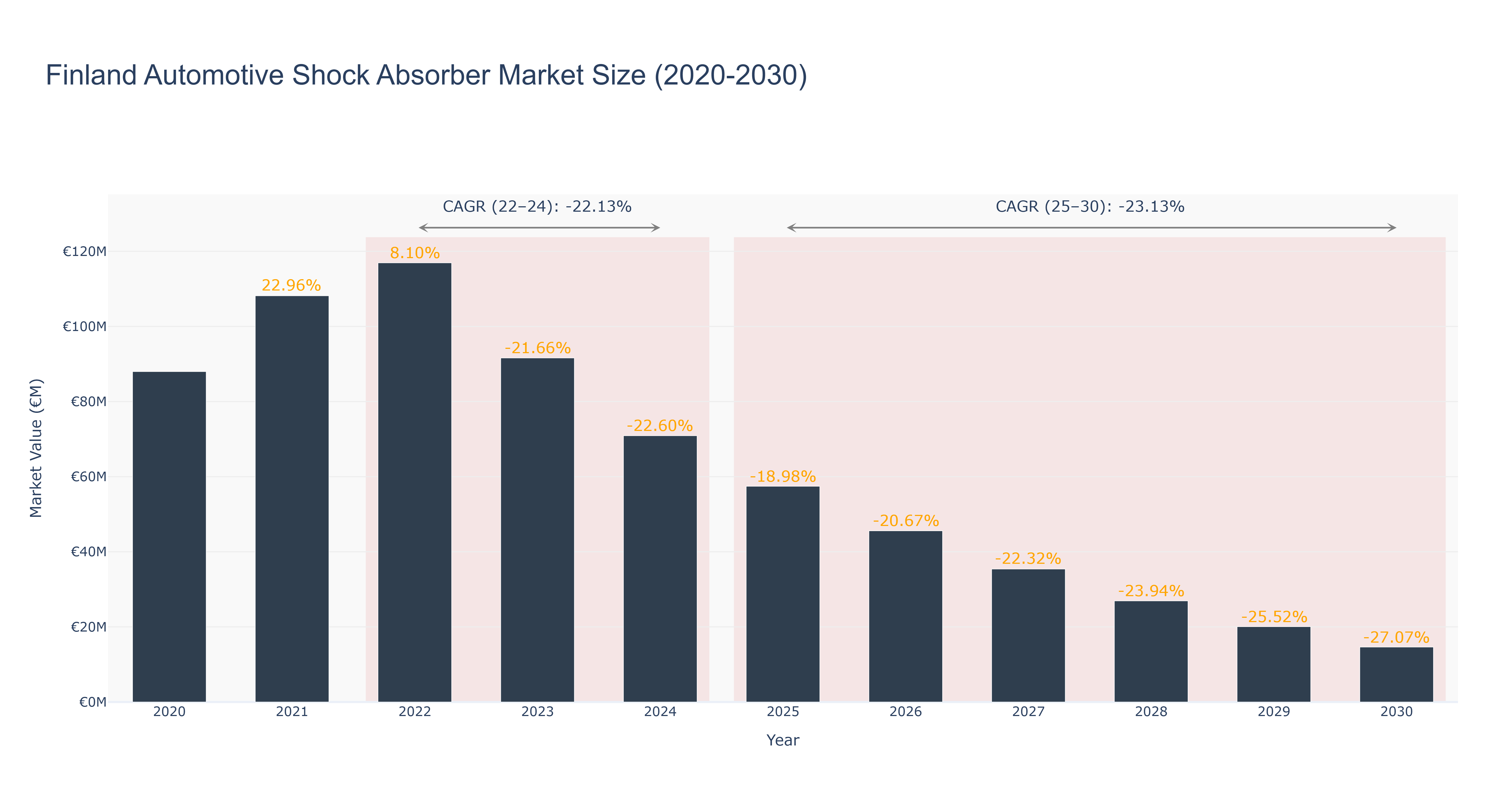
The Finland Automotive Shock Absorber Market experienced its peak in 2021, reaching a market size of €108.17 million, before facing a considerable downturn. The actual market size decreased to €91.61 million in 2023, with a significant negative growth rate of -21.66%, and is projected to decline further to €70.90 million by 2024, resulting in a compound annual growth rate (CAGR) of -22.13% for the period from 2022 to 2024. Looking ahead to 2025-2030, the market is expected to continue its downward trajectory, with forecasted sizes of €57.44 million in 2025 and €14.62 million by 2030, reflecting a CAGR of -23.13%. This decline can be attributed to reduced vehicle production and maintenance activities, alongside a shift towards electric vehicles, which may require different suspension technologies. The market's future outlook remains challenging without significant industry innovations or infrastructure projects to stimulate demand.
Finland Automotive Shock Absorber Market: Production & Trade Performance (2019-2025)
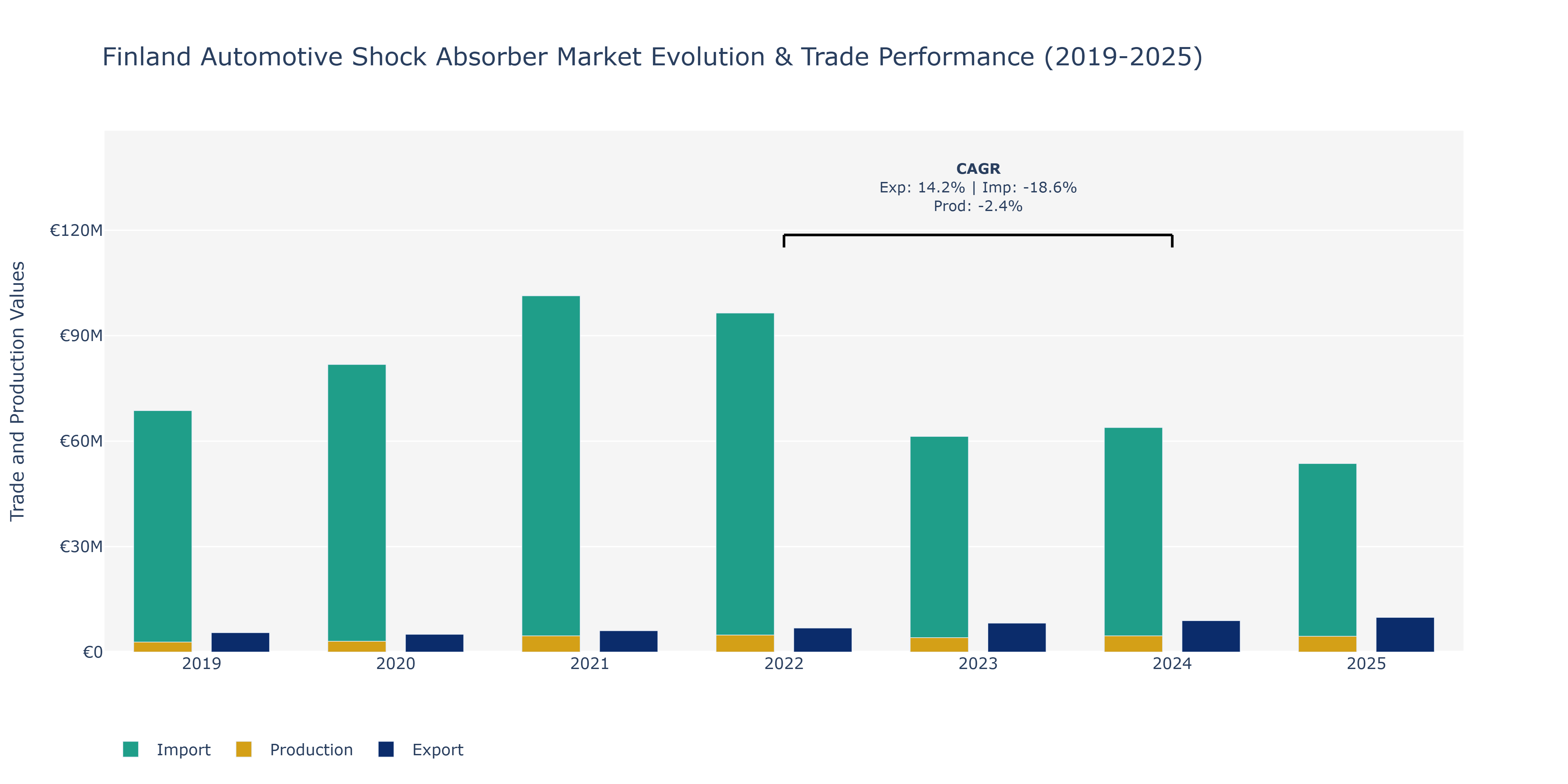
In the Finland Automotive Shock Absorber Market, from 2019 to 2025, exports experienced a steady growth trajectory, starting at €5.5 million in 2019 and reaching €9.9 million in 2025. Conversely, imports fluctuated notably, peaking at €101.35 million in 2021 before declining to €53.62 million in 2025. Production also displayed fluctuations, with a peak in 2021 at €4.6 million before experiencing a slight decrease to €4.5 million in 2025. The fluctuations in imports can be attributed to changing global trade dynamics and economic conditions impacting demand for shock absorbers. The growth in exports may be due to increased market demand, innovations in product quality, and successful marketing strategies. The decline in production towards 2025 might reflect adjustments in manufacturing processes or supply chain challenges. These trends emphasize the market's sensitivity to external factors, necessitating agile strategies to navigate evolving market conditions.
Key Highlights of the Report:
- Finland Automotive Shock Absorber Market Outlook
- Market Size of Finland Automotive Shock Absorber Market, 2024
- Forecast of Finland Automotive Shock Absorber Market, 2031
- Historical Data and Forecast of Finland Automotive Shock Absorber Revenues & Volume for the Period 2021- 2031
- Finland Automotive Shock Absorber Market Trend Evolution
- Finland Automotive Shock Absorber Market Drivers and Challenges
- Finland Automotive Shock Absorber Price Trends
- Finland Automotive Shock Absorber Porter's Five Forces
- Finland Automotive Shock Absorber Industry Life Cycle
- Historical Data and Forecast of Finland Automotive Shock Absorber Market Revenues & Volume By Mechanism for the Period 2021- 2031
- Historical Data and Forecast of Finland Automotive Shock Absorber Market Revenues & Volume By Gas Charged for the Period 2021- 2031
- Historical Data and Forecast of Finland Automotive Shock Absorber Market Revenues & Volume By Hydraulic for the Period 2021- 2031
- Historical Data and Forecast of Finland Automotive Shock Absorber Market Revenues & Volume By Product Type for the Period 2021- 2031
- Historical Data and Forecast of Finland Automotive Shock Absorber Market Revenues & Volume By Conventional Shock Absorber for the Period 2021- 2031
- Historical Data and Forecast of Finland Automotive Shock Absorber Market Revenues & Volume By Regenerative Shock Absorber for the Period 2021- 2031
- Historical Data and Forecast of Finland Automotive Shock Absorber Market Revenues & Volume By Technology for the Period 2021- 2031
- Historical Data and Forecast of Finland Automotive Shock Absorber Market Revenues & Volume By Active for the Period 2021- 2031
- Historical Data and Forecast of Finland Automotive Shock Absorber Market Revenues & Volume By Passive for the Period 2021- 2031
- Historical Data and Forecast of Finland Automotive Shock Absorber Market Revenues & Volume By Vehicle Type for the Period 2021- 2031
- Historical Data and Forecast of Finland Automotive Shock Absorber Market Revenues & Volume By Two and Three Wheelers for the Period 2021- 2031
- Historical Data and Forecast of Finland Automotive Shock Absorber Market Revenues & Volume By Passenger Vehicles for the Period 2021- 2031
- Historical Data and Forecast of Finland Automotive Shock Absorber Market Revenues & Volume By Commercial Vehicles for the Period 2021- 2031
- Historical Data and Forecast of Finland Automotive Shock Absorber Market Revenues & Volume By Sales Channel for the Period 2021- 2031
- Historical Data and Forecast of Finland Automotive Shock Absorber Market Revenues & Volume By OEMs for the Period 2021- 2031
- Historical Data and Forecast of Finland Automotive Shock Absorber Market Revenues & Volume By Aftermarket for the Period 2021- 2031
- Finland Automotive Shock Absorber Import Export Trade Statistics
- Market Opportunity Assessment By Mechanism
- Market Opportunity Assessment By Product Type
- Market Opportunity Assessment By Technology
- Market Opportunity Assessment By Vehicle Type
- Market Opportunity Assessment By Sales Channel
- Finland Automotive Shock Absorber Top Companies Market Share
- Finland Automotive Shock Absorber Competitive Benchmarking By Technical and Operational Parameters
- Finland Automotive Shock Absorber Company Profiles
- Finland Automotive Shock Absorber Key Strategic Recommendations






































