Finland Automotive Windshield Market Size (2020-2030)
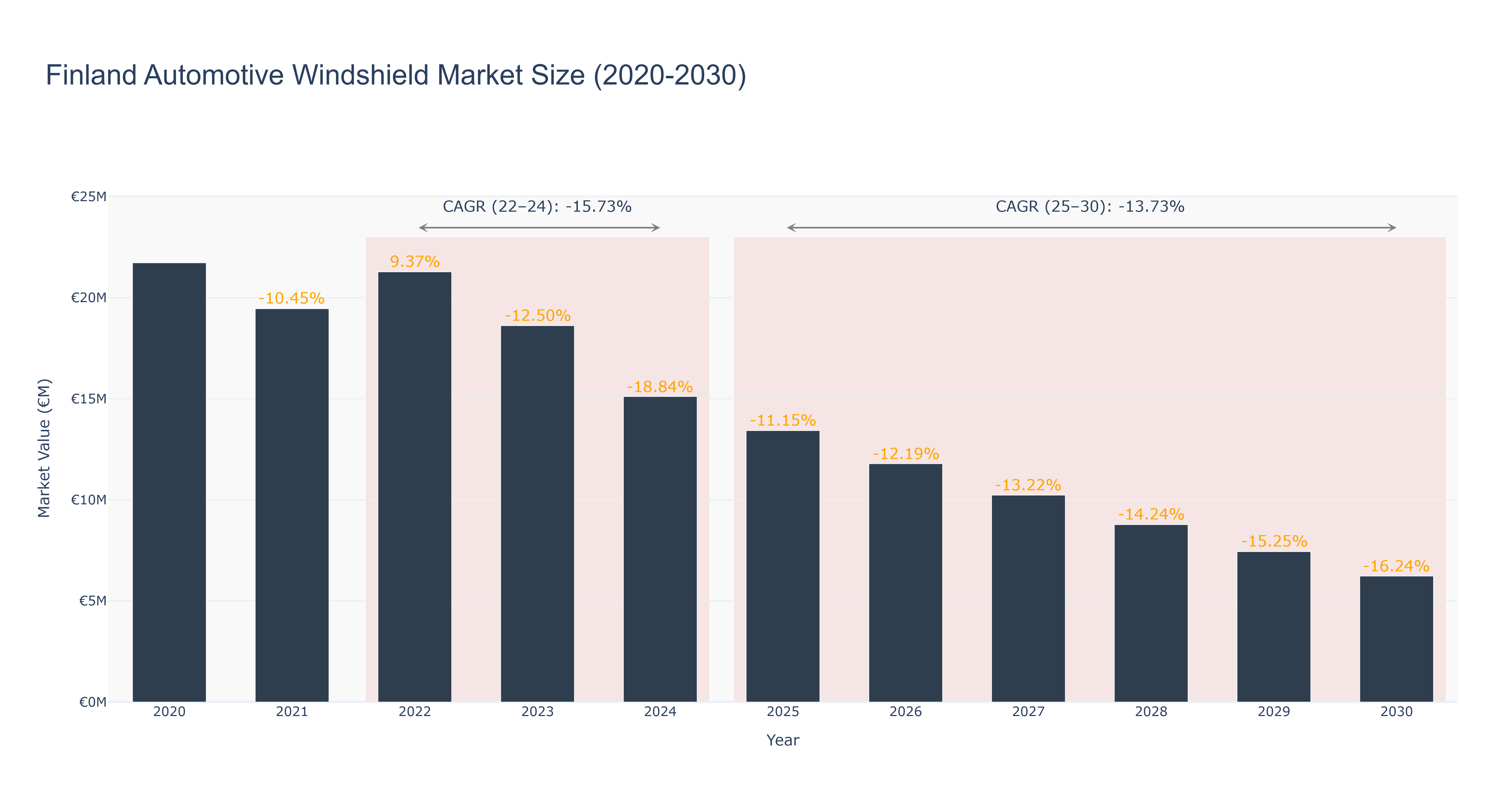
Finland Automotive Windshield Market has experienced a decline in market size from €21.27 million in 2022 to €6.23 million in 2030. The peak market size was observed in 2020 at €21.72 million. The actual market size decreased consistently due to factors like economic downturn and reduced consumer spending post-2020. The forecasted market size indicates a continued downward trend, with a CAGR of -15.73% from 2022 to 2024 and -13.73% from 2025 to 2030. Industry drivers such as technological advancements leading to longer-lasting windshields and a shift towards electric vehicles have impacted the market dynamics. Recent developments in the Finnish automotive industry include partnerships with global automakers to enhance windshield technologies and sustainability initiatives to reduce waste in manufacturing processes. These efforts aim to revitalize the market and drive future growth.
Finland Automotive Windshield Market: Production & Trade Performance (2019-2025)
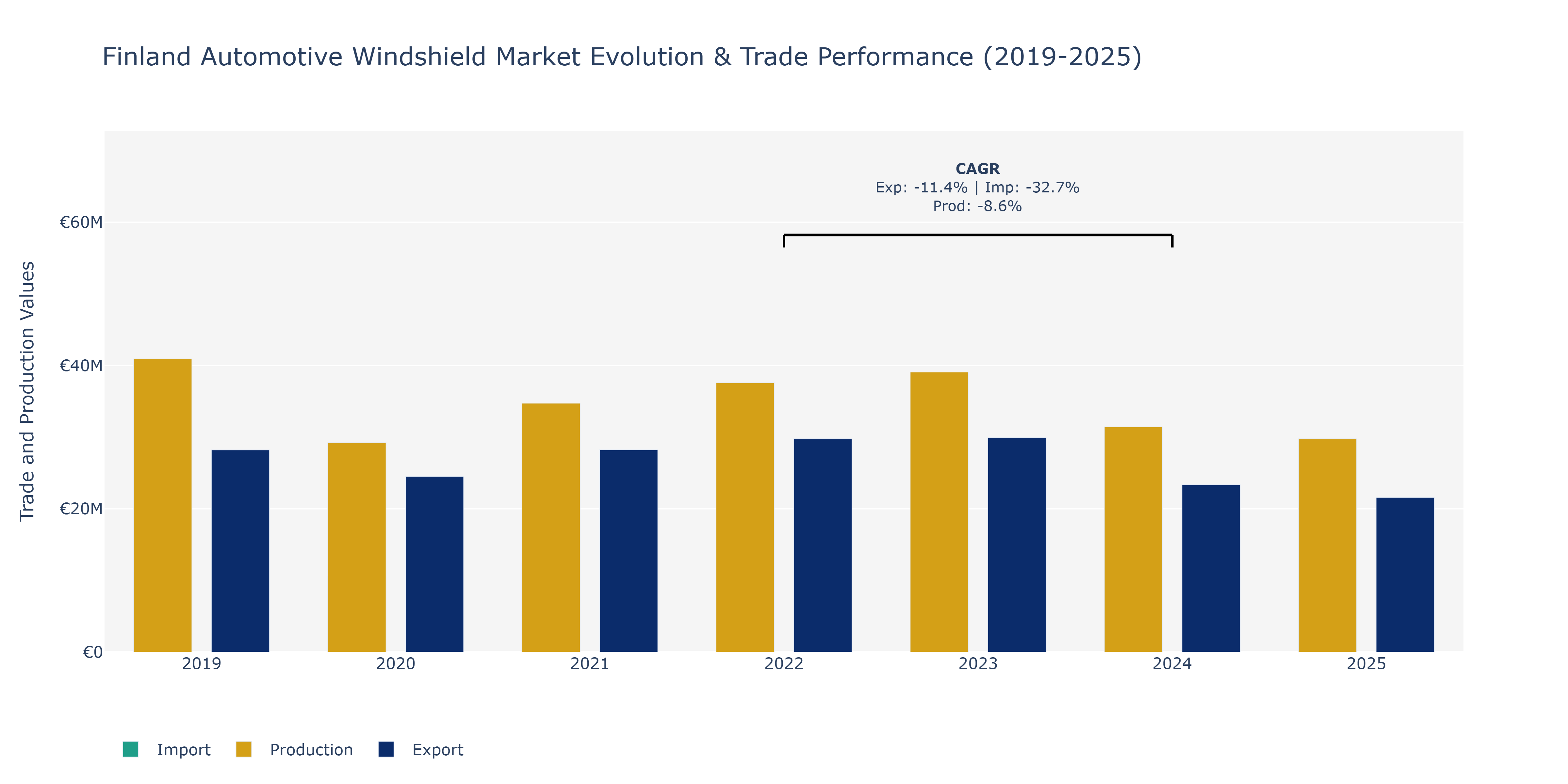
Between 2019 and 2025, the Finland Automotive Windshield Market witnessed notable fluctuations in Exports, Imports, and Production. Exports peaked in 2019 at approximately €28.22 million, then experienced a downward trend until 2025, reaching around €21.58 million. Imports followed a similar pattern, with a peak of around €11.07 million in 2019, decreasing to about €3.77 million in 2025. Production levels also peaked in 2019, exceeding €40.92 million, before showing a consistent decline to approximately €29.77 million in 2025. These trends can be attributed to various factors such as shifts in consumer demand, changes in global trade dynamics, and advancements in technology impacting production efficiencies. Additionally, the decline in imports could be linked to efforts towards promoting local manufacturing or disruptions in the global supply chain. To sustain growth, market players may need to focus on innovation, cost optimization, and adapting to evolving market conditions.
Key Highlights of the Report:
- Finland Automotive Windshield Market Outlook
- Market Size of Finland Automotive Windshield Market, 2024
- Forecast of Finland Automotive Windshield Market, 2031
- Historical Data and Forecast of Finland Automotive Windshield Revenues & Volume for the Period 2021-2031
- Finland Automotive Windshield Market Trend Evolution
- Finland Automotive Windshield Market Drivers and Challenges
- Finland Automotive Windshield Price Trends
- Finland Automotive Windshield Porter`s Five Forces
- Finland Automotive Windshield Industry Life Cycle
- Historical Data and Forecast of Finland Automotive Windshield Market Revenues & Volume By Glass Type for the Period 2021-2031
- Historical Data and Forecast of Finland Automotive Windshield Market Revenues & Volume By Laminated for the Period 2021-2031
- Historical Data and Forecast of Finland Automotive Windshield Market Revenues & Volume By Tempered for the Period 2021-2031
- Historical Data and Forecast of Finland Automotive Windshield Market Revenues & Volume By Material Type for the Period 2021-2031
- Historical Data and Forecast of Finland Automotive Windshield Market Revenues & Volume By Thermoset for the Period 2021-2031
- Historical Data and Forecast of Finland Automotive Windshield Market Revenues & Volume By Thermoplastic for the Period 2021-2031
- Historical Data and Forecast of Finland Automotive Windshield Market Revenues & Volume By Position for the Period 2021-2031
- Historical Data and Forecast of Finland Automotive Windshield Market Revenues & Volume By Front for the Period 2021-2031
- Historical Data and Forecast of Finland Automotive Windshield Market Revenues & Volume By Rear for the Period 2021-2031
- Finland Automotive Windshield Import Export Trade Statistics
- Market Opportunity Assessment By Glass Type
- Market Opportunity Assessment By Material Type
- Market Opportunity Assessment By Position
- Finland Automotive Windshield Top Companies Market Share
- Finland Automotive Windshield Competitive Benchmarking By Technical and Operational Parameters
- Finland Automotive Windshield Company Profiles
- Finland Automotive Windshield Key Strategic Recommendations






































