Finland Bedding Market Size (2020-2030)
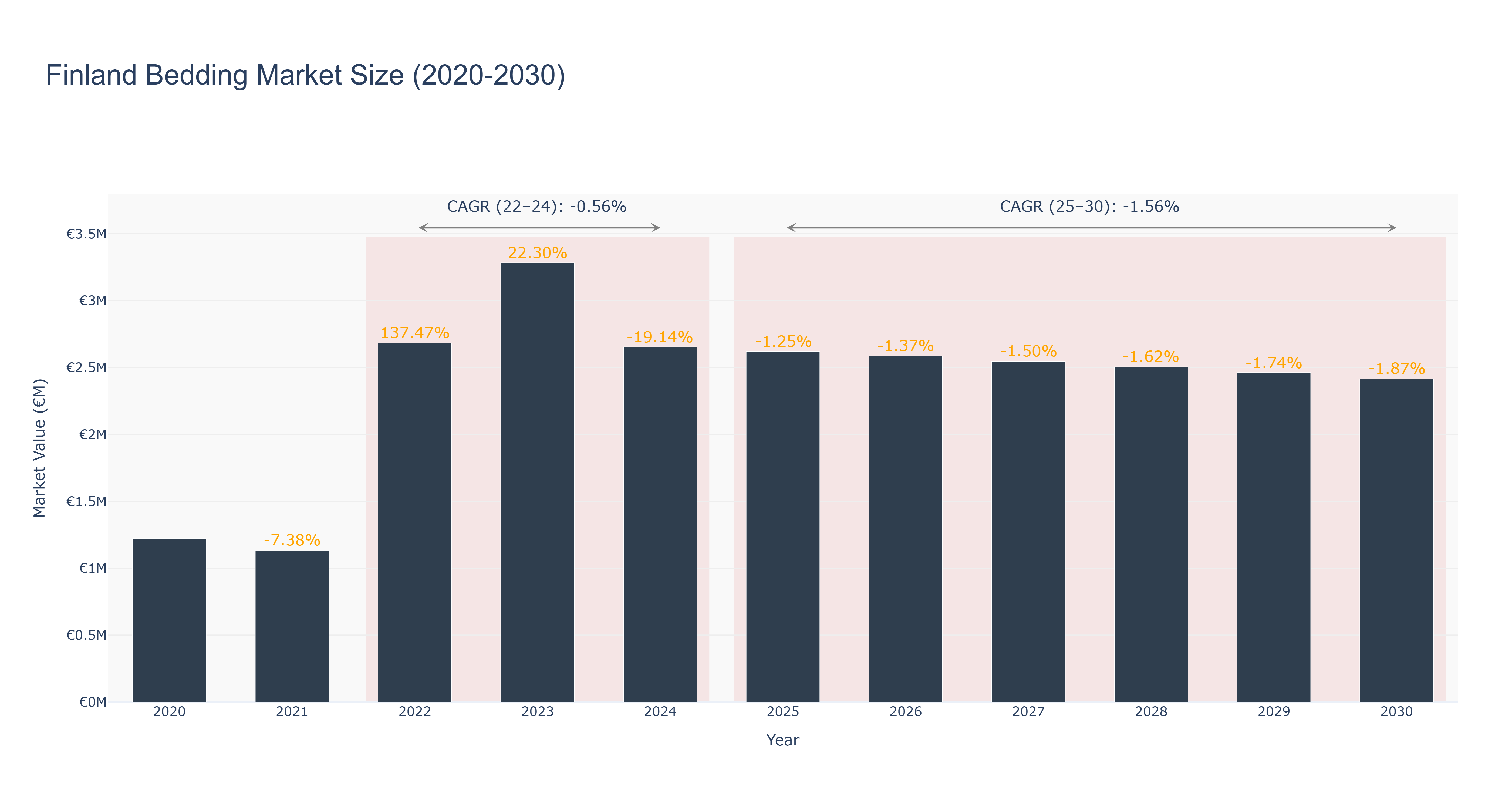
The Finland Bedding Market experienced a peak in 2023 with a market size of €3.28 million, followed by a decline to €2.65 million in 2024. The market is projected to continue shrinking with a forecasted size of €2.42 million in 2030. The CAGR for the period 2022-24 was -0.56%, while for 2025-30 it is expected to be -1.56%. The decline in market size can be attributed to changing consumer preferences towards sustainable and eco-friendly bedding options, impacting traditional market players. To counter this trend, industry players are investing in innovative technologies to develop smart bedding solutions that cater to modern consumer needs. In the near future, Finland is set to witness the launch of a collaborative project between leading bedding manufacturers and tech companies to introduce smart textiles infused with health-monitoring sensors, aiming to revolutionize the bedding market landscape.
Finland Bedding Market: Production & Trade Performance (2019-2025)
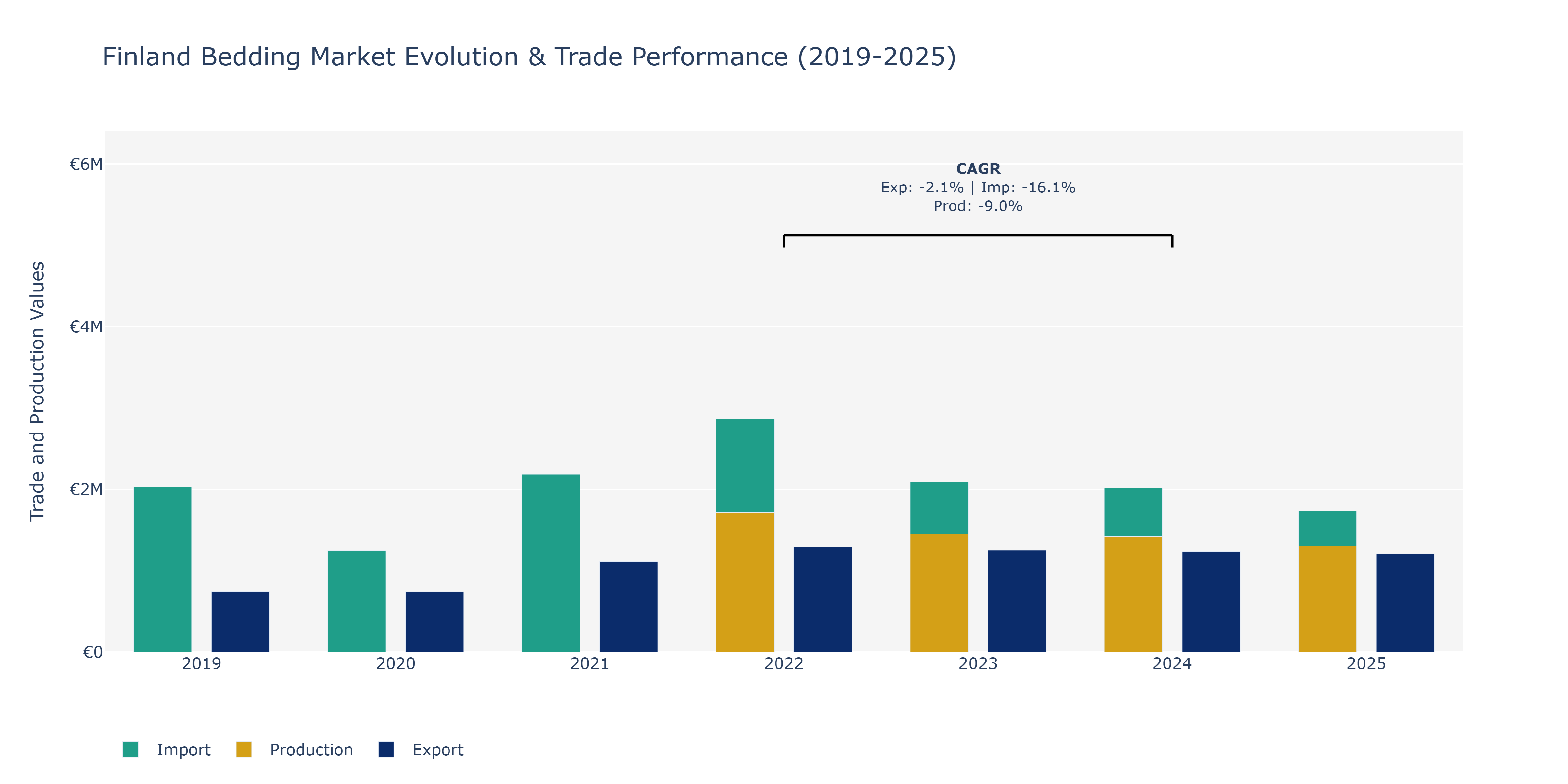
In the Finland Bedding Market, exports experienced a slight decline from €744.17 thousand in 2019 to €741.04 thousand in 2020 before rebounding to €1.11 million in 2021. However, a downward trend resumed in the following years, with exports decreasing to €1.25 million in 2023 and further to €1.21 million in 2024. Imports, on the other hand, showed fluctuations, reaching €2.86 million in 2022, the highest point in the provided data, before decreasing to €1.73 million in 2025. Production also saw a declining trend, with a noticeable drop from €1.71 million in 2022 to €1.30 million in 2025. These trends could be attributed to various factors such as changes in consumer preferences, global economic conditions affecting trade patterns, and shifts in raw material costs impacting production levels. The decrease in production might indicate optimizing manufacturing processes or shifting production to more cost-effective locations, reflecting market dynamics and competitive pressures. To adapt to these trends, companies in the bedding market may need to focus on innovation, cost-efficiency, and sustainability to maintain competitiveness in a changing market landscape.
Key Highlights of the Report:
- Finland Bedding Market Outlook
- Market Size of Finland Bedding Market, 2024
- Forecast of Finland Bedding Market, 2031
- Historical Data and Forecast of Finland Bedding Revenues & Volume for the Period 2021- 2031
- Finland Bedding Market Trend Evolution
- Finland Bedding Market Drivers and Challenges
- Finland Bedding Price Trends
- Finland Bedding Porter's Five Forces
- Finland Bedding Industry Life Cycle
- Historical Data and Forecast of Finland Bedding Market Revenues & Volume By Type for the Period 2021- 2031
- Historical Data and Forecast of Finland Bedding Market Revenues & Volume By home Bedding for the Period 2021- 2031
- Historical Data and Forecast of Finland Bedding Market Revenues & Volume By Hotel Bedding for the Period 2021- 2031
- Historical Data and Forecast of Finland Bedding Market Revenues & Volume By Distribution Channel for the Period 2021- 2031
- Historical Data and Forecast of Finland Bedding Market Revenues & Volume By supermarkets/Hypermarkets for the Period 2021- 2031
- Historical Data and Forecast of Finland Bedding Market Revenues & Volume By Specialty Stores for the Period 2021- 2031
- Historical Data and Forecast of Finland Bedding Market Revenues & Volume By Online for the Period 2021- 2031
- Historical Data and Forecast of Finland Bedding Market Revenues & Volume By Other Distribution Channels for the Period 2021- 2031
- Finland Bedding Import Export Trade Statistics
- Market Opportunity Assessment By Type
- Market Opportunity Assessment By Distribution Channel
- Finland Bedding Top Companies Market Share
- Finland Bedding Competitive Benchmarking By Technical and Operational Parameters
- Finland Bedding Company Profiles
- Finland Bedding Key Strategic Recommendations






































