Finland Bread Market Size (2020-2030)
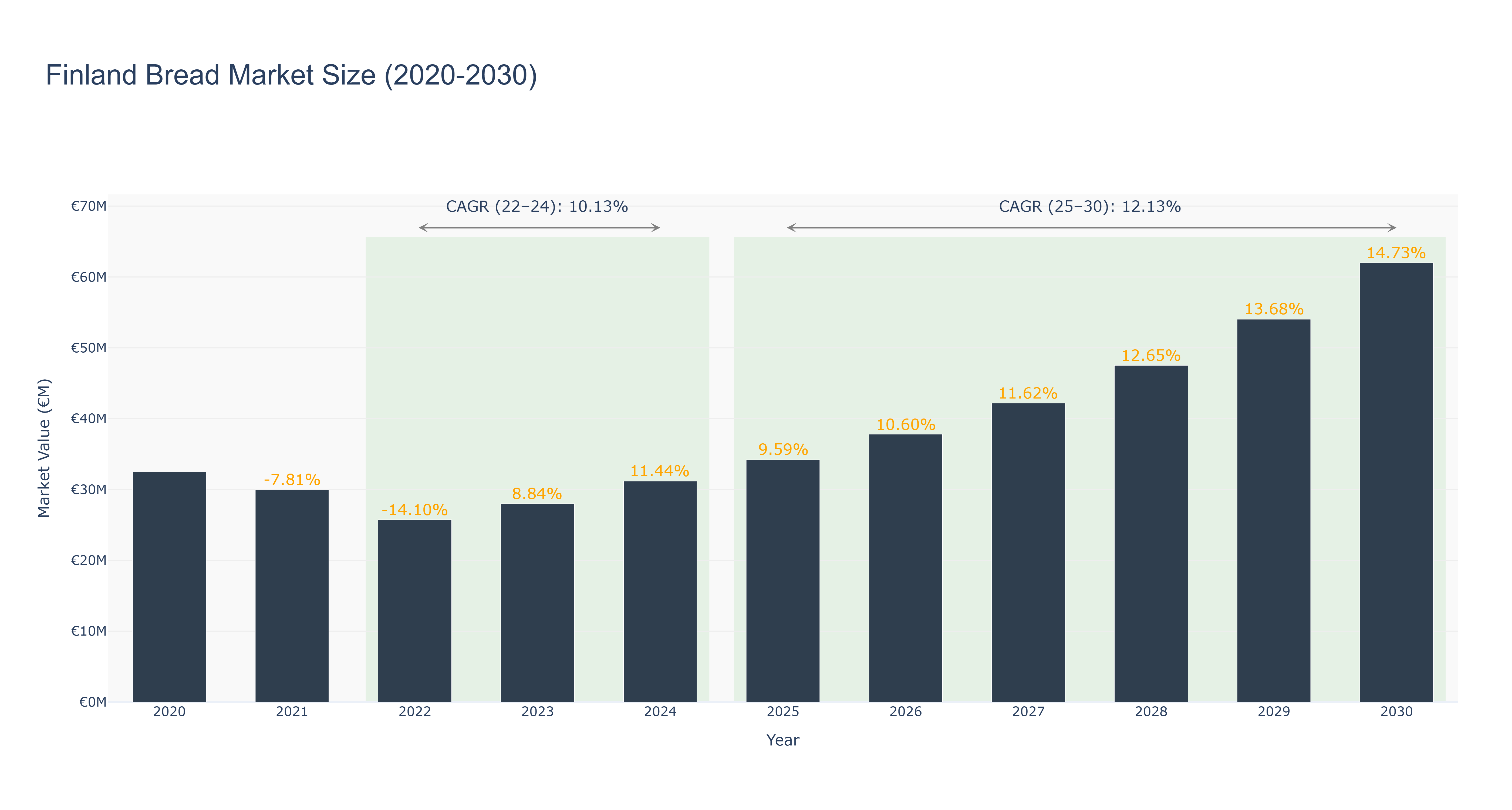
Finland Bread Market has shown a fluctuating trend in recent years. The market peaked at €62.00 million in 2030, with a steady growth trajectory. From 2020 to 2024, the market size decreased from €32.47 million to €31.19 million due to changing consumer preferences and economic conditions. However, from 2025 to 2030, the market is forecasted to grow significantly, reaching €62.00 million in 2030, driven by innovative product offerings and increased health consciousness among consumers. The CAGR for the periods 2022-24 and 2025-30 stand at 10.13% and 12.13%, respectively. Recent developments in the market include collaborations with local farmers to source high-quality ingredients and the launch of gluten-free and organic bread ranges to cater to evolving consumer demands. Future plans involve expanding distribution channels and investing in sustainable packaging solutions to further boost market growth.
Finland Bread Market: Production & Trade Performance (2019-2025)
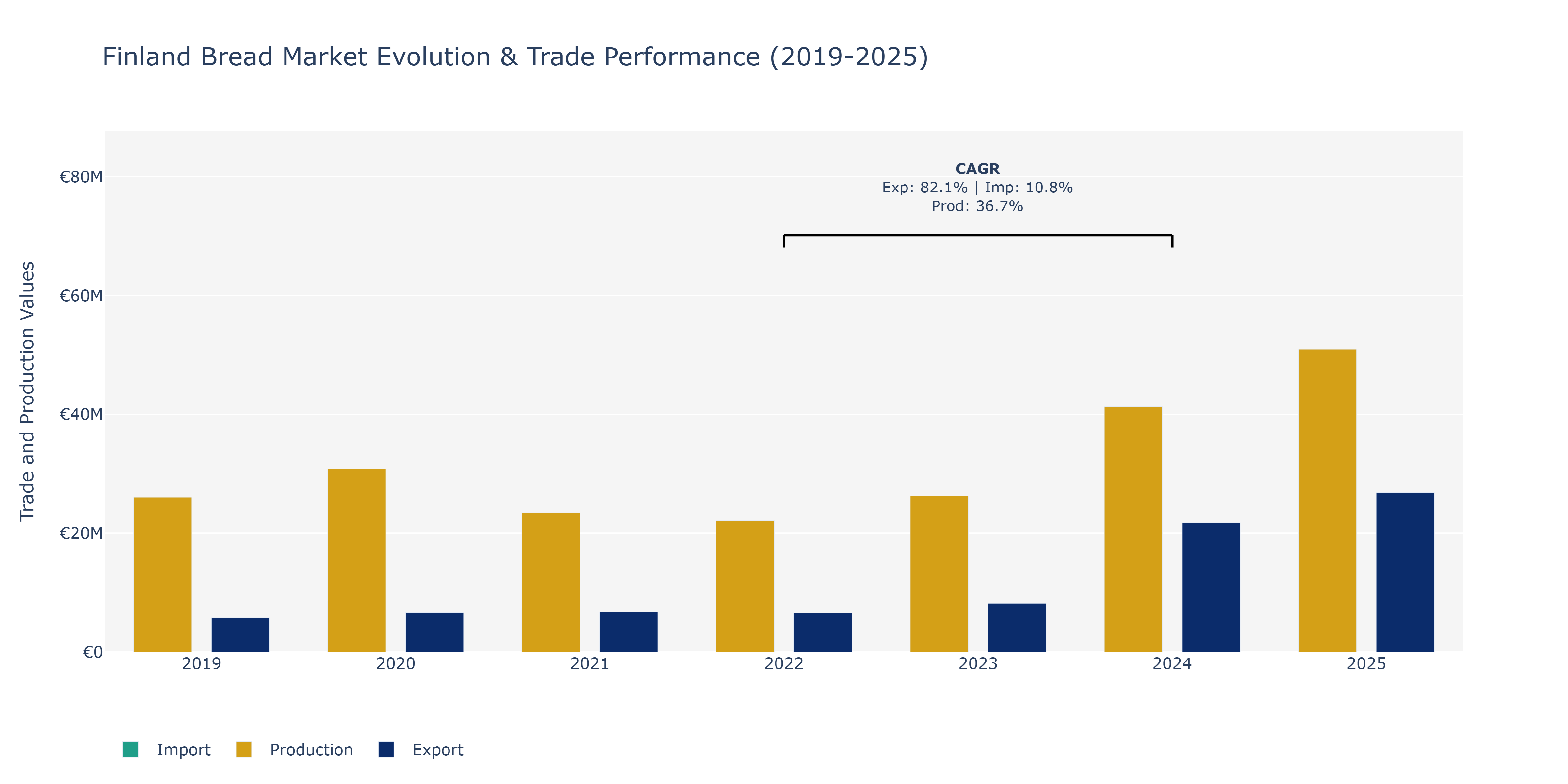
Between 2019 and 2025, Finland's Bread Market exhibited notable dynamics in Exports, Imports, and Production. Starting at €5.75 million in 2019, Exports saw consistent growth, reaching €26.83 million by 2025, indicating a significant upward trajectory. Conversely, Imports fluctuated, peaking at €11.68 million in 2025 after a dip in 2021, possibly due to market demand shifts or supply chain disruptions. Production value mirrored this variance, hitting €51.01 million in 2025, showcasing a substantial incline from 2019. The surge in Exports could be attributed to increased international demand for Finnish bread varieties, while the fluctuating Imports might reflect changing consumer preferences or trade agreements influencing sourcing strategies. The rise in Production can be linked to innovations in manufacturing processes and heightened domestic consumption, aligning with global trends towards healthier and diverse bread options.
Key Highlights of the Report:
- Finland Bread Market Outlook
- Market Size of Finland Bread Market, 2025
- Forecast of Finland Bread Market, 2032
- Historical Data and Forecast of Finland Bread Revenues & Volume for the Period 2022 - 2032F
- Finland Bread Market Trend Evolution
- Finland Bread Market Drivers and Challenges
- Finland Bread Price Trends
- Finland Bread Porter`s Five Forces
- Finland Bread Industry Life Cycle
- Historical Data and Forecast of Finland Bread Market Revenues & Volume By Loaves for the Period 2022 - 2032F
- Historical Data and Forecast of Finland Bread Market Revenues & Volume By Baguettes for the Period 2022 - 2032F
- Historical Data and Forecast of Finland Bread Market Revenues & Volume By Rolls for the Period 2022 - 2032F
- Historical Data and Forecast of Finland Bread Market Revenues & Volume By Burger Buns for the Period 2022 - 2032F
- Historical Data and Forecast of Finland Bread Market Revenues & Volume By Ciabatta for the Period 2022 - 2032F
- Historical Data and Forecast of Finland Bread Market Revenues & Volume By Others for the Period 2022 - 2032F
- Historical Data and Forecast of Finland Bread Market Revenues & Volume By Convenience Stores for the Period 2022 - 2032F
- Historical Data and Forecast of Finland Bread Market Revenues & Volume By Specialist Retailers for the Period 2022 - 2032F
- Historical Data and Forecast of Finland Bread Market Revenues & Volume By Supermarkets and Hypermarkets for the Period 2022 - 2032F
- Historical Data and Forecast of Finland Bread Market Revenues & Volume By Online Retail for the Period 2022 - 2032F
- Historical Data and Forecast of Finland Bread Market Revenues & Volume By Variety Stores for the Period 2022 - 2032F
- Historical Data and Forecast of Finland Bread Market Revenues & Volume By Others for the Period 2022 - 2032F
- Finland Bread Import Export Trade Statistics
- Market Opportunity Assessment By Loaves
- Market Opportunity Assessment By Convenience Stores
- Finland Bread Top Companies Market Share
- Finland Bread Competitive Benchmarking By Technical and Operational Parameters
- Finland Bread Company Profiles
- Finland Bread Key Strategic Recommendations






































