Finland Carbon Black Market Size (2020-2030)
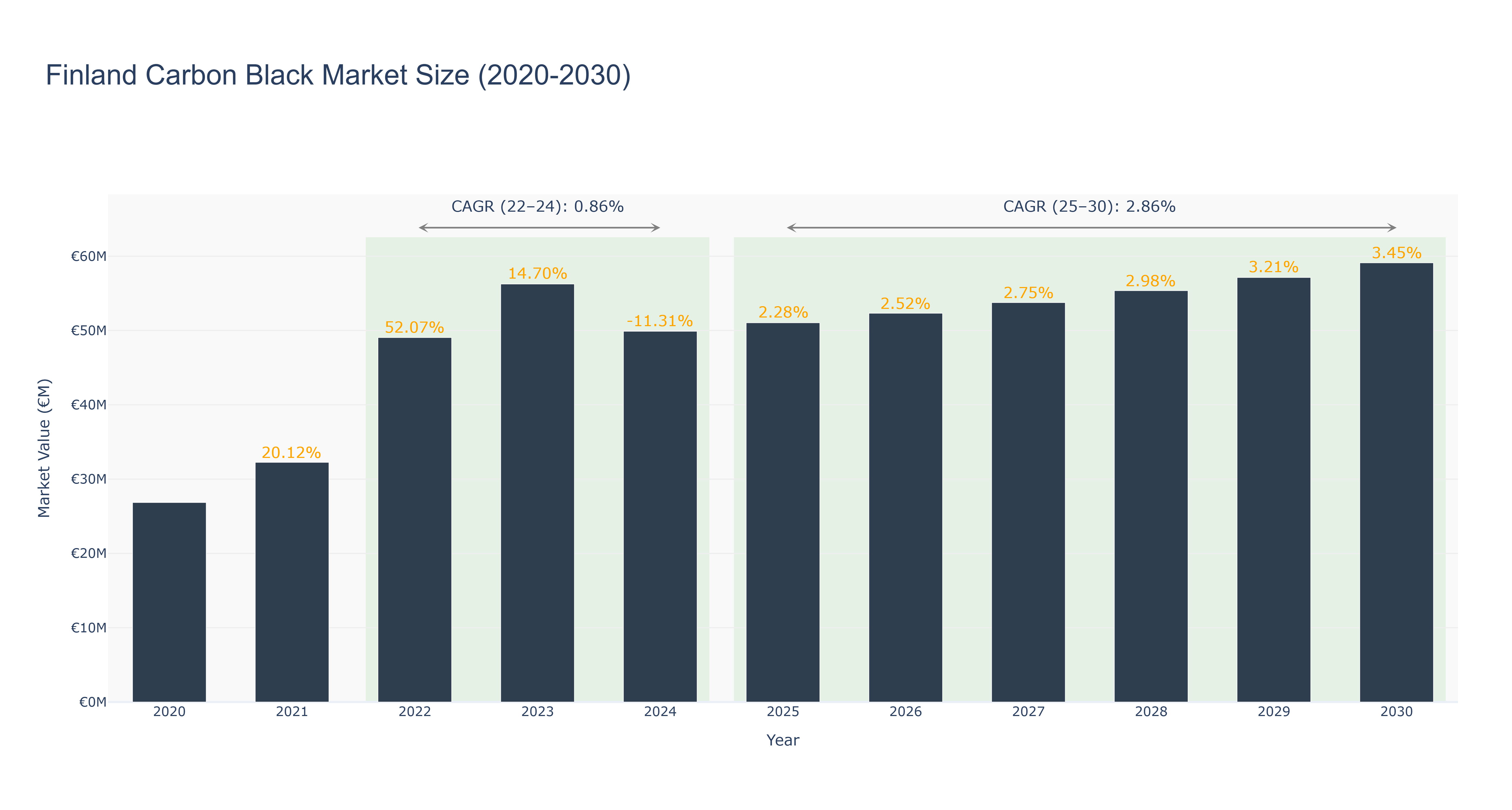
The Finland Carbon Black Market experienced steady growth from 2020 to 2024, with the peak market size of €56.26 million in 2023. However, a slight decline was observed in 2024 to €49.90 million, attributed to market adjustments and economic factors. Looking ahead, the market is forecasted to continue its upward trajectory, reaching €59.11 million by 2030, with a CAGR of 2.86% from 2025 to 2030. The CAGR for the period 2022-24 was 0.86%. Industry drivers such as increasing demand for sustainable products and technological advancements are expected to fuel this growth. Recent developments include collaborations with sustainable suppliers and investments in eco-friendly production processes. Future projects focus on enhancing product quality and expanding market reach through strategic partnerships.
Finland Carbon Black Market: Production & Trade Performance (2019-2025)
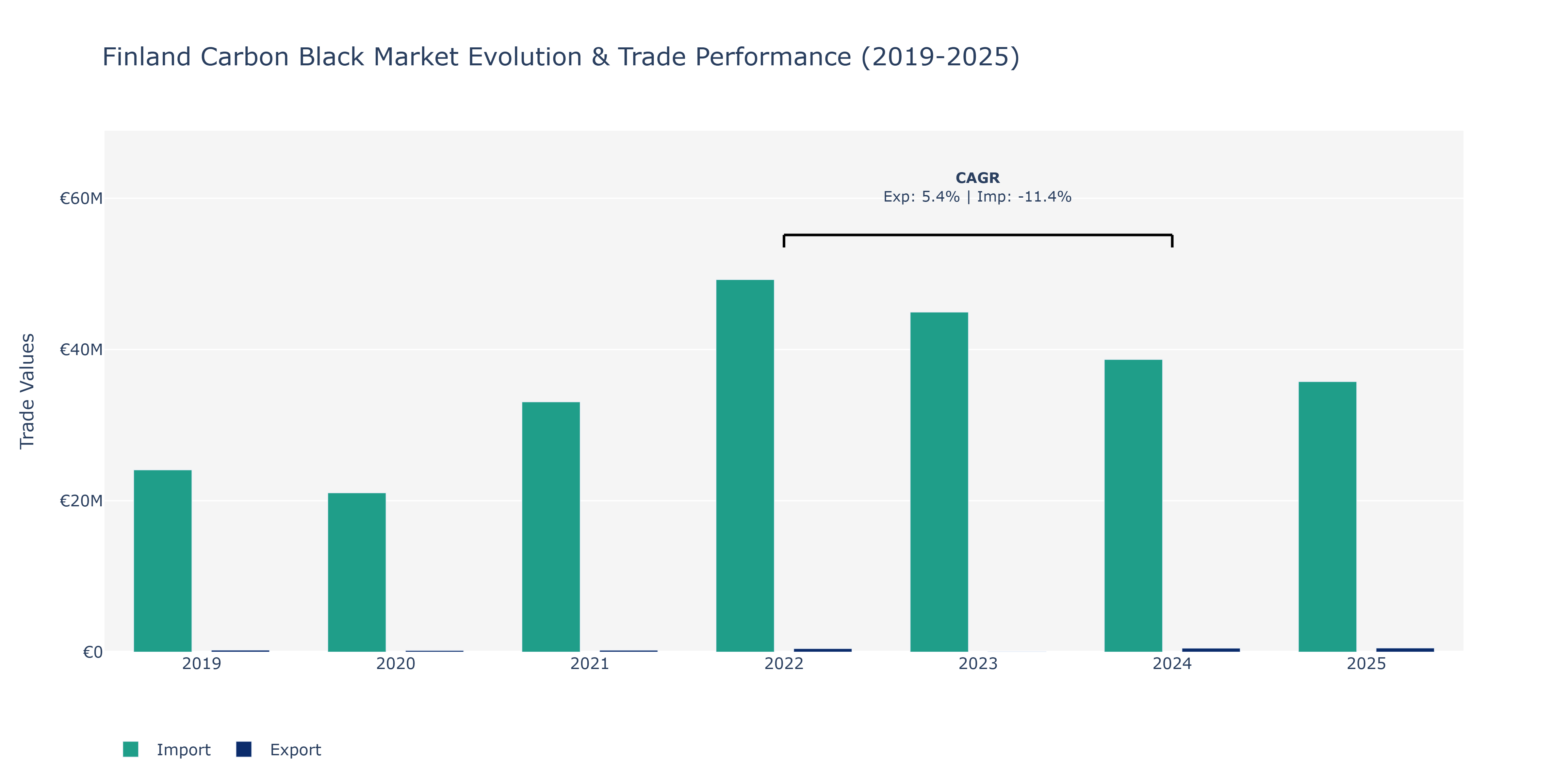
The Finland Carbon Black Market witnessed fluctuations in both exports and imports during the period under review. From 2019 to 2020, exports decreased from €247.53 thousand to €206.26 thousand while imports followed a similar downward trend from €24.08 million to €21.05 million. However, in 2021, both exports and imports rebounded significantly, with exports reaching €236.95 thousand and imports soaring to €33.08 million, showing a notable spike in demand for carbon black products. The following year, 2022, marked a substantial surge in exports to €453.99 thousand, likely driven by increased international demand for Finnish carbon black products. In contrast, imports peaked at €49.24 million, reflecting a substantial rise in foreign carbon black purchases. The subsequent years saw varied patterns, with exports declining to €59.27 thousand in 2023 and then recovering to €503.90 thousand in 2024, showcasing potential market volatility and shifting global demands for carbon black products. Concurrently, imports fluctuated, notably decreasing to €38.68 million in 2024 after the peak in the previous year, possibly influenced by factors such as changes in global trade dynamics, economic conditions, and shifting consumer preferences towards sustainable products. By 2025, exports slightly increased to €533.33 thousand, while imports decreased to €35.75 million, reflecting a stabilization in trade flows for carbon black in the Finnish market. The observed trends suggest a dynamic market influenced by both domestic and international factors, emphasizing the need for market players to stay agile and responsive to evolving industry dynamics and global market trends.
Key Highlights of the Report:
- Finland Carbon Black Market Outlook
- Market Size of Finland Carbon Black Market, 2025
- Forecast of Finland Carbon Black Market, 2032
- Historical Data and Forecast of Finland Carbon Black Revenues & Volume for the Period 2022 - 2032F
- Finland Carbon Black Market Trend Evolution
- Finland Carbon Black Market Drivers and Challenges
- Finland Carbon Black Price Trends
- Finland Carbon Black Porter`s Five Forces
- Finland Carbon Black Industry Life Cycle
- Historical Data and Forecast of Finland Carbon Black Market Revenues & Volume By Type for the Period 2022 - 2032F
- Historical Data and Forecast of Finland Carbon Black Market Revenues & Volume By Furnace Black for the Period 2022 - 2032F
- Historical Data and Forecast of Finland Carbon Black Market Revenues & Volume By Channel Black for the Period 2022 - 2032F
- Historical Data and Forecast of Finland Carbon Black Market Revenues & Volume By Thermal Black for the Period 2022 - 2032F
- Historical Data and Forecast of Finland Carbon Black Market Revenues & Volume By Acetylene Black for the Period 2022 - 2032F
- Historical Data and Forecast of Finland Carbon Black Market Revenues & Volume By Others for the Period 2022 - 2032F
- Historical Data and Forecast of Finland Carbon Black Market Revenues & Volume By Grade for the Period 2022 - 2032F
- Historical Data and Forecast of Finland Carbon Black Market Revenues & Volume By Standard for the Period 2022 - 2032F
- Historical Data and Forecast of Finland Carbon Black Market Revenues & Volume By Specialty for the Period 2022 - 2032F
- Historical Data and Forecast of Finland Carbon Black Market Revenues & Volume By Application for the Period 2022 - 2032F
- Historical Data and Forecast of Finland Carbon Black Market Revenues & Volume By Tires for the Period 2022 - 2032F
- Historical Data and Forecast of Finland Carbon Black Market Revenues & Volume By High-performance Coatings for the Period 2022 - 2032F
- Historical Data and Forecast of Finland Carbon Black Market Revenues & Volume By Plastics for the Period 2022 - 2032F
- Historical Data and Forecast of Finland Carbon Black Market Revenues & Volume By Others for the Period 2022 - 2032F
- Finland Carbon Black Import Export Trade Statistics
- Market Opportunity Assessment By Type
- Market Opportunity Assessment By Grade
- Market Opportunity Assessment By Application
- Finland Carbon Black Top Companies Market Share
- Finland Carbon Black Competitive Benchmarking By Technical and Operational Parameters
- Finland Carbon Black Company Profiles
- Finland Carbon Black Key Strategic Recommendations






































