Finland Compressor Oil Market Top 5 Importing Countries and Market Competition (HHI) Analysis
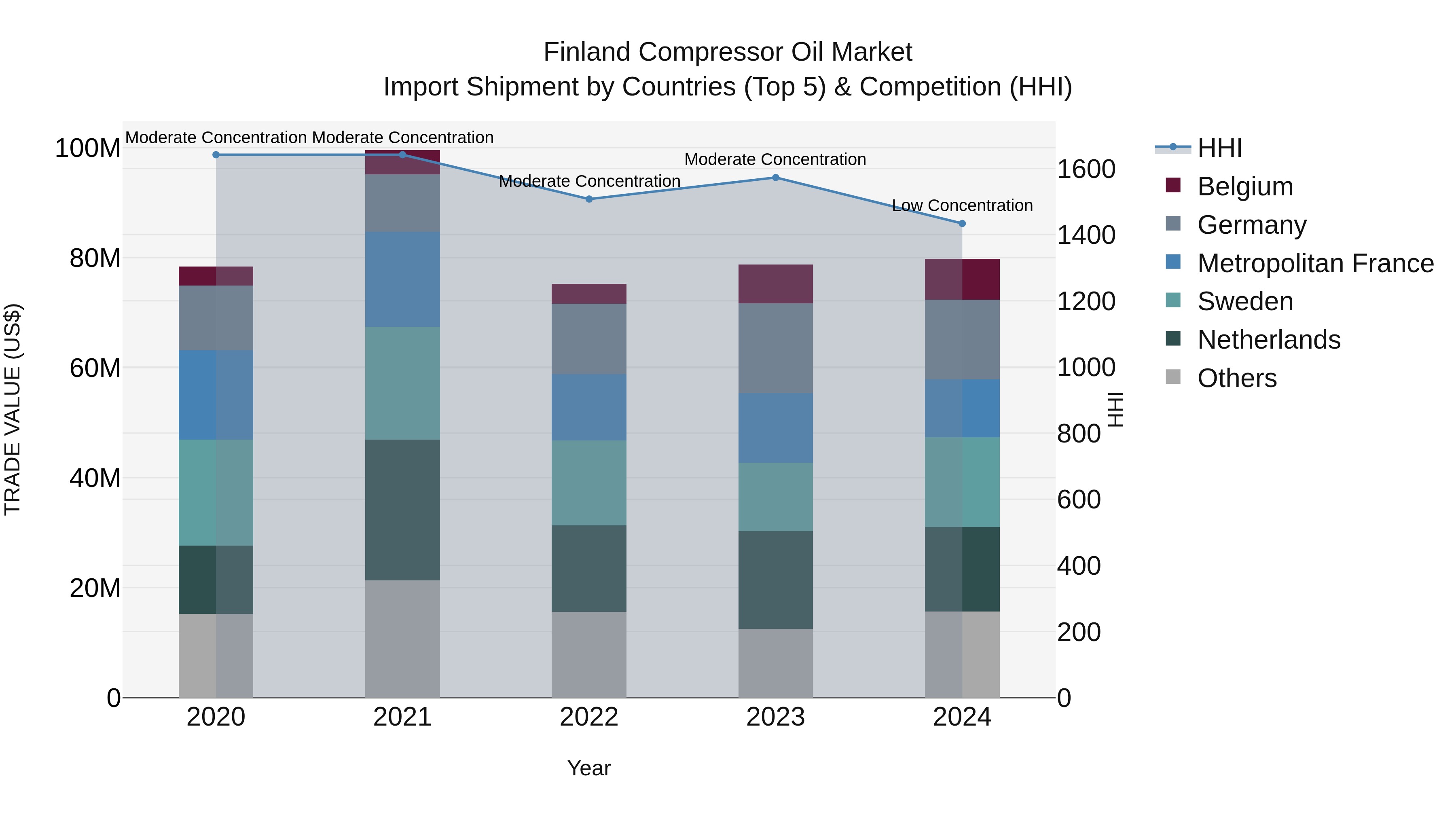
In 2024, Finland`s compressor oil import market saw a steady growth with a CAGR of 0.45 over the period 2020-2024. The top exporting countries to Finland included Sweden, Netherlands, Germany, Metropolitan France, and Belgium, reflecting a diverse import source base. The market concentration, as measured by the HHI, decreased from moderate to low in 2024, indicating a more competitive landscape. The growth rate from 2023 to 2024 stood at 1.36, suggesting a positive momentum in the import shipments of compressor oil to Finland.
Finland Compressor Oil Market Overview
The Compressor Oil Market in Finland is expanding due to the increasing need for lubricants that enhance the performance and lifespan of compressors. Compressor oils play a crucial role in maintaining compressor efficiency and preventing wear and tear. With industries such as manufacturing, automotive, and HVAC demanding high-quality oils to meet specific operational needs, the market for compressor oils in Finland is evolving to provide more specialized products with superior lubrication properties.
Drivers of the market
The Compressor Oil Market in Finland is growing as industries rely on high-quality lubricants to ensure the efficient operation and longevity of compressors. With increasing demand in sectors like manufacturing, construction, and HVAC, the need for specialized compressor oils that offer enhanced lubrication, reduced wear, and improved performance is rising.
Challenges of the market
The compressor oil market in Finland faces challenges from increasing demand for eco-friendly and sustainable oil products. Manufacturers must adapt to stricter environmental regulations while maintaining product performance. The high cost of producing synthetic and biodegradable oils, combined with market competition, makes it difficult for smaller players to thrive.
Government Policy of the market
The Finnish government encourages the compressor oil market by promoting the use of eco-friendly oils that reduce the environmental impact of compressor systems. Policies focus on improving energy efficiency and extending the lifespan of compressors through advanced lubrication technologies. The government supports innovation in sustainable and high-performance compressor oils for industrial applications.
Key Highlights of the Report:
- Finland Compressor Oil Market Outlook
- Market Size of Finland Compressor Oil Market, 2024
- Forecast of Finland Compressor Oil Market, 2031
- Historical Data and Forecast of Finland Compressor Oil Revenues & Volume for the Period 2021-2031
- Finland Compressor Oil Market Trend Evolution
- Finland Compressor Oil Market Drivers and Challenges
- Finland Compressor Oil Price Trends
- Finland Compressor Oil Porter`s Five Forces
- Finland Compressor Oil Industry Life Cycle
- Historical Data and Forecast of Finland Compressor Oil Market Revenues & Volume By Base oil for the Period 2021-2031
- Historical Data and Forecast of Finland Compressor Oil Market Revenues & Volume By Synthetic for the Period 2021-2031
- Historical Data and Forecast of Finland Compressor Oil Market Revenues & Volume By Mineral for the Period 2021-2031
- Historical Data and Forecast of Finland Compressor Oil Market Revenues & Volume By Semi-Synthetic for the Period 2021-2031
- Historical Data and Forecast of Finland Compressor Oil Market Revenues & Volume By Bio-based for the Period 2021-2031
- Historical Data and Forecast of Finland Compressor Oil Market Revenues & Volume By Compressor Type for the Period 2021-2031
- Historical Data and Forecast of Finland Compressor Oil Market Revenues & Volume By Dynamic for the Period 2021-2031
- Historical Data and Forecast of Finland Compressor Oil Market Revenues & Volume By Positive Displacement for the Period 2021-2031
- Historical Data and Forecast of Finland Compressor Oil Market Revenues & Volume By Application for the Period 2021-2031
- Historical Data and Forecast of Finland Compressor Oil Market Revenues & Volume By Gas for the Period 2021-2031
- Historical Data and Forecast of Finland Compressor Oil Market Revenues & Volume By Air for the Period 2021-2031
- Finland Compressor Oil Import Export Trade Statistics
- Market Opportunity Assessment By Base oil
- Market Opportunity Assessment By Compressor Type
- Market Opportunity Assessment By Application
- Finland Compressor Oil Top Companies Market Share
- Finland Compressor Oil Competitive Benchmarking By Technical and Operational Parameters
- Finland Compressor Oil Company Profiles
- Finland Compressor Oil Key Strategic Recommendations






































