Finland Concrete Vibrator Market Size (2020-2030)
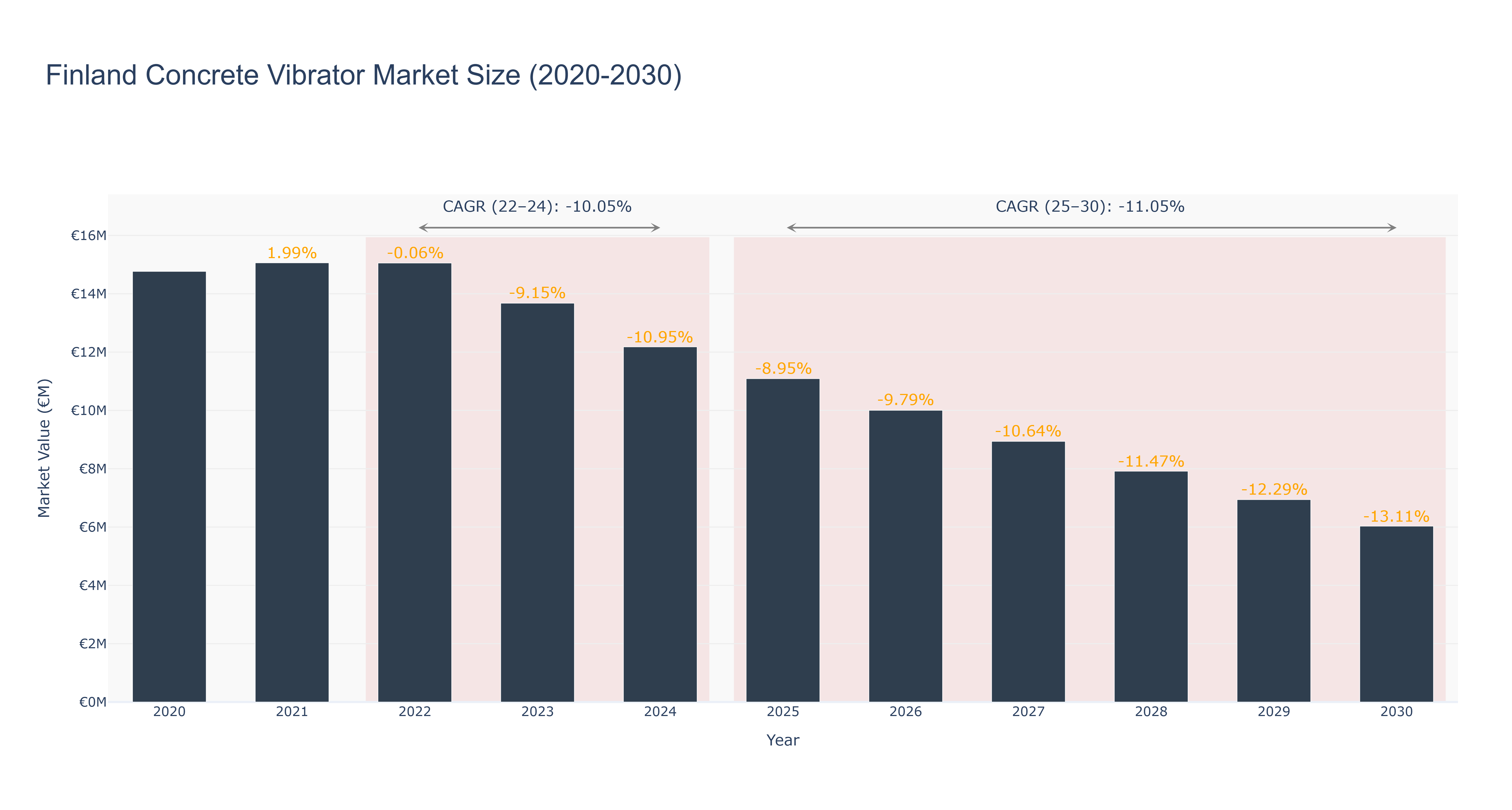
The Finland Concrete Vibrator Market experienced a peak market size of €15.06 million in 2021, followed by a downward trend. The actual market size decreased steadily from 2020 to 2024, reaching €12.18 million. The forecasted market size from 2025 to 2030 shows a continued decline with an estimated value of €6.03 million in 2030. The CAGR for the period 2022-24 is -10.05%, while for 2025-30, it stands at -11.05%. The market downturn can be attributed to factors such as economic slowdown, reduced construction activities, and technological advancements impacting demand. Looking ahead, Finland is set to introduce sustainable construction initiatives in response to environmental concerns, aiming to boost market growth and innovation in the coming years. Industry drivers include infrastructure development projects, urbanization trends, and government policies promoting construction sector growth. Future developments in the Finland Concrete Vibrator Market may involve increased focus on eco-friendly construction practices, digitalization in construction processes, and collaborations with global players for technology adoption and market expansion.
Finland Concrete Vibrator Market: Production & Trade Performance (2019-2025)
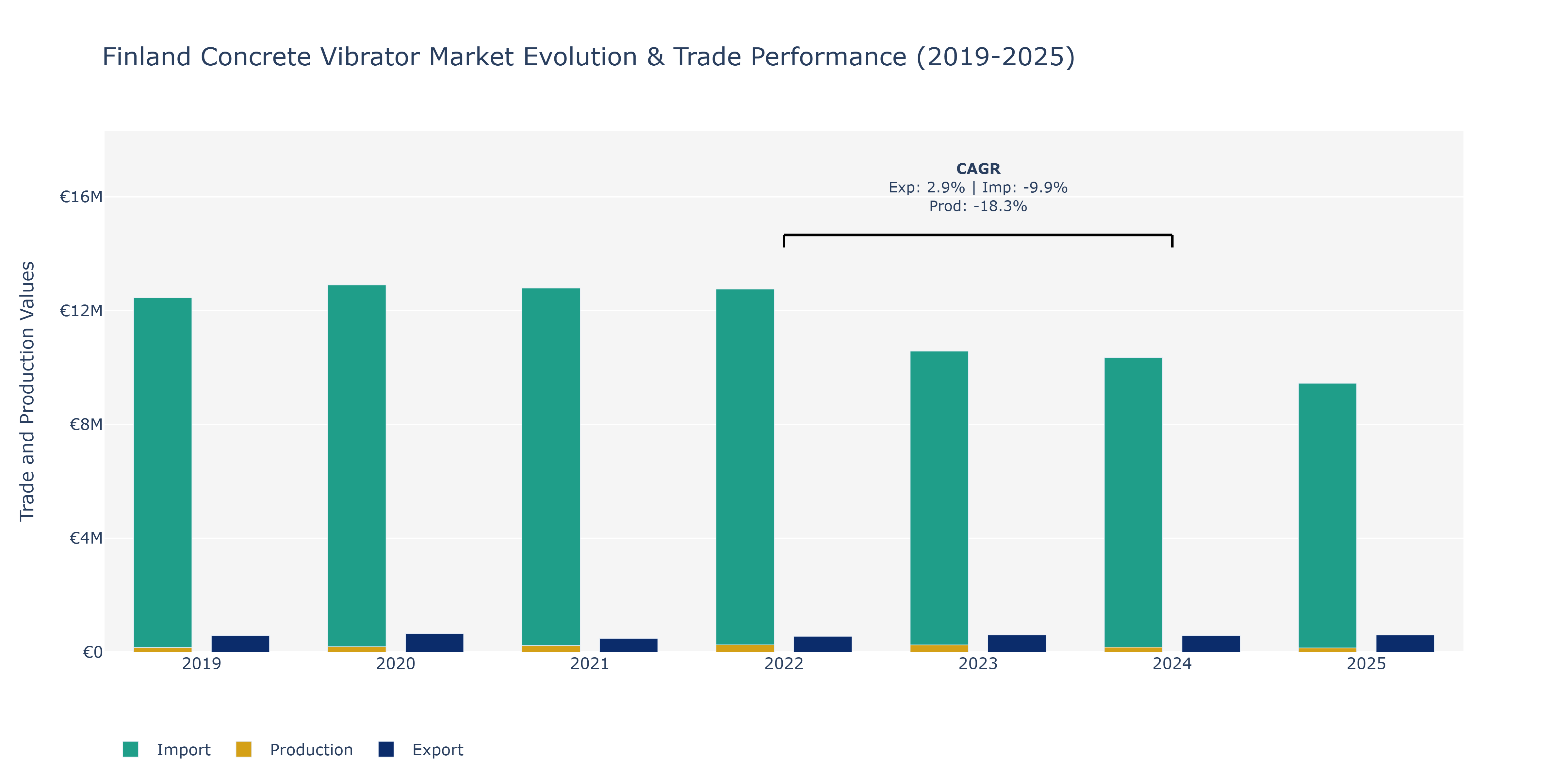
In the Finland Concrete Vibrator Market, exports demonstrated a fluctuating pattern over the years, starting at €586.49 thousand in 2019, peaking in 2020 at €646.12 thousand, and then experiencing a decline to €483.23 thousand in 2021 before gradually increasing again in subsequent years. Imports, on the other hand, consistently decreased from €12.45 million in 2019 to around €9.45 million in 2025. Production value followed a similar trend, reaching their highest value in 2022 at €253 million and then declining to €142.40 million in 2025. The fluctuations in exports can be attributed to changing demand from international markets and competitive pricing strategies. The decline in imports could be influenced by shifts in domestic production capabilities and changes in trade agreements impacting procurement decisions. The decrease in production might be due to technological advancements leading to higher efficiency in manufacturing processes. These trends signal the importance of market intelligence for strategic decision-making in the concrete vibrator industry in Finland.
Key Highlights of the Report:
- Finland Concrete Vibrator Market Outlook
- Market Size of Finland Concrete Vibrator Market, 2024
- Forecast of Finland Concrete Vibrator Market, 2031
- Historical Data and Forecast of Finland Concrete Vibrator Revenues & Volume for the Period 2021-2031
- Finland Concrete Vibrator Market Trend Evolution
- Finland Concrete Vibrator Market Drivers and Challenges
- Finland Concrete Vibrator Price Trends
- Finland Concrete Vibrator Porter`s Five Forces
- Finland Concrete Vibrator Industry Life Cycle
- Historical Data and Forecast of Finland Concrete Vibrator Market Revenues & Volume By Type for the Period 2021-2031
- Historical Data and Forecast of Finland Concrete Vibrator Market Revenues & Volume By External Vibrator for the Period 2021-2031
- Historical Data and Forecast of Finland Concrete Vibrator Market Revenues & Volume By Internal Vibrator for the Period 2021-2031
- Historical Data and Forecast of Finland Concrete Vibrator Market Revenues & Volume By Others for the Period 2021-2031
- Historical Data and Forecast of Finland Concrete Vibrator Market Revenues & Volume By Application for the Period 2021-2031
- Historical Data and Forecast of Finland Concrete Vibrator Market Revenues & Volume By Architectural Engineering for the Period 2021-2031
- Historical Data and Forecast of Finland Concrete Vibrator Market Revenues & Volume By Dam Engineering for the Period 2021-2031
- Historical Data and Forecast of Finland Concrete Vibrator Market Revenues & Volume By Mine and Well Engineering for the Period 2021-2031
- Historical Data and Forecast of Finland Concrete Vibrator Market Revenues & Volume By Others for the Period 2021-2031
- Finland Concrete Vibrator Import Export Trade Statistics
- Market Opportunity Assessment By Type
- Market Opportunity Assessment By Application
- Finland Concrete Vibrator Top Companies Market Share
- Finland Concrete Vibrator Competitive Benchmarking By Technical and Operational Parameters
- Finland Concrete Vibrator Company Profiles
- Finland Concrete Vibrator Key Strategic Recommendations






































