Finland Electric Locomotives Market Size (2020-2030)
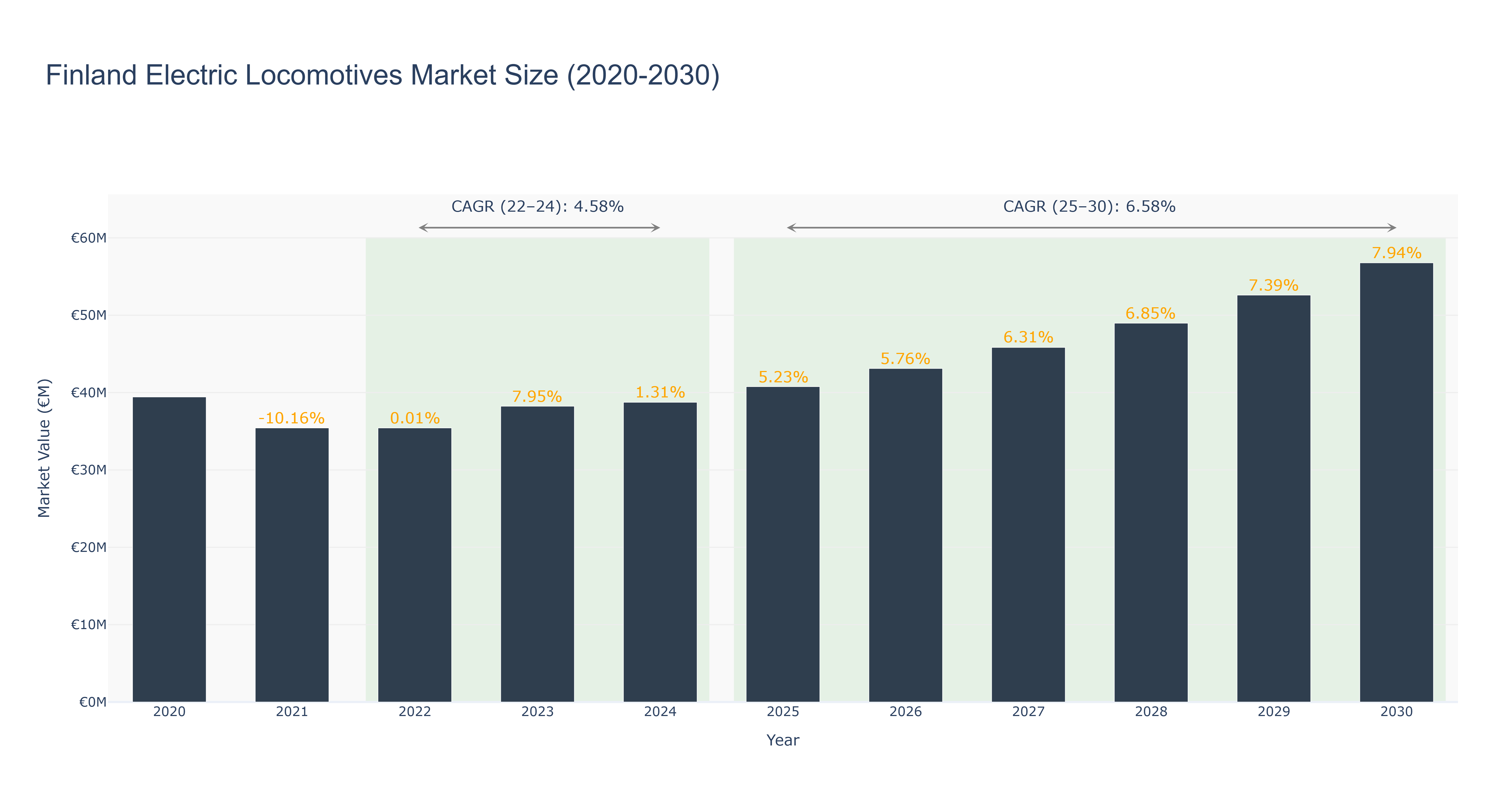
Finland Electric Locomotives Market has shown a steady growth trajectory over the past decade. The peak market size of €56.77 million was reached in 2030, with consistent annual growth rates. From 2020 to 2024, the market size ranged from €39.43 million to €38.74 million, exhibiting slight fluctuations. Noteworthy growth is forecasted from 2025 to 2030, with an expected CAGR of 6.58%. The CAGR from 2022 to 2024 was 4.58%. The market's growth can be attributed to increased government investments in sustainable transportation infrastructure and the rising demand for eco-friendly locomotives. Looking ahead, Finland is set to launch a national initiative to further expand its electric locomotive fleet, aiming to reduce carbon emissions significantly by 2035. This initiative aligns with the country's commitment to environmental sustainability and will likely drive further growth in the electric locomotives market.
Finland Electric Locomotives Market: Production & Trade Performance (2019-2025)
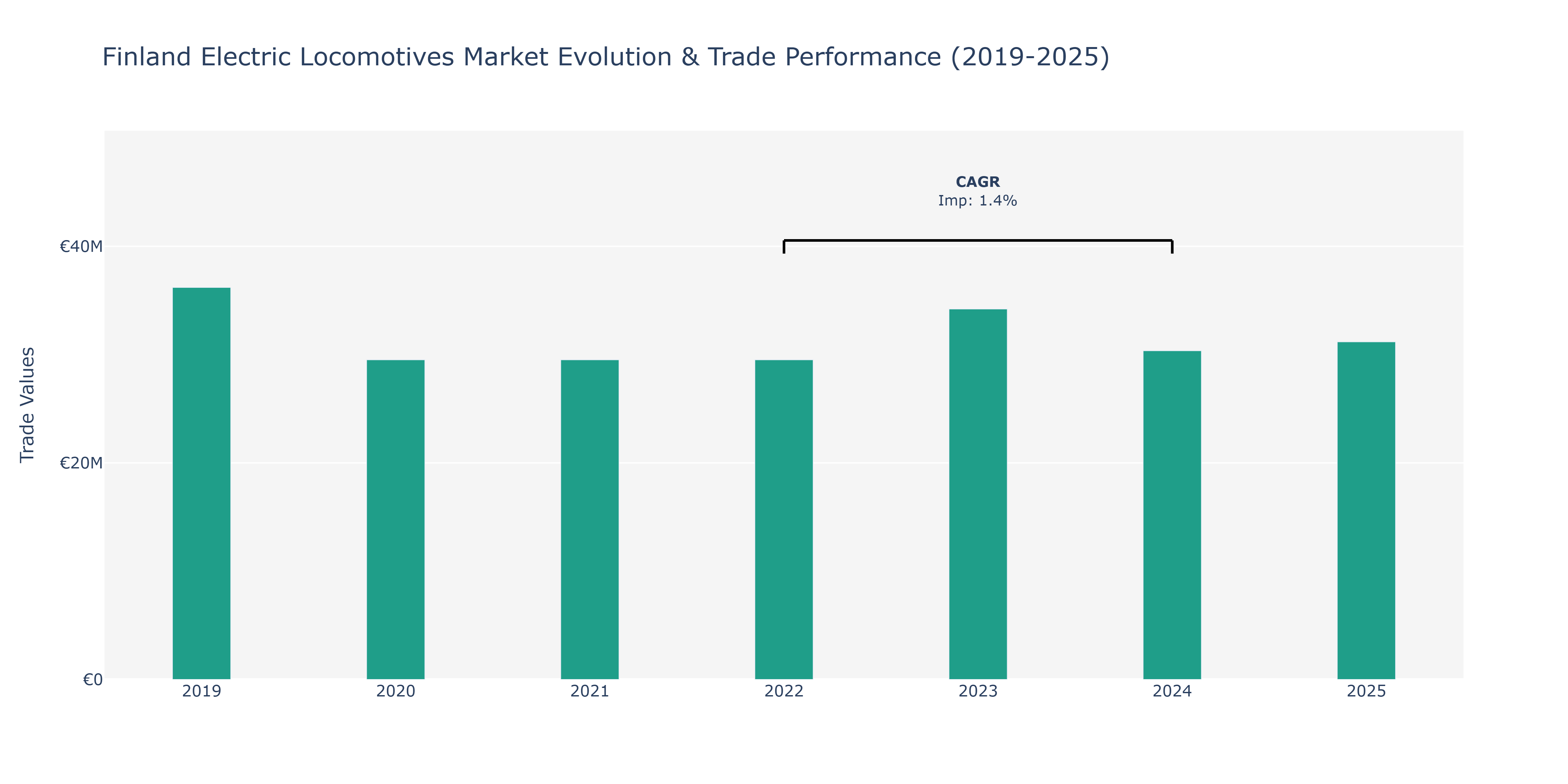
In the Finland Electric Locomotives Market, imports exhibited varying trends over the years. In 2019, imports stood at €36.2 million, showing a decline to €29.52 million in 2020 and maintaining the same level in 2021. A slight increase was observed in 2022, reaching €29.52 million and slightly higher at €34.21 million in 2023. However, a decrease was noted in 2024 with imports amounting to €30.35 million before a modest recovery to €31.18 million in 2025. The fluctuations in imports can be attributed to factors such as changes in demand for electric locomotives, market competition, and economic conditions impacting trade. The slight increase in 2022 may signify a renewed interest in electric transportation, while the subsequent decline in 2024 could be influenced by supply chain disruptions or regulatory changes affecting imports of electric locomotives.
Key Highlights of the Report:
- Finland Electric Locomotives Market Outlook
- Market Size of Finland Electric Locomotives Market, 2024
- Forecast of Finland Electric Locomotives Market, 2031
- Historical Data and Forecast of Finland Electric Locomotives Revenues & Volume for the Period 2021-2031
- Finland Electric Locomotives Market Trend Evolution
- Finland Electric Locomotives Market Drivers and Challenges
- Finland Electric Locomotives Price Trends
- Finland Electric Locomotives Porter`s Five Forces
- Finland Electric Locomotives Industry Life Cycle
- Historical Data and Forecast of Finland Electric Locomotives Market Revenues & Volume By Energy Transfer for the Period 2021-2031
- Historical Data and Forecast of Finland Electric Locomotives Market Revenues & Volume By Overhead Lines for the Period 2021-2031
- Historical Data and Forecast of Finland Electric Locomotives Market Revenues & Volume By Third Rail for the Period 2021-2031
- Historical Data and Forecast of Finland Electric Locomotives Market Revenues & Volume By On-board Energy Storage for the Period 2021-2031
- Historical Data and Forecast of Finland Electric Locomotives Market Revenues & Volume By Technology for the Period 2021-2031
- Historical Data and Forecast of Finland Electric Locomotives Market Revenues & Volume By IGBT Module for the Period 2021-2031
- Historical Data and Forecast of Finland Electric Locomotives Market Revenues & Volume By GTO Thyristor for the Period 2021-2031
- Historical Data and Forecast of Finland Electric Locomotives Market Revenues & Volume By SiC Module for the Period 2021-2031
- Historical Data and Forecast of Finland Electric Locomotives Market Revenues & Volume By Traction Units for the Period 2021-2031
- Historical Data and Forecast of Finland Electric Locomotives Market Revenues & Volume By AC Traction Units for the Period 2021-2031
- Historical Data and Forecast of Finland Electric Locomotives Market Revenues & Volume By DC Traction Units for the Period 2021-2031
- Historical Data and Forecast of Finland Electric Locomotives Market Revenues & Volume By Multi System Units for the Period 2021-2031
- Historical Data and Forecast of Finland Electric Locomotives Market Revenues & Volume By Application for the Period 2021-2031
- Historical Data and Forecast of Finland Electric Locomotives Market Revenues & Volume By Passenger Transport for the Period 2021-2031
- Historical Data and Forecast of Finland Electric Locomotives Market Revenues & Volume By Freight Transport for the Period 2021-2031
- Finland Electric Locomotives Import Export Trade Statistics
- Market Opportunity Assessment By Energy Transfer
- Market Opportunity Assessment By Technology
- Market Opportunity Assessment By Traction Units
- Market Opportunity Assessment By Application
- Finland Electric Locomotives Top Companies Market Share
- Finland Electric Locomotives Competitive Benchmarking By Technical and Operational Parameters
- Finland Electric Locomotives Company Profiles
- Finland Electric Locomotives Key Strategic Recommendations






































