Finland Flexible Epoxy Resin Market Top 5 Importing Countries and Market Competition (HHI) Analysis
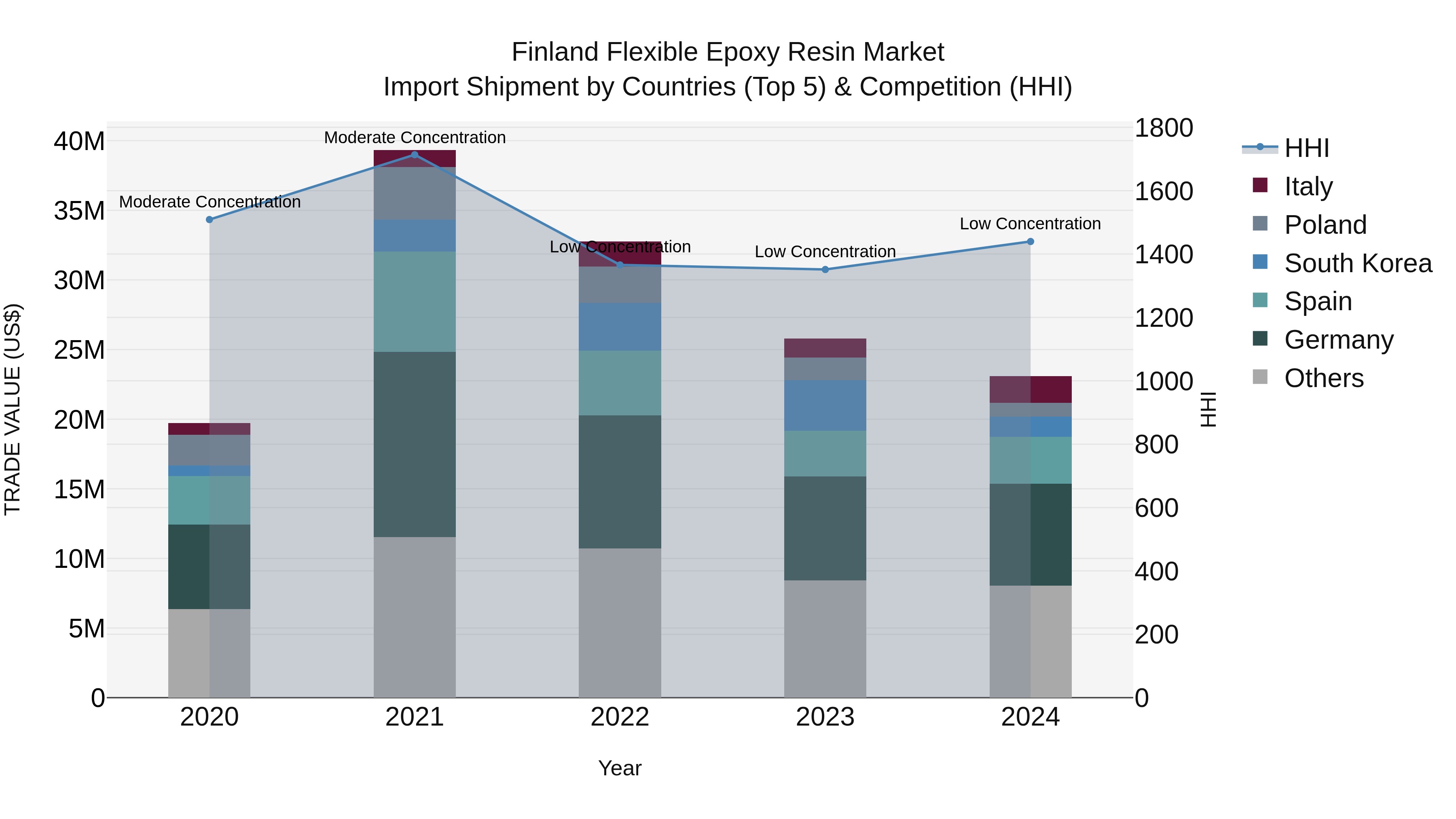
Finland`s import of flexible epoxy resin saw steady growth with a CAGR of 4.04% from 2020 to 2024. However, a slight decline of -10.41% was observed in the growth rate from 2023 to 2024. Top exporting countries like Germany, Spain, Italy, South Korea, and Poland played key roles in supplying flexible epoxy resin to Finland. Despite this, the market remained relatively unconcentrated as indicated by the low Herfindahl-Hirschman Index (HHI) in 2024, showcasing a diverse and competitive import landscape for flexible epoxy resin in Finland.
Finland Flexible Epoxy Resin Market Overview
The flexible epoxy resin market in Finland is growing in response to the need for high-performance, durable materials in industries such as automotive, electronics, and construction. Flexible epoxy resins offer superior adhesive properties, thermal stability, and resistance to chemicals, making them ideal for a wide range of applications. As demand for advanced, flexible materials increases, especially in manufacturing and product development, the market for flexible epoxy resins is expected to continue its upward trajectory.
Drivers of the market
The demand for durable and flexible materials in industries such as electronics, automotive, and construction is driving the flexible epoxy resin market in Finland. The increasing use of these resins for coatings, adhesives, and composites is fueling market expansion.
Challenges of the market
The flexible epoxy resin market in Finland faces challenges related to the growing demand for lightweight, high-strength materials in industries like automotive and construction. Manufacturers must constantly innovate to improve resin flexibility while maintaining the necessary durability and performance. Additionally, there is an ongoing need to address environmental concerns related to the chemical composition of resins.
Government Policy of the market
Finland promotes the use of flexible epoxy resins in industrial and construction applications through policies encouraging innovation in advanced materials. Environmental regulations push manufacturers to adopt eco-friendly production methods and recyclable materials.
Key Highlights of the Report:
- Finland Flexible Epoxy Resin Market Outlook
- Market Size of Finland Flexible Epoxy Resin Market, 2024
- Forecast of Finland Flexible Epoxy Resin Market, 2031
- Historical Data and Forecast of Finland Flexible Epoxy Resin Revenues & Volume for the Period 2021-2031
- Finland Flexible Epoxy Resin Market Trend Evolution
- Finland Flexible Epoxy Resin Market Drivers and Challenges
- Finland Flexible Epoxy Resin Price Trends
- Finland Flexible Epoxy Resin Porter`s Five Forces
- Finland Flexible Epoxy Resin Industry Life Cycle
- Historical Data and Forecast of Finland Flexible Epoxy Resin Market Revenues & Volume By Type for the Period 2021-2031
- Historical Data and Forecast of Finland Flexible Epoxy Resin Market Revenues & Volume By Urethane Modified for the Period 2021-2031
- Historical Data and Forecast of Finland Flexible Epoxy Resin Market Revenues & Volume By Rubber Modified for the Period 2021-2031
- Historical Data and Forecast of Finland Flexible Epoxy Resin Market Revenues & Volume By Dimer Acid for the Period 2021-2031
- Historical Data and Forecast of Finland Flexible Epoxy Resin Market Revenues & Volume By Application for the Period 2021-2031
- Historical Data and Forecast of Finland Flexible Epoxy Resin Market Revenues & Volume By Paints & Coatings for the Period 2021-2031
- Historical Data and Forecast of Finland Flexible Epoxy Resin Market Revenues & Volume By Composites for the Period 2021-2031
- Historical Data and Forecast of Finland Flexible Epoxy Resin Market Revenues & Volume By Adhesives for the Period 2021-2031
- Finland Flexible Epoxy Resin Import Export Trade Statistics
- Market Opportunity Assessment By Type
- Market Opportunity Assessment By Application
- Finland Flexible Epoxy Resin Top Companies Market Share
- Finland Flexible Epoxy Resin Competitive Benchmarking By Technical and Operational Parameters
- Finland Flexible Epoxy Resin Company Profiles
- Finland Flexible Epoxy Resin Key Strategic Recommendations






































