Finland Formaldehyde Market Size (2020-2030)
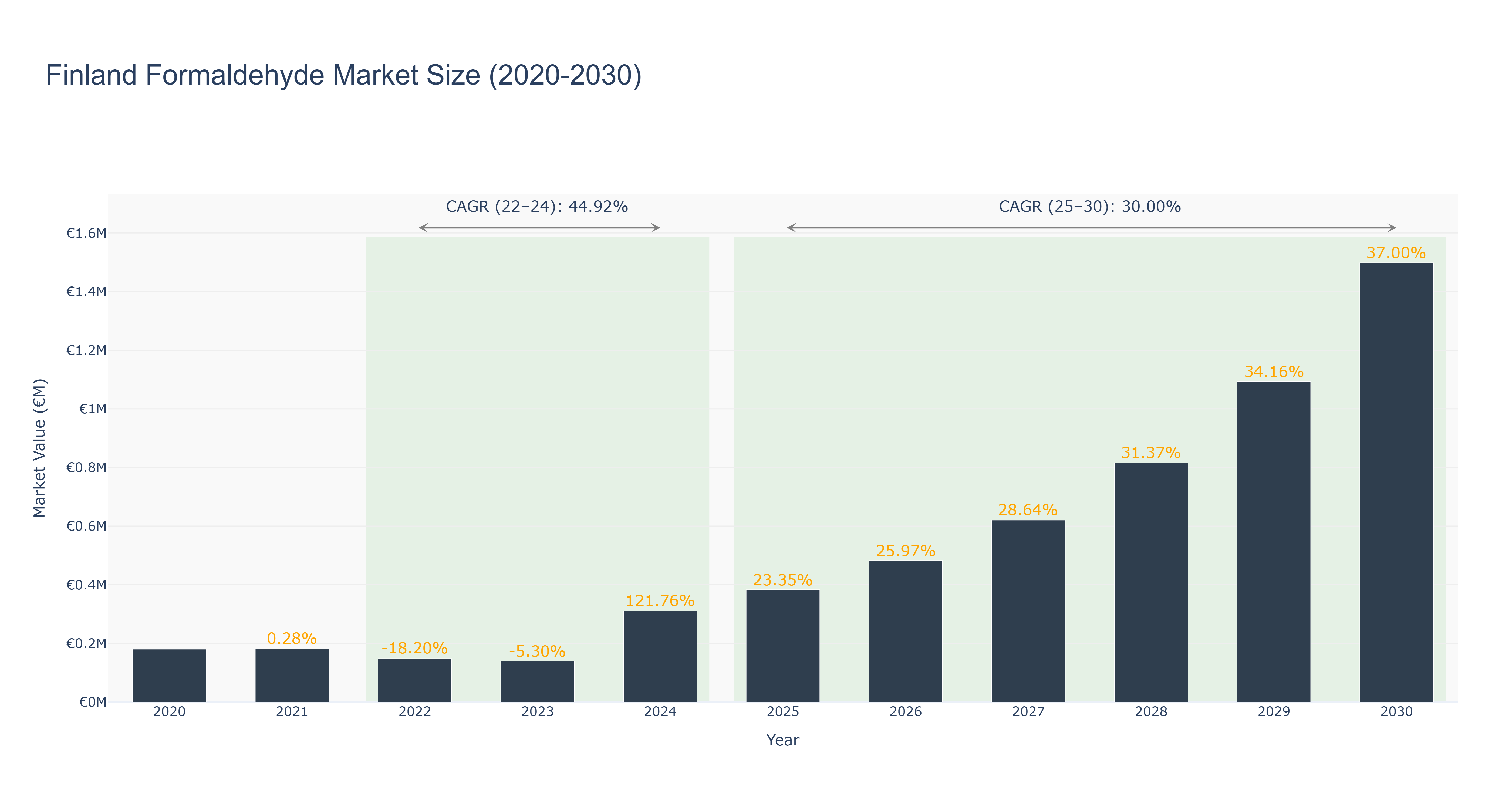
Finland Formaldehyde Market has shown a fluctuating trend in recent years. The market size peaked at €1.50 million in 2030, with a notable growth rate of 37.00% from 2029. The actual market size experienced a significant surge from €0.15 million in 2022 to €0.31 million in 2024, driven by a CAGR of 44.92%. However, a decline followed with a market size of €0.14 million in 2023 due to various economic factors. Looking ahead, the market is forecasted to continue its growth trajectory, with a CAGR of 30.0% from 2025 to 2030. The growth can be attributed to increasing demand for formaldehyde in various industries such as construction and automotive. Recent developments in Finland's formaldehyde market include investments in sustainable production methods to meet environmental regulations, ensuring a positive outlook for the industry.
Finland Formaldehyde Market: Production & Trade Performance (2019-2025)
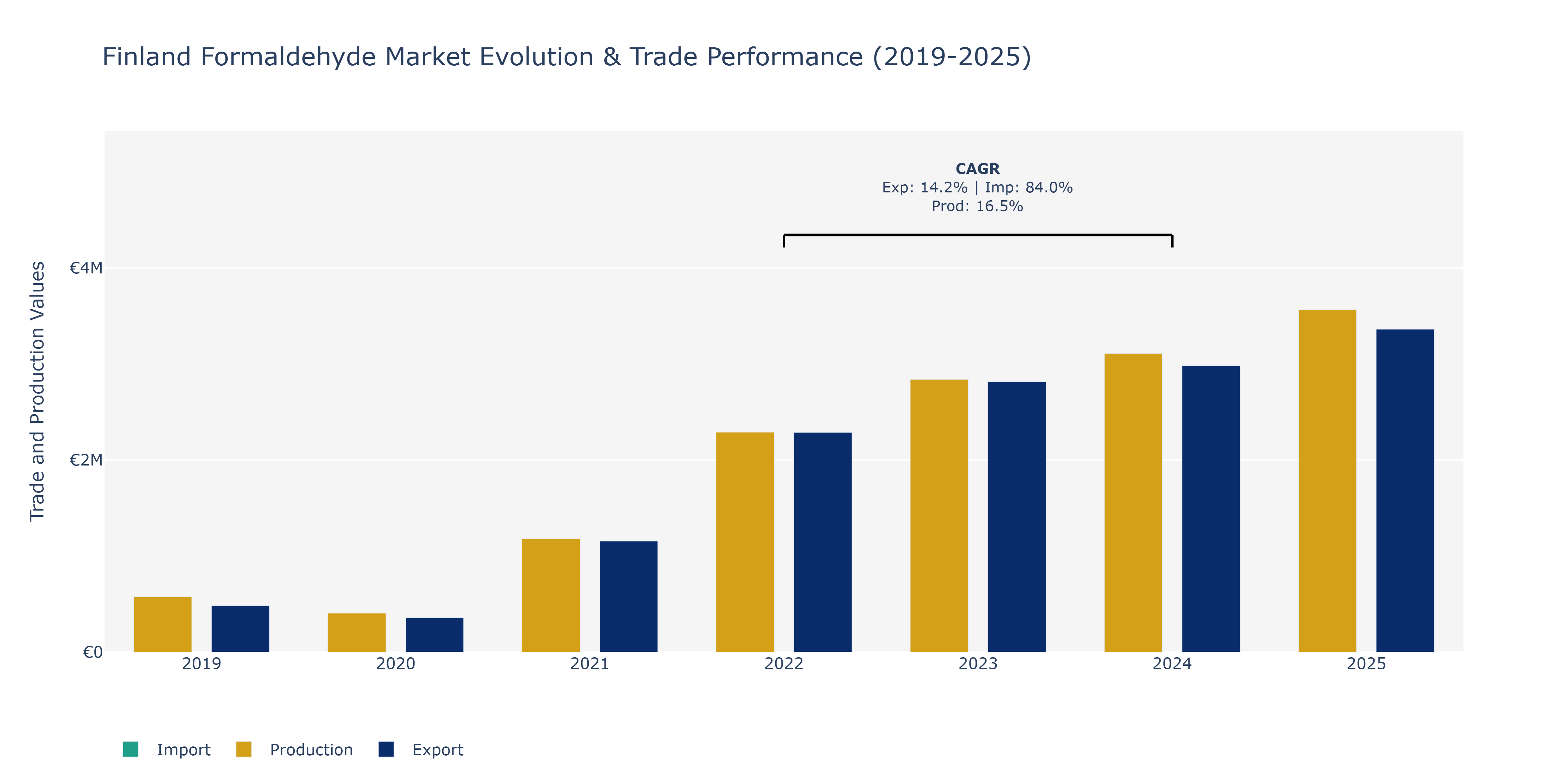
In the Finland Formaldehyde Market, from 2019 to 2025, exports experienced fluctuations. In 2019, exports stood at €483.44 thousand, notably dropping to €356.98 thousand in 2020 before a substantial surge to €1.16 million in 2021. The trend continued with an increase to €2.29 million in 2022 and €2.82 million in 2023, reaching €2.98 million in 2024, and peaking at €3.36 million in 2025. In contrast, imports fluctuated differently, with a peak in 2025 at €314.85 thousand. Production showed steady growth, increasing from €574.97 thousand in 2019 to €3.56 million in 2025. The rise in exports can be attributed to increased global demand, especially from industries like plastics and textiles. The surge in imports in 2025 may indicate growing domestic consumption or a shift in sourcing strategies. The consistent production growth aligns with the expanding application areas for formaldehyde in various sectors like automotive and construction, reflecting industry expansion efforts and technological advancements.
Finland Formaldehyde Market Overview
The formaldehyde market in Finland is driven by its significant applications in the production of resins, plastics, and chemicals. It is primarily used in industries such as construction, automotive, and furniture, where it is a key component of adhesive resins and composite materials. Additionally, formaldehyde`s role in disinfectants and preservatives supports its demand in various sectors. However, due to growing environmental concerns, the market is seeing a shift towards more eco-friendly alternatives, though the demand for formaldehyde-based products continues to be significant.
Drivers of the market
The formaldehyde market in Finland is driven by its widespread use in the production of resins and as a preservative in various industrial processes. With growing demand in construction, automotive, and healthcare industries, formaldehyde-based products such as plywood, MDF, and automotive parts continue to see substantial use. Additionally, formaldehyde is crucial in the production of disinfectants and embalming agents, contributing to market growth in sectors requiring long-lasting and durable materials.
Challenges of the market
The formaldehyde market in Finland is facing increasing regulatory pressure due to the harmful environmental and health effects of formaldehyde exposure. Stricter regulations on its use in industries such as construction, furniture manufacturing, and textiles are driving manufacturers to seek alternative, safer chemicals. The high cost of transitioning to these alternatives and the need for continuous innovation to meet regulatory standards add complexity to the market.
Government Policy of the market
Stringent environmental regulations govern the production and use of formaldehyde in Finland. The government supports research into low-emission formaldehyde applications and alternative materials, aligning with Finlands commitment to reducing industrial pollution and ensuring workplace safety.
Key Highlights of the Report:
- Finland Formaldehyde Market Outlook
- Market Size of Finland Formaldehyde Market, 2024
- Forecast of Finland Formaldehyde Market, 2031
- Historical Data and Forecast of Finland Formaldehyde Revenues & Volume for the Period 2021-2031
- Finland Formaldehyde Market Trend Evolution
- Finland Formaldehyde Market Drivers and Challenges
- Finland Formaldehyde Price Trends
- Finland Formaldehyde Porter`s Five Forces
- Finland Formaldehyde Industry Life Cycle
- Historical Data and Forecast of Finland Formaldehyde Market Revenues & Volume By Application for the Period 2021-2031
- Historical Data and Forecast of Finland Formaldehyde Market Revenues & Volume By Resins for the Period 2021-2031
- Historical Data and Forecast of Finland Formaldehyde Market Revenues & Volume By Fibers for the Period 2021-2031
- Historical Data and Forecast of Finland Formaldehyde Market Revenues & Volume By Solvents for the Period 2021-2031
- Historical Data and Forecast of Finland Formaldehyde Market Revenues & Volume By Plasticizers for the Period 2021-2031
- Historical Data and Forecast of Finland Formaldehyde Market Revenues & Volume By Drying Agents for the Period 2021-2031
- Historical Data and Forecast of Finland Formaldehyde Market Revenues & Volume By Other Chemical Intermediates for the Period 2021-2031
- Historical Data and Forecast of Finland Formaldehyde Market Revenues & Volume By Derivative for the Period 2021-2031
- Historical Data and Forecast of Finland Formaldehyde Market Revenues & Volume By Urea-formaldehyde Resin for the Period 2021-2031
- Historical Data and Forecast of Finland Formaldehyde Market Revenues & Volume By Phenol Formaldehyde Resin for the Period 2021-2031
- Historical Data and Forecast of Finland Formaldehyde Market Revenues & Volume By Polyoxymethylene for the Period 2021-2031
- Historical Data and Forecast of Finland Formaldehyde Market Revenues & Volume By Melamine Formaldehyde Resin for the Period 2021-2031
- Historical Data and Forecast of Finland Formaldehyde Market Revenues & Volume By Pentaerythritol for the Period 2021-2031
- Historical Data and Forecast of Finland Formaldehyde Market Revenues & Volume By Methylene Diphenyl Diisocyanate for the Period 2021-2031
- Historical Data and Forecast of Finland Formaldehyde Market Revenues & Volume By Hexamethylenetetramine for the Period 2021-2031
- Historical Data and Forecast of Finland Formaldehyde Market Revenues & Volume By Others for the Period 2021-2031
- Historical Data and Forecast of Finland Formaldehyde Market Revenues & Volume By End-Use for the Period 2021-2031
- Historical Data and Forecast of Finland Formaldehyde Market Revenues & Volume By Chemicals for the Period 2021-2031
- Historical Data and Forecast of Finland Formaldehyde Market Revenues & Volume By Agriculture for the Period 2021-2031
- Historical Data and Forecast of Finland Formaldehyde Market Revenues & Volume By Building & Construction for the Period 2021-2031
- Historical Data and Forecast of Finland Formaldehyde Market Revenues & Volume By Personal Care & Cosmetics for the Period 2021-2031
- Historical Data and Forecast of Finland Formaldehyde Market Revenues & Volume By Healthcare for the Period 2021-2031
- Historical Data and Forecast of Finland Formaldehyde Market Revenues & Volume By Automotive for the Period 2021-2031
- Historical Data and Forecast of Finland Formaldehyde Market Revenues & Volume By Others for the Period 2021-2031
- Finland Formaldehyde Import Export Trade Statistics
- Market Opportunity Assessment By Application
- Market Opportunity Assessment By Derivative
- Market Opportunity Assessment By End-Use
- Finland Formaldehyde Top Companies Market Share
- Finland Formaldehyde Competitive Benchmarking By Technical and Operational Parameters
- Finland Formaldehyde Company Profiles
- Finland Formaldehyde Key Strategic Recommendations






































