Finland Gaming Console Market Size (2020-2030)
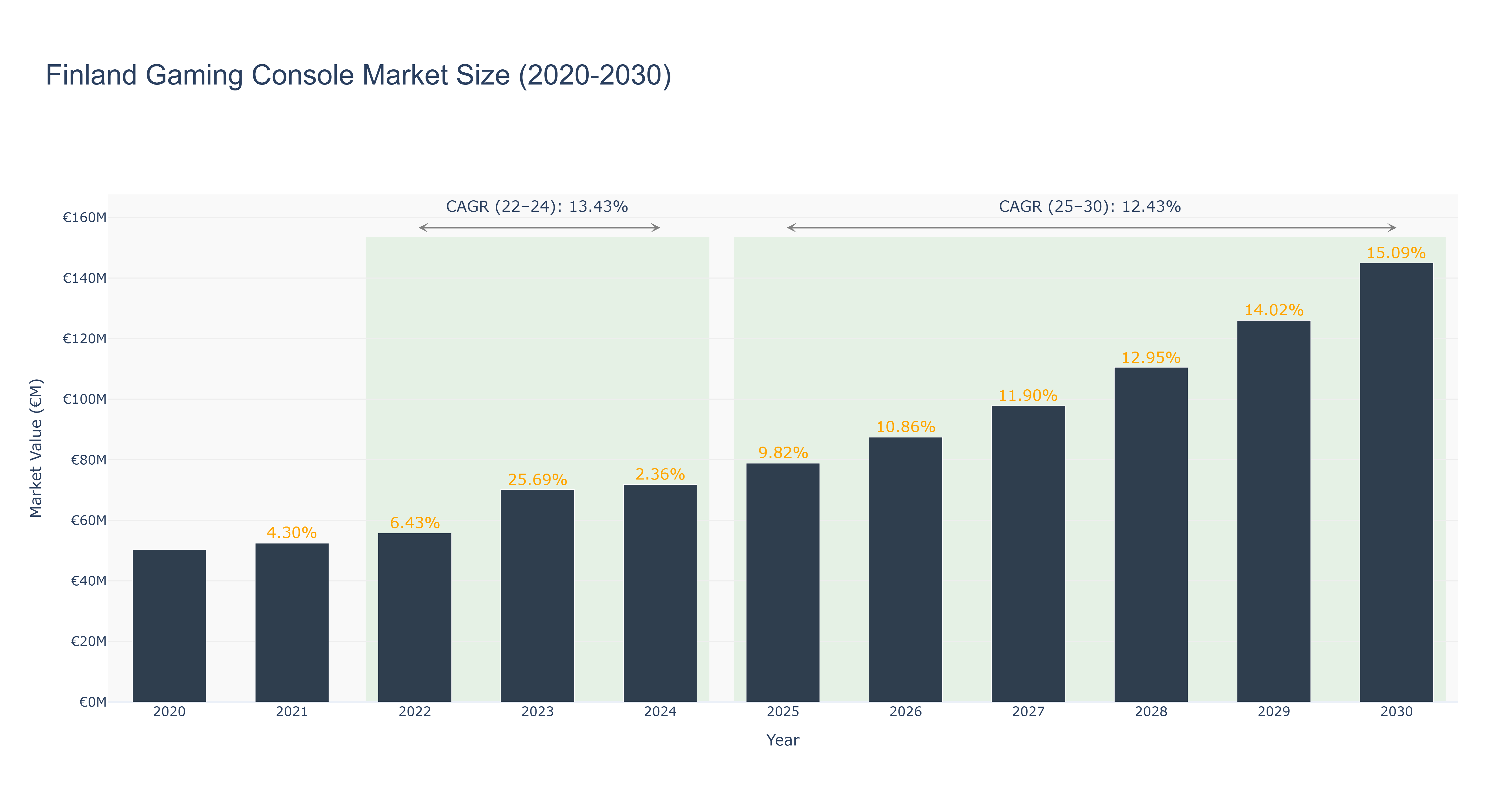
The Finland Gaming Console Market has shown a promising growth trajectory. The market experienced steady growth from €50.28 million in 2020 to €71.82 million in 2024, driven by the increasing demand for gaming consoles and related accessories. The peak market size was €145.02 million in 2030, reflecting a robust expansion over the forecasted period. The CAGR for the market from 2022 to 2024 was 13.43%, while for the period 2025 to 2030, it is projected at 12.43%. The market's growth can be attributed to technological advancements in gaming consoles, a growing gaming community, and the rise of esports in Finland. Looking ahead, recent developments indicate collaborations between local game developers and international gaming companies to launch innovative gaming products tailored to the Finnish market, fostering further market growth.
Finland Gaming Console Market: Production & Trade Performance (2019-2025)
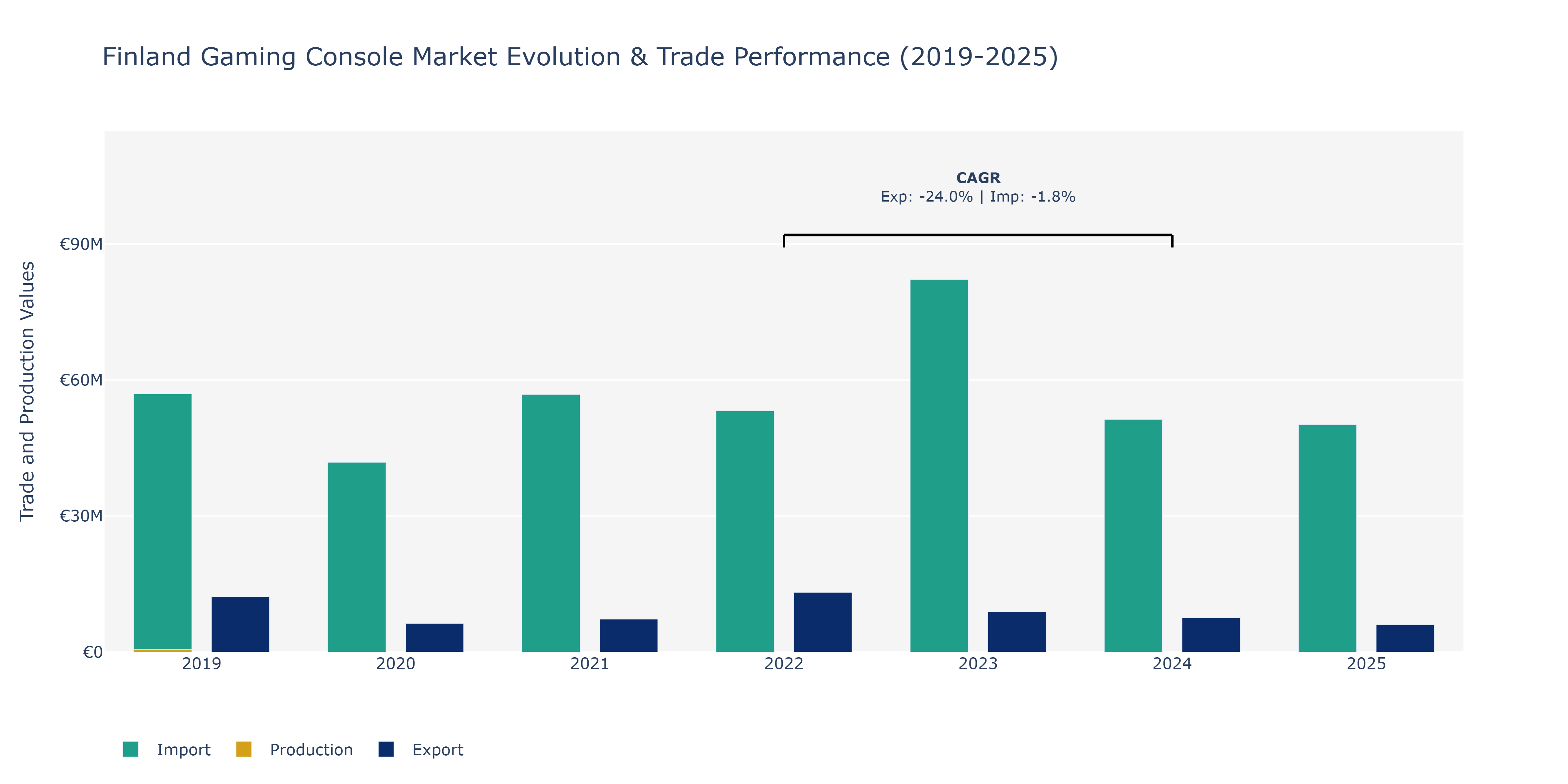
In the Finland Gaming Console Market, exports experienced a notable fluctuation over the years, peaking at €13.16 million in 2022 and declining to €6.04 million in 2025. This decline can be attributed to shifts in consumer preferences, competition from other markets, and potentially supply chain disruptions impacting outbound shipments. Imports, on the other hand, remained relatively stable, with a peak of €82.15 million in 2023 and a slight decrease to €50.18 million in 2025. This indicates a consistent demand for gaming consoles in Finland, supported by factors such as the popularity of gaming culture and the release of new console models. Production value were consistently lower compared to exports and imports, standing at €586.75 million in 2019. The fluctuations and trends observed in exports and imports reflect the dynamic nature of the gaming console market, influenced by evolving technologies and shifting consumer preferences.
Key Highlights of the Report:
- Finland Gaming Console Market Outlook
- Market Size of Finland Gaming Console Market, 2024
- Forecast of Finland Gaming Console Market, 2031
- Historical Data and Forecast of Finland Gaming Console Revenues & Volume for the Period 2021-2031
- Finland Gaming Console Market Trend Evolution
- Finland Gaming Console Market Drivers and Challenges
- Finland Gaming Console Price Trends
- Finland Gaming Console Porter`s Five Forces
- Finland Gaming Console Industry Life Cycle
- Historical Data and Forecast of Finland Gaming Console Market Revenues & Volume By Component for the Period 2021-2031
- Historical Data and Forecast of Finland Gaming Console Market Revenues & Volume By Hardware for the Period 2021-2031
- Historical Data and Forecast of Finland Gaming Console Market Revenues & Volume By Software for the Period 2021-2031
- Historical Data and Forecast of Finland Gaming Console Market Revenues & Volume By Type for the Period 2021-2031
- Historical Data and Forecast of Finland Gaming Console Market Revenues & Volume By Home Consoles for the Period 2021-2031
- Historical Data and Forecast of Finland Gaming Console Market Revenues & Volume By Handheld Consoles for the Period 2021-2031
- Historical Data and Forecast of Finland Gaming Console Market Revenues & Volume By Hybrid Consoles for the Period 2021-2031
- Historical Data and Forecast of Finland Gaming Console Market Revenues & Volume By Dedicated Consoles for the Period 2021-2031
- Historical Data and Forecast of Finland Gaming Console Market Revenues & Volume By Others for the Period 2021-2031
- Historical Data and Forecast of Finland Gaming Console Market Revenues & Volume By End-use for the Period 2021-2031
- Historical Data and Forecast of Finland Gaming Console Market Revenues & Volume By Personal for the Period 2021-2031
- Historical Data and Forecast of Finland Gaming Console Market Revenues & Volume By Commercial for the Period 2021-2031
- Historical Data and Forecast of Finland Gaming Console Market Revenues & Volume By Others for the Period 2021-2031
- Finland Gaming Console Import Export Trade Statistics
- Market Opportunity Assessment By Component
- Market Opportunity Assessment By Type
- Market Opportunity Assessment By End-use
- Finland Gaming Console Top Companies Market Share
- Finland Gaming Console Competitive Benchmarking By Technical and Operational Parameters
- Finland Gaming Console Company Profiles
- Finland Gaming Console Key Strategic Recommendations






































