Finland Glycerol Market Size (2020-2030)
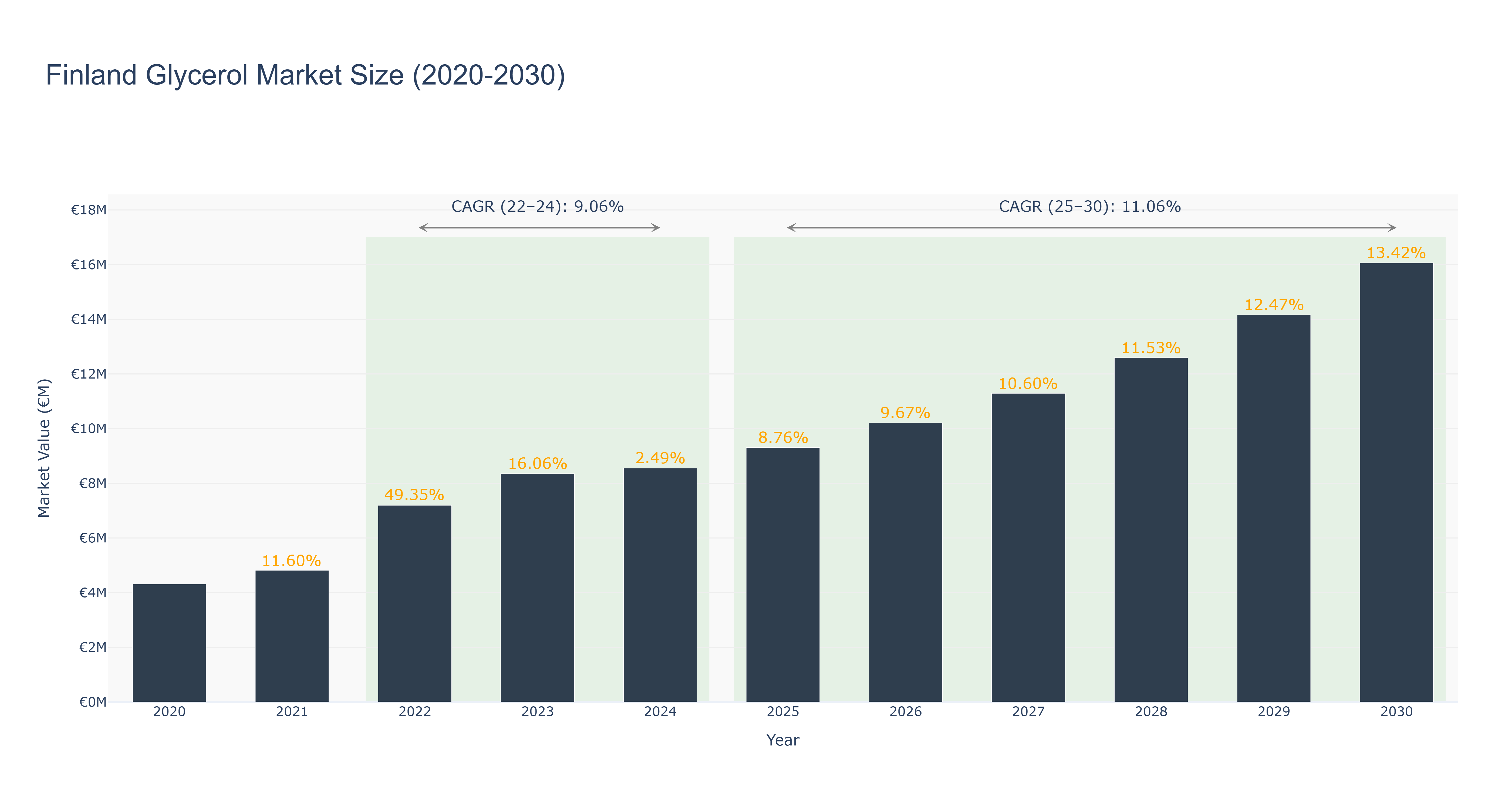
Finland's Glycerol Market has shown steady growth over the years. The market peaked at €16.06 million in 2030, with a notable increase in size from €4.32 million in 2020. The period from 2020 to 2024 saw consistent growth, attributed to increased demand for glycerol-based products in various industries. The forecasted market size from 2025 to 2030 is expected to continue this upward trajectory, with a CAGR of 11.06%. The CAGR from 2022 to 2024 was 9.06%, indicating a slightly slower growth rate during that period. Industry drivers such as the rising awareness of sustainable products and the expanding applications of glycerol in cosmetics and pharmaceuticals are propelling the market forward. In the near future, Finland's Glycerol Market is expected to witness new investments in research and development to innovate glycerol-based products, further driving market growth.
Finland Glycerol Market: Production & Trade Performance (2019-2025)
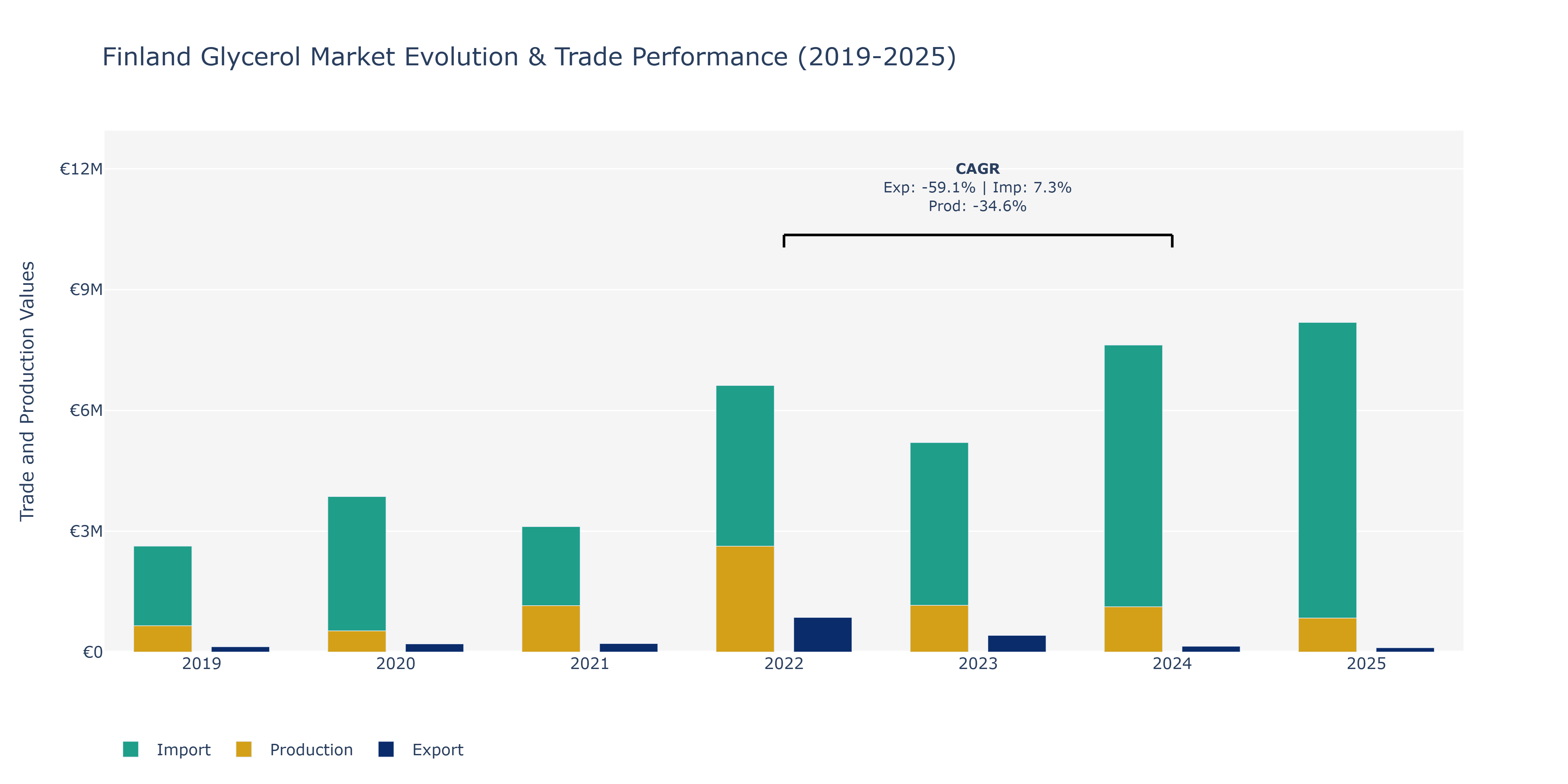
In the Finland Glycerol Market, a notable upward trend is observed in exports from 2019 to 2022, reaching a peak of €860.85 thousand in 2022, driven by increased demand and competitiveness in the global market. However, there was a substantial decline in exports in 2023 and 2024, possibly due to changing market dynamics or trade policies impacting outbound shipments. Imports consistently grew throughout the period, with a peak of €7.62 million in 2024, indicating a reliance on foreign sources to meet domestic demand. Production levels fluctuated, with a significant increase in 2021 followed by a decline in 2022 and 2024, possibly reflecting adjustments in supply chain strategies or production capacity. These fluctuations may be influenced by factors such as raw material availability, technological advancements, and environmental regulations affecting the glycerol industry. Further analysis incorporating market demand shifts and regulatory changes would provide valuable insights into the market dynamics.
Finland Glycerol Market Overview
The glycerol market in Finland is witnessing growth, largely driven by its use in cosmetics, pharmaceuticals, and food production. As a versatile, non-toxic ingredient with multiple applications, glycerol is a popular choice for moisturizing products, oral care formulations, and food additives. With a rising preference for organic and natural ingredients, the demand for glycerol is expected to increase.
Drivers of the market
The glycerol market in Finland is expanding as glycerol is used in a variety of industries, including food and beverages, pharmaceuticals, and chemicals. The rising demand for glycerol in the production of personal care products, along with its role as a humectant and preservative, is fueling the market`s growth. As sustainability trends continue to influence consumer preferences, the demand for glycerol sourced from renewable resources is also rising.
Challenges of the market
The glycerol market in Finland faces challenges related to the growing demand for natural glycerol derived from renewable sources. There is increasing competition from synthetic glycerol, which is cheaper to produce, although concerns regarding sustainability and environmental impact are pushing demand for bio-based alternatives. Additionally, fluctuating raw material prices and the need to meet various quality and safety standards add complexity to market conditions.
Government Policy of the market
Policies in Finland promote the sustainable production of glycerol for use in various industries. Incentives are offered for innovations in refining processes and the development of bio-based glycerol applications.
Key Highlights of the Report:
- Finland Glycerol Market Outlook
- Market Size of Finland Glycerol Market, 2024
- Forecast of Finland Glycerol Market, 2031
- Historical Data and Forecast of Finland Glycerol Revenues & Volume for the Period 2021-2031
- Finland Glycerol Market Trend Evolution
- Finland Glycerol Market Drivers and Challenges
- Finland Glycerol Price Trends
- Finland Glycerol Porter`s Five Forces
- Finland Glycerol Industry Life Cycle
- Historical Data and Forecast of Finland Glycerol Market Revenues & Volume By Source for the Period 2021-2031
- Historical Data and Forecast of Finland Glycerol Market Revenues & Volume By Biodiesel for the Period 2021-2031
- Historical Data and Forecast of Finland Glycerol Market Revenues & Volume By Fatty Alcohols for the Period 2021-2031
- Historical Data and Forecast of Finland Glycerol Market Revenues & Volume By Fatty Acids for the Period 2021-2031
- Historical Data and Forecast of Finland Glycerol Market Revenues & Volume By Soap for the Period 2021-2031
- Historical Data and Forecast of Finland Glycerol Market Revenues & Volume By Type for the Period 2021-2031
- Historical Data and Forecast of Finland Glycerol Market Revenues & Volume By Crude for the Period 2021-2031
- Historical Data and Forecast of Finland Glycerol Market Revenues & Volume By Refined for the Period 2021-2031
- Historical Data and Forecast of Finland Glycerol Market Revenues & Volume By End-use for the Period 2021-2031
- Historical Data and Forecast of Finland Glycerol Market Revenues & Volume By Food & Beverage for the Period 2021-2031
- Historical Data and Forecast of Finland Glycerol Market Revenues & Volume By Pharmaceutical for the Period 2021-2031
- Historical Data and Forecast of Finland Glycerol Market Revenues & Volume By Nutraceutical for the Period 2021-2031
- Historical Data and Forecast of Finland Glycerol Market Revenues & Volume By Personal Care & Cosmetics for the Period 2021-2031
- Historical Data and Forecast of Finland Glycerol Market Revenues & Volume By Industrial for the Period 2021-2031
- Historical Data and Forecast of Finland Glycerol Market Revenues & Volume By Others for the Period 2021-2031
- Finland Glycerol Import Export Trade Statistics
- Market Opportunity Assessment By Source
- Market Opportunity Assessment By Type
- Market Opportunity Assessment By End-use
- Finland Glycerol Top Companies Market Share
- Finland Glycerol Competitive Benchmarking By Technical and Operational Parameters
- Finland Glycerol Company Profiles
- Finland Glycerol Key Strategic Recommendations






































