Finland Graphite Electrode Market Size (2020-2030)
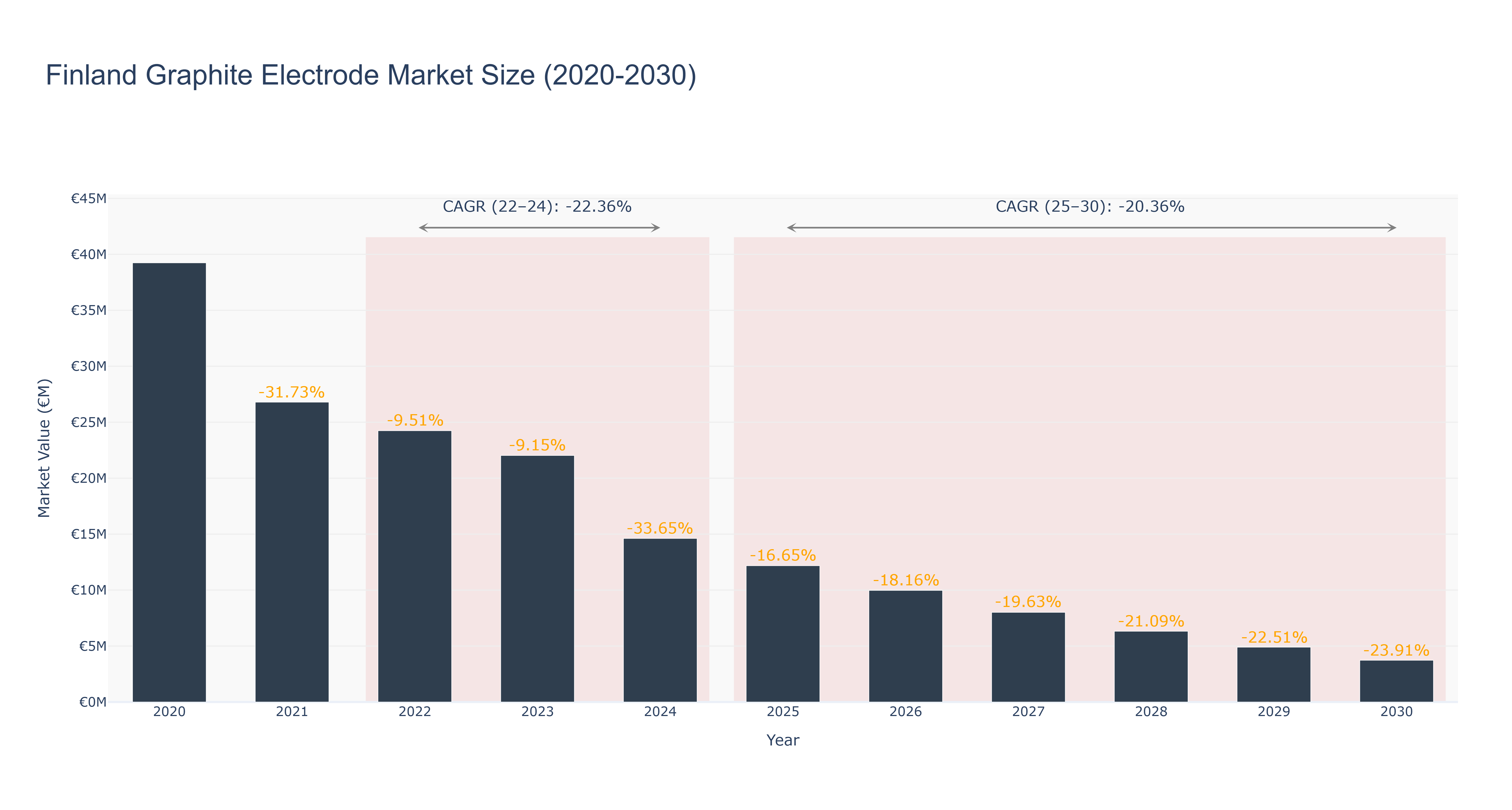
The Finland Graphite Electrode Market experienced its peak market size in 2020 at €39.24 million, followed by a significant downturn, with actual market sizes declining to €22.03 million in 2023, reflecting a CAGR of -22.36% from 2022 to 2024. The market's contraction is attributed to various factors, including reduced demand in steel production, shifts towards alternative materials, and economic challenges exacerbated by global supply chain disruptions. Looking ahead, the forecasted period from 2025 to 2030 anticipates continued decline, with projected market sizes decreasing to €3.73 million by 2030, representing a CAGR of -20.36%. This bleak outlook stems from persistent market pressures and a lack of substantial new projects or developments that could revitalize the industry. The ongoing trend towards sustainability and technological advancements in production methods may further inhibit recovery in this sector, emphasizing the need for innovative solutions to address declining demand.
Finland Graphite Electrode Market: Production & Trade Performance (2019-2025)
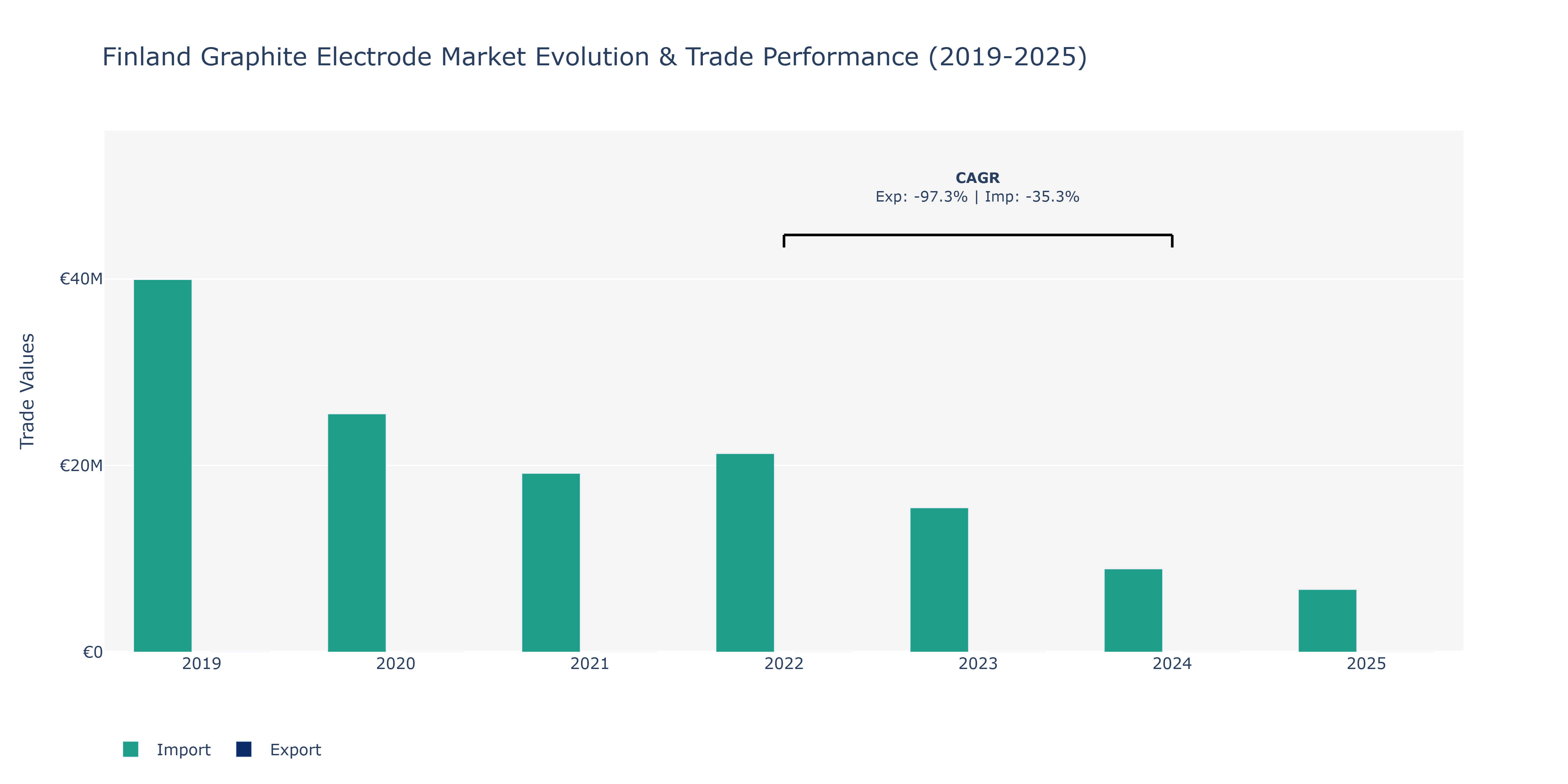
The Finland Graphite Electrode Market experienced notable fluctuations in both Exports and Imports from 2019 to 2025. In 2019, Imports stood at a substantial €39.92 million, significantly higher than Exports at €21.61 thousand, indicating a reliance on external sources. However, the following years saw a consistent decline in both metrics. Exports dropped to €1.50 million in 2025, reflecting a sharp decrease over the period. Imports followed a similar trend, decreasing to €6.69 million in 2025. These declines could be attributed to various factors such as changes in demand, global market conditions, technological advancements impacting material usage, and shifts in supplier relationships. The decreasing trend in Exports and Imports aligns with the reported negative CAGRs, indicating a challenging market environment. This suggests a need for market players to adapt their strategies to leverage emerging opportunities or mitigate risks posed by such volatility in the Finland Graphite Electrode Market.
Key Highlights of the Report:
- Finland Graphite Electrode Market Outlook
- Market Size of Finland Graphite Electrode Market, 2024
- Forecast of Finland Graphite Electrode Market, 2031
- Historical Data and Forecast of Finland Graphite Electrode Revenues & Volume for the Period 2021-2031
- Finland Graphite Electrode Market Trend Evolution
- Finland Graphite Electrode Market Drivers and Challenges
- Finland Graphite Electrode Price Trends
- Finland Graphite Electrode Porter`s Five Forces
- Finland Graphite Electrode Industry Life Cycle
- Historical Data and Forecast of Finland Graphite Electrode Market Revenues & Volume By Electrode Grade for the Period 2021-2031
- Historical Data and Forecast of Finland Graphite Electrode Market Revenues & Volume By Ultra High Power (UHP) for the Period 2021-2031
- Historical Data and Forecast of Finland Graphite Electrode Market Revenues & Volume By High Power (SHP) for the Period 2021-2031
- Historical Data and Forecast of Finland Graphite Electrode Market Revenues & Volume By Regular Power (RP) for the Period 2021-2031
- Historical Data and Forecast of Finland Graphite Electrode Market Revenues & Volume By Application for the Period 2021-2031
- Historical Data and Forecast of Finland Graphite Electrode Market Revenues & Volume By Electric Arc Furnace for the Period 2021-2031
- Historical Data and Forecast of Finland Graphite Electrode Market Revenues & Volume By Basic Oxygen Furnace for the Period 2021-2031
- Historical Data and Forecast of Finland Graphite Electrode Market Revenues & Volume By Non-steel Application for the Period 2021-2031
- Finland Graphite Electrode Import Export Trade Statistics
- Market Opportunity Assessment By Electrode Grade
- Market Opportunity Assessment By Application
- Finland Graphite Electrode Top Companies Market Share
- Finland Graphite Electrode Competitive Benchmarking By Technical and Operational Parameters
- Finland Graphite Electrode Company Profiles
- Finland Graphite Electrode Key Strategic Recommendations






































