Finland Hydrochloric Acid Market Size (2020-2030)
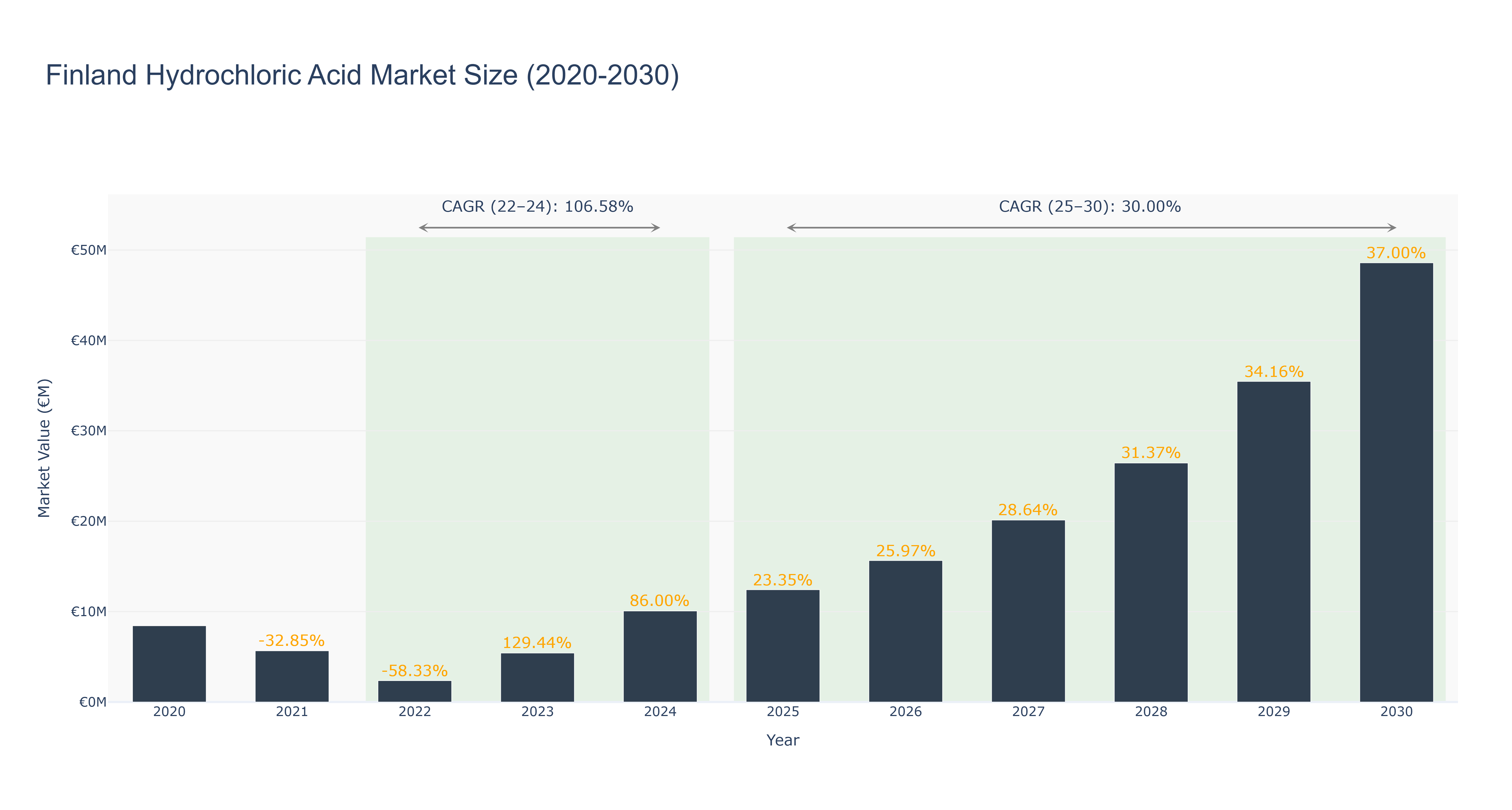
The Finland Hydrochloric Acid Market has shown a fluctuating trend over the years. The market peaked at €48.58 million in 2030, with a steady growth trajectory from 2020 to 2024, reaching €10.07 million in 2024. The market is forecasted to continue its growth, with an expected market size of €15.64 million in 2026, and a CAGR of 30.0% from 2025 to 2030. The significant growth in the market can be attributed to the increasing demand for hydrochloric acid in various industries such as chemicals, pharmaceuticals, and food processing. Recent developments in Finland's chemical industry, including investments in infrastructure and technology, are expected to further drive the market growth in the coming years.
Finland Hydrochloric Acid Market: Production & Trade Performance (2019-2025)
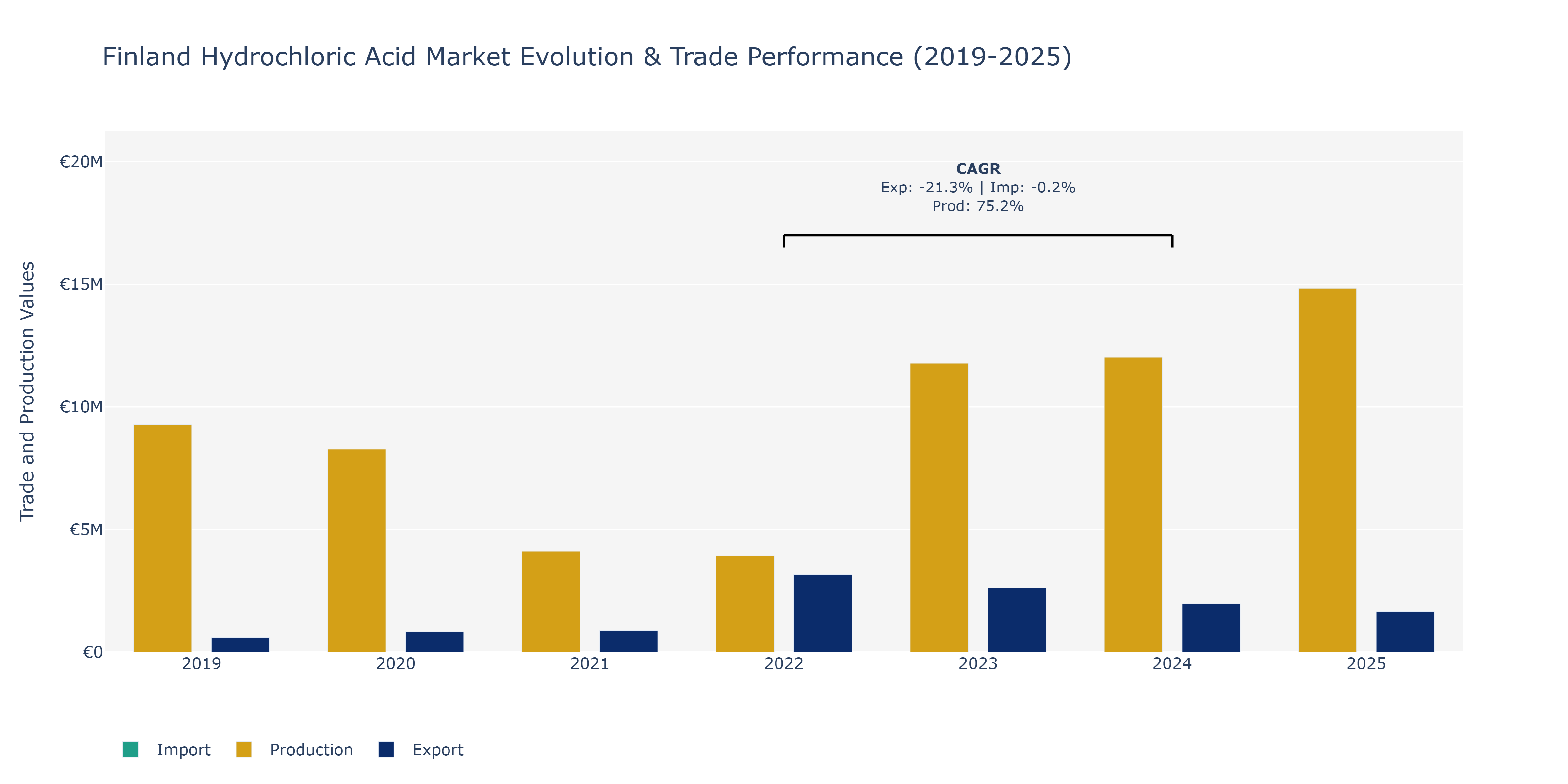
The Finland Hydrochloric Acid Market experienced notable dynamics in exports, imports, and production between 2019 and 2025. Exports surged from €597.17 thousand in 2019 to €1.66 million in 2025, indicating a remarkable growth trajectory primarily driven by increased global demand for Finnish hydrochloric acid products. In contrast, imports fluctuated, reaching a peak of €397.8 thousand in 2023 before receding to €356.66 thousand in 2025. This fluctuation may be attributed to varying raw material costs, international trade policies, and evolving market dynamics impacting inbound hydrochloric acid flows. Production value displayed a significant decline from €9.27 billion in 2019 to €4.11 billion in 2021, followed by a gradual recovery to €14.83 billion in 2025. This fluctuation could be linked to market consolidation, technological advancements, and shifts in domestic consumption patterns influencing production capacities in Finland's hydrochloric acid sector. The market's resilience and adaptability to global factors underscore its competitive position in the chemical industry landscape, necessitating continuous innovation and strategic market positioning to sustain growth.
Key Highlights of the Report:
- Finland Hydrochloric Acid Market Outlook
- Market Size of Finland Hydrochloric Acid Market, 2025
- Forecast of Finland Hydrochloric Acid Market, 2032
- Historical Data and Forecast of Finland Hydrochloric Acid Revenues & Volume for the Period 2022 - 2032F
- Finland Hydrochloric Acid Market Trend Evolution
- Finland Hydrochloric Acid Market Drivers and Challenges
- Finland Hydrochloric Acid Price Trends
- Finland Hydrochloric Acid Porter`s Five Forces
- Finland Hydrochloric Acid Industry Life Cycle
- Historical Data and Forecast of Finland Hydrochloric Acid Market Revenues & Volume By End-user Industry for the Period 2022 - 2032F
- Historical Data and Forecast of Finland Hydrochloric Acid Market Revenues & Volume By Food and Beverage for the Period 2022 - 2032F
- Historical Data and Forecast of Finland Hydrochloric Acid Market Revenues & Volume By Steel for the Period 2022 - 2032F
- Historical Data and Forecast of Finland Hydrochloric Acid Market Revenues & Volume By Oil and Gas for the Period 2022 - 2032F
- Historical Data and Forecast of Finland Hydrochloric Acid Market Revenues & Volume By Chemical for the Period 2022 - 2032F
- Historical Data and Forecast of Finland Hydrochloric Acid Market Revenues & Volume By Textile for the Period 2022 - 2032F
- Historical Data and Forecast of Finland Hydrochloric Acid Market Revenues & Volume By Other End-user Industries (Leather, Rubber, etc.) for the Period 2022 - 2032F
- Finland Hydrochloric Acid Import Export Trade Statistics
- Market Opportunity Assessment By End-user Industry
- Finland Hydrochloric Acid Top Companies Market Share
- Finland Hydrochloric Acid Competitive Benchmarking By Technical and Operational Parameters
- Finland Hydrochloric Acid Company Profiles
- Finland Hydrochloric Acid Key Strategic Recommendations






































