Finland Induction Motor Market Size (2020-2030)
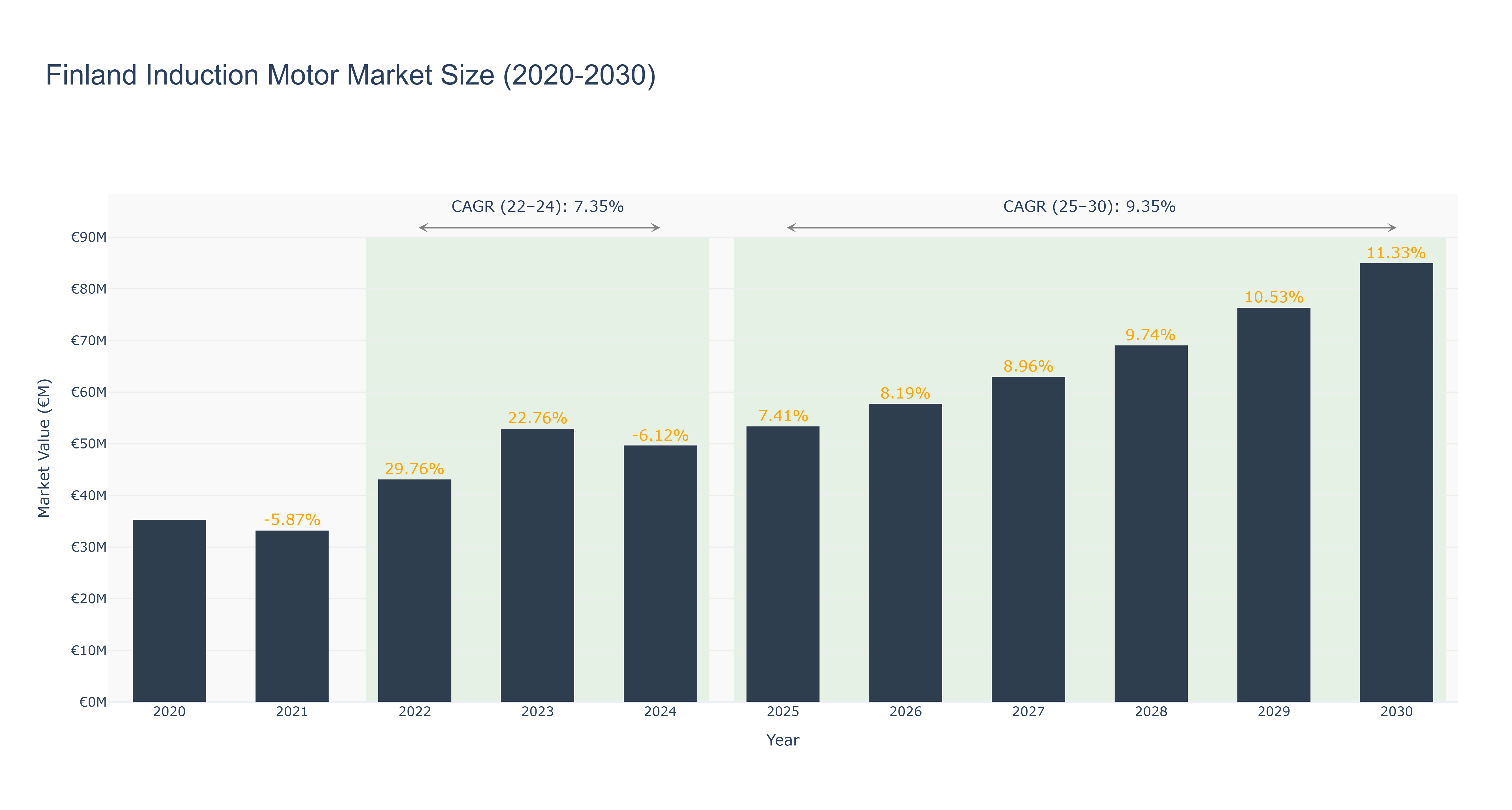
The Finland Induction Motor Market experienced notable fluctuations from 2020 to 2024, with a peak market size of €52.97 million in 2023, following significant growth of 22.76%. However, the market contracted in 2021 and 2024, posting declines of -5.87% and -6.12%, respectively. The actual compound annual growth rate (CAGR) for the period 2022-2024 stands at 7.35%, driven by increasing industrial automation and a shift towards energy-efficient technologies. Looking ahead, the forecasted period from 2025 to 2030 anticipates a robust recovery with a projected CAGR of 9.35%, culminating in a market size of €85.04 million by 2030. This growth is expected to be fueled by rising demand for renewable energy solutions and advancements in electric vehicle technologies, positioning Finland as a key player in the European induction motor landscape. Continued investment in infrastructure and sustainable practices will further enhance market opportunities.
Finland Induction Motor Market: Production & Trade Performance (2019-2025)
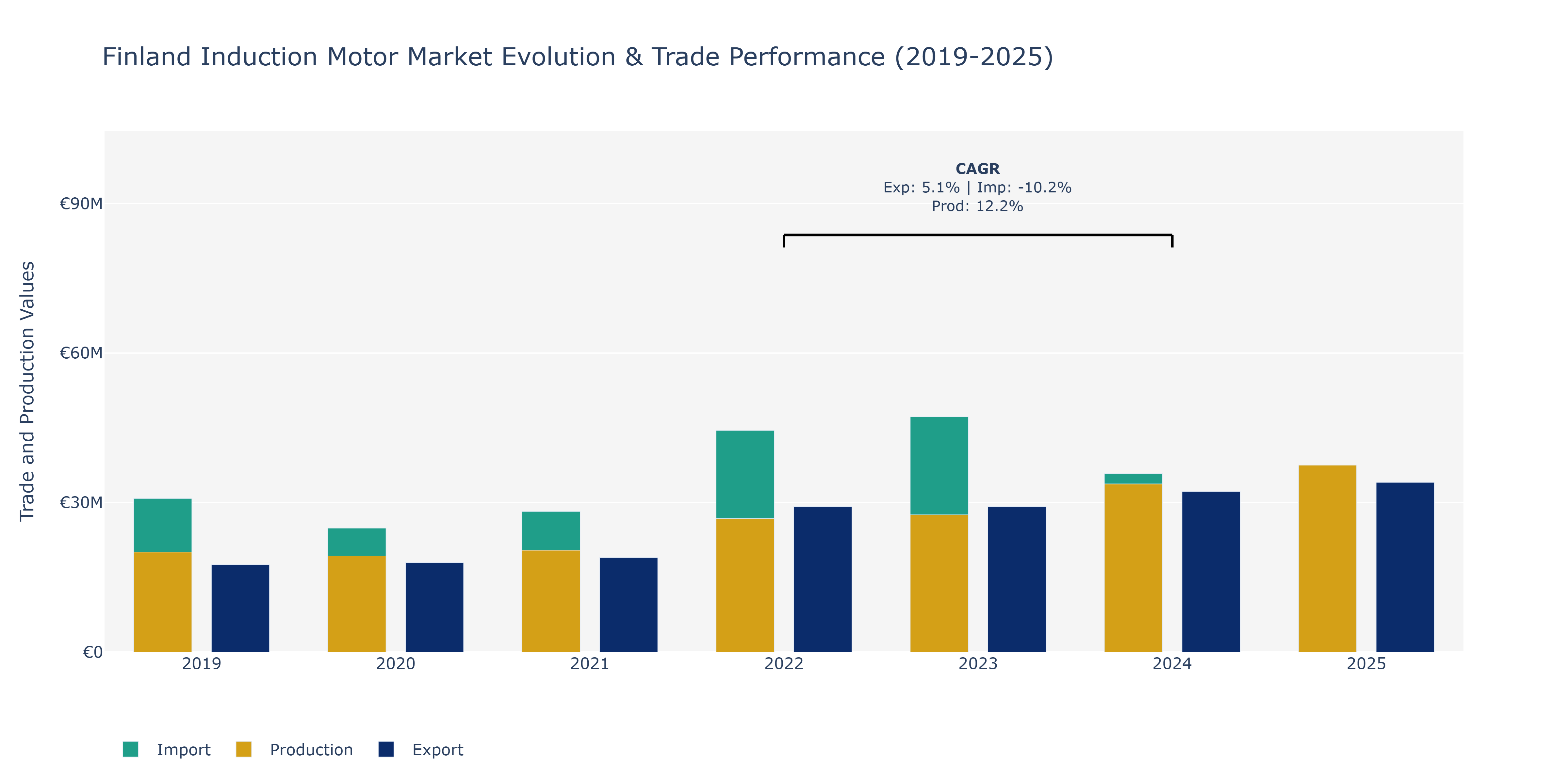
Between 2019 and 2025, Finland's Induction Motor Market witnessed notable fluctuations in exports, imports, and production. Exports showed a steady growth trajectory, starting at €17.55 million in 2019 and reaching €34.06 million in 2025. This upward trend can be attributed to the increasing global demand for energy-efficient electric motors, which aligns with Finland's reputation for high-quality engineering. On the other hand, imports initially peaked in 2022 at €44.47 million before declining to €33.44 million in 2025. This drop may reflect efforts by the Finnish market to enhance domestic production capabilities or optimize supply chain efficiency. Production also saw a consistent rise from €20.05 million in 2019 to €37.52 million in 2025, showcasing Finland's commitment to innovation and technological advancement in the motor industry. These trends underline Finland's position as a key player in the Induction Motor Market, leveraging its strengths in engineering and sustainability to drive growth.
Key Highlights of the Report:
- Finland Induction Motor Market Outlook
- Market Size of Finland Induction Motor Market, 2024
- Forecast of Finland Induction Motor Market, 2031
- Historical Data and Forecast of Finland Induction Motor Revenues & Volume for the Period 2021-2031
- Finland Induction Motor Market Trend Evolution
- Finland Induction Motor Market Drivers and Challenges
- Finland Induction Motor Price Trends
- Finland Induction Motor Porter`s Five Forces
- Finland Induction Motor Industry Life Cycle
- Historical Data and Forecast of Finland Induction Motor Market Revenues & Volume By Type for the Period 2021-2031
- Historical Data and Forecast of Finland Induction Motor Market Revenues & Volume By Single Phase for the Period 2021-2031
- Historical Data and Forecast of Finland Induction Motor Market Revenues & Volume By Three Phase for the Period 2021-2031
- Historical Data and Forecast of Finland Induction Motor Market Revenues & Volume By Application for the Period 2021-2031
- Historical Data and Forecast of Finland Induction Motor Market Revenues & Volume By Residential for the Period 2021-2031
- Historical Data and Forecast of Finland Induction Motor Market Revenues & Volume By Industrial for the Period 2021-2031
- Historical Data and Forecast of Finland Induction Motor Market Revenues & Volume By Commercial for the Period 2021-2031
- Historical Data and Forecast of Finland Induction Motor Market Revenues & Volume By Transportation for the Period 2021-2031
- Historical Data and Forecast of Finland Induction Motor Market Revenues & Volume By Others for the Period 2021-2031
- Finland Induction Motor Import Export Trade Statistics
- Market Opportunity Assessment By Type
- Market Opportunity Assessment By Application
- Finland Induction Motor Top Companies Market Share
- Finland Induction Motor Competitive Benchmarking By Technical and Operational Parameters
- Finland Induction Motor Company Profiles
- Finland Induction Motor Key Strategic Recommendations






































