Finland Isocyanate Market Top 5 Importing Countries and Market Competition (HHI) Analysis
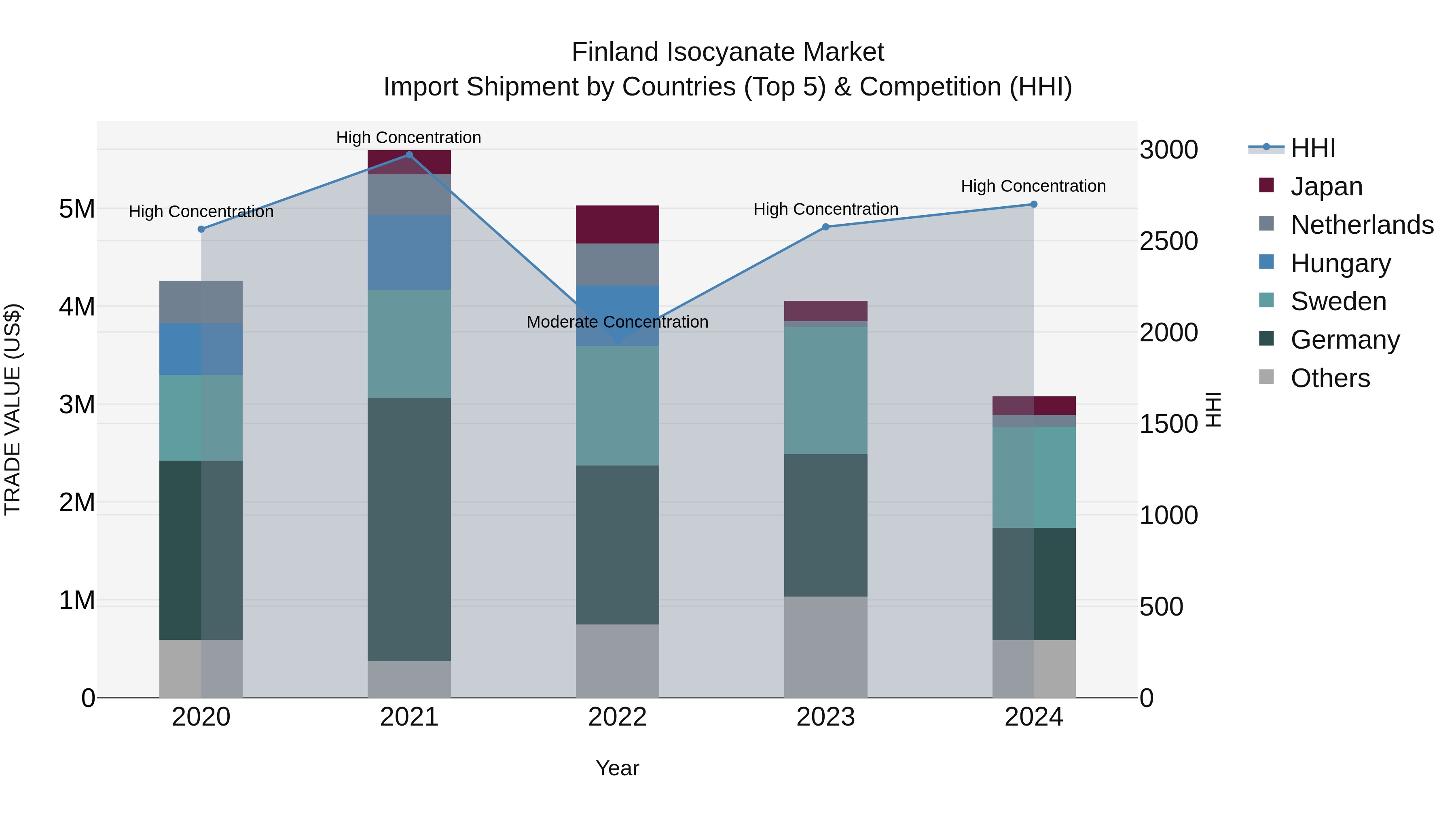
Despite a continued high concentration of isocyanate imports in Finland in 2024, the market saw a significant decline with a negative CAGR of -7.79% from 2020 to 2024. Top exporting countries such as Germany, Sweden, South Korea, Japan, and the Netherlands maintained their position, with a notable drop in growth rate by -24.0% from 2023 to 2024. This suggests a challenging landscape for isocyanate imports in Finland, possibly influenced by global economic conditions and industry dynamics.
Finland Isocyanate Market Overview
The isocyanate market in Finland is growing due to its use in the production of polyurethanes, which are used in applications such as insulation materials, automotive parts, and furniture. Isocyanates are highly reactive chemicals that play a crucial role in various industries. Finlands strong chemical manufacturing sector and its focus on sustainable production practices are driving the demand for isocyanates. The market is expected to expand as the demand for polyurethane products increases in construction, automotive, and other sectors.
Drivers of the market
The isocyanate market in Finland is expanding due to its critical role in the production of polyurethane products, including foams, coatings, and adhesives. With increasing demand in the automotive, construction, and furniture industries, isocyanates are essential for the production of high-performance materials. Finlands thriving manufacturing sector, particularly in automotive and construction, supports the growth of the isocyanate market.
Challenges of the market
The isocyanate market in Finland faces challenges related to the environmental and health risks associated with the production and use of isocyanates. While they are critical in the production of polyurethane foams and coatings, the market must navigate stringent regulatory requirements concerning the safe handling and disposal of isocyanates. Companies must also address the rising demand for eco-friendly and sustainable alternatives in polyurethane production.
Government Policy of the market
Finland`s policies on the isocyanate market emphasize safety, environmental protection, and the reduction of harmful emissions in the production and use of isocyanates, which are used in the manufacture of polyurethane products. The government promotes research into safer alternatives and encourages industries to adopt best practices for handling isocyanates to minimize health and environmental risks. Finland also supports the development of more sustainable manufacturing processes that reduce the environmental impact of isocyanate production and use, aligning with its commitment to circular economy principles and sustainability.
Key Highlights of the Report:
- Finland Isocyanate Market Outlook
- Market Size of Finland Isocyanate Market, 2024
- Forecast of Finland Isocyanate Market, 2031
- Historical Data and Forecast of Finland Isocyanate Revenues & Volume for the Period 2021-2031
- Finland Isocyanate Market Trend Evolution
- Finland Isocyanate Market Drivers and Challenges
- Finland Isocyanate Price Trends
- Finland Isocyanate Porter`s Five Forces
- Finland Isocyanate Industry Life Cycle
- Historical Data and Forecast of Finland Isocyanate Market Revenues & Volume By Type for the Period 2021-2031
- Historical Data and Forecast of Finland Isocyanate Market Revenues & Volume By MDI for the Period 2021-2031
- Historical Data and Forecast of Finland Isocyanate Market Revenues & Volume By TDI for the Period 2021-2031
- Historical Data and Forecast of Finland Isocyanate Market Revenues & Volume By Aliphatic for the Period 2021-2031
- Historical Data and Forecast of Finland Isocyanate Market Revenues & Volume By Others for the Period 2021-2031
- Historical Data and Forecast of Finland Isocyanate Market Revenues & Volume By &Application for the Period 2021-2031
- Historical Data and Forecast of Finland Isocyanate Market Revenues & Volume By Rigid Foam for the Period 2021-2031
- Historical Data and Forecast of Finland Isocyanate Market Revenues & Volume By Flexible Foam for the Period 2021-2031
- Historical Data and Forecast of Finland Isocyanate Market Revenues & Volume By Paints & Coatings for the Period 2021-2031
- Historical Data and Forecast of Finland Isocyanate Market Revenues & Volume By Adhesive & Sealants for the Period 2021-2031
- Historical Data and Forecast of Finland Isocyanate Market Revenues & Volume By Elastomers & Binders for the Period 2021-2031
- Finland Isocyanate Import Export Trade Statistics
- Market Opportunity Assessment By Type
- Market Opportunity Assessment By &Application
- Finland Isocyanate Top Companies Market Share
- Finland Isocyanate Competitive Benchmarking By Technical and Operational Parameters
- Finland Isocyanate Company Profiles
- Finland Isocyanate Key Strategic Recommendations






































