Finland Jaw Crusher Market Size (2020-2030)
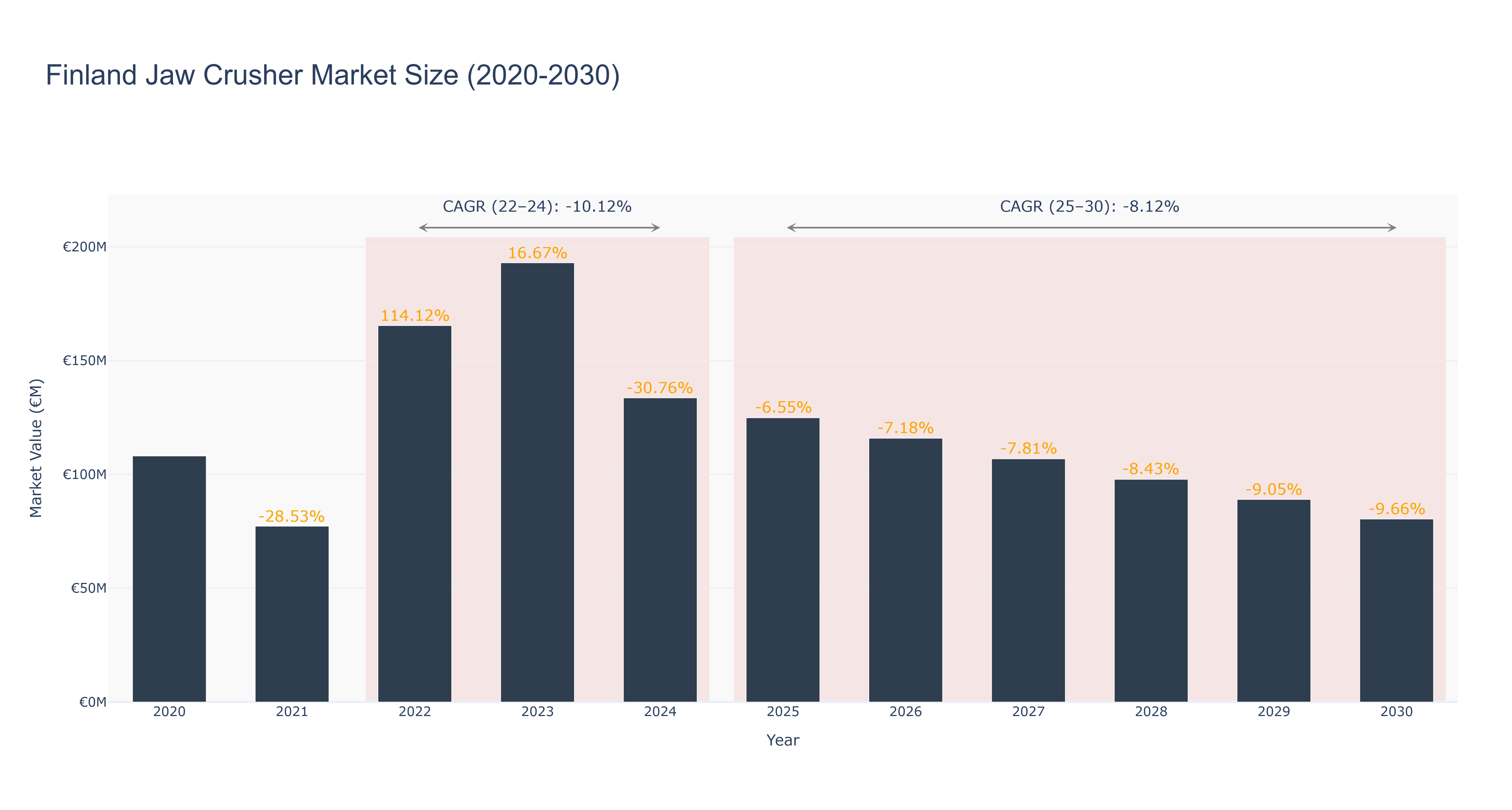
Finland Jaw Crusher Market has seen fluctuations in market size over the years. The peak market size was in 2023 at €192.98 million. From 2020 to 2024, the market size decreased steadily, reaching €133.61 million in 2024. The forecasted market size from 2025 to 2030 shows a continuing decline with an expected size of €80.38 million in 2030. The CAGR for the period 2022-24 was -10.12%, while for 2025-30, it is projected at -8.12%. The downward trend can be attributed to factors like economic downturns impacting infrastructure investments and technological advancements leading to more efficient crusher models. Looking ahead, Finland is set to invest in sustainable mining practices, focusing on reducing environmental impact, which could shape the future landscape of the jaw crusher market in the country. Industry drivers for the Finland Jaw Crusher Market include demand from the mining sector and infrastructure projects, technological advancements in crusher designs, and environmental regulations promoting sustainable practices.
Finland Jaw Crusher Market: Production & Trade Performance (2019-2025)
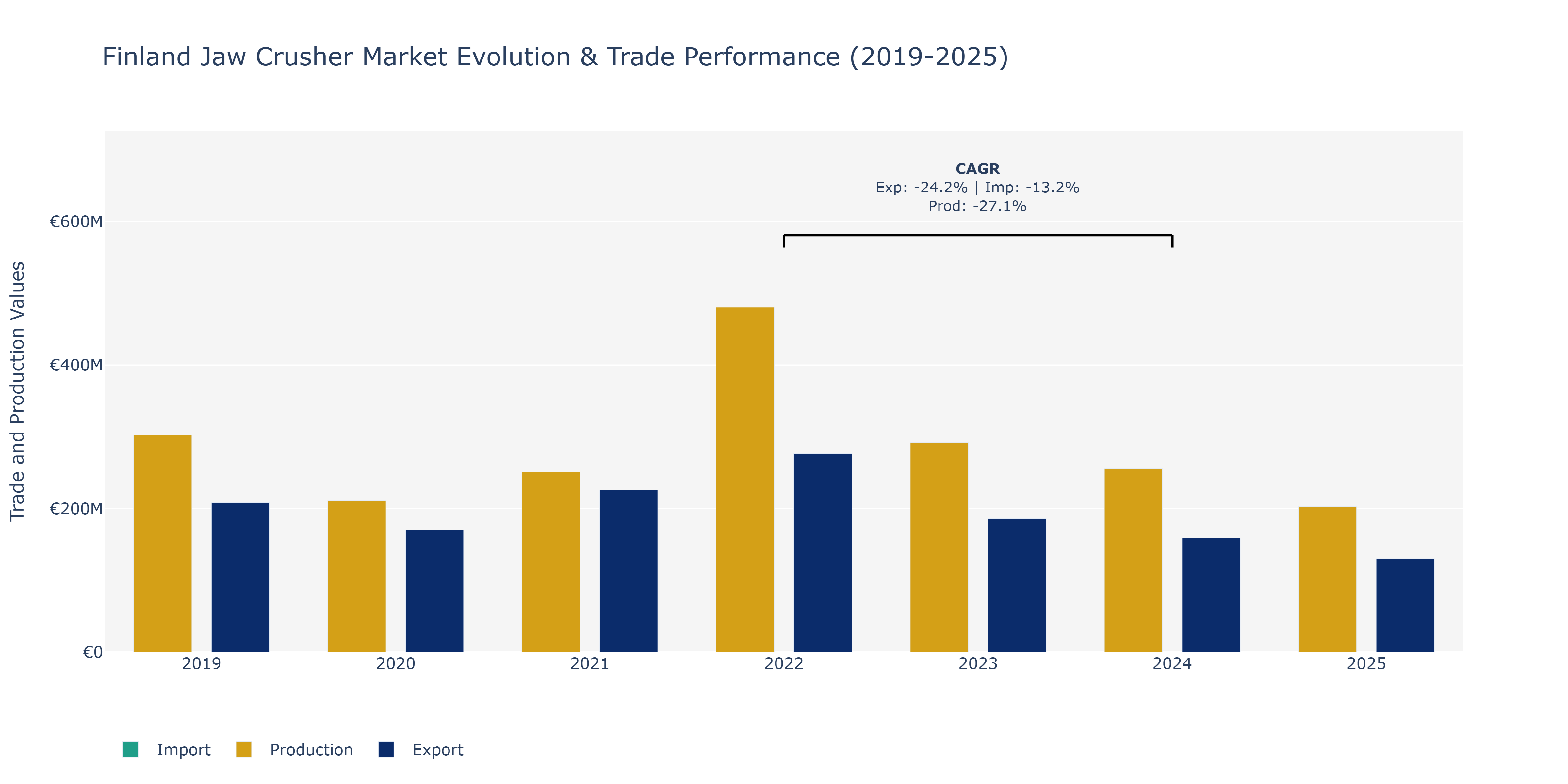
In the Finland Jaw Crusher Market, exports experienced a notable fluctuation over the years, starting at €208.31 million in 2019, dropping to €129.95 million in 2025. The trend suggests a declining pattern with occasional peaks in between. Imports followed a similar pattern, decreasing from €40.20 million in 2019 to €26.32 million in 2025. Production, on the other hand, witnessed a decline from €302.34 million in 2019 to €202.87 million in 2025. The market faced challenges such as changing global demand, competitive pressures, and technological advancements impacting manufacturing processes. With declining production levels, manufacturers may need to focus on efficiency improvements and product innovation to stay competitive in the market. The fluctuations in exports and imports could be attributed to changing trade relationships, market demand shifts, and economic conditions affecting the overall industry landscape.
Key Highlights of the Report:
- Finland Jaw Crusher Market Outlook
- Market Size of Finland Jaw Crusher Market,2024
- Forecast of Finland Jaw Crusher Market, 2031
- Historical Data and Forecast of Finland Jaw Crusher Revenues & Volume for the Period 2021-2031
- Finland Jaw Crusher Market Trend Evolution
- Finland Jaw Crusher Market Drivers and Challenges
- Finland Jaw Crusher Price Trends
- Finland Jaw Crusher Porter's Five Forces
- Finland Jaw Crusher Industry Life Cycle
- Historical Data and Forecast of Finland Jaw Crusher Market Revenues & Volume By Product Type for the Period 2021-2031
- Historical Data and Forecast of Finland Jaw Crusher Market Revenues & Volume By Single Toggle Jaw Crusher for the Period 2021-2031
- Historical Data and Forecast of Finland Jaw Crusher Market Revenues & Volume By Double Toggle Jaw Crusher for the Period 2021-2031
- Historical Data and Forecast of Finland Jaw Crusher Market Revenues & Volume By Mobility for the Period 2021-2031
- Historical Data and Forecast of Finland Jaw Crusher Market Revenues & Volume By Stationary for the Period 2021-2031
- Historical Data and Forecast of Finland Jaw Crusher Market Revenues & Volume By Portable for the Period 2021-2031
- Historical Data and Forecast of Finland Jaw Crusher Market Revenues & Volume By Application for the Period 2021-2031
- Historical Data and Forecast of Finland Jaw Crusher Market Revenues & Volume By Mining for the Period 2021-2031
- Historical Data and Forecast of Finland Jaw Crusher Market Revenues & Volume By Construction for the Period 2021-2031
- Historical Data and Forecast of Finland Jaw Crusher Market Revenues & Volume By Recycling for the Period 2021-2031
- Historical Data and Forecast of Finland Jaw Crusher Market Revenues & Volume By Power Source for the Period 2021-2031
- Historical Data and Forecast of Finland Jaw Crusher Market Revenues & Volume By Electric for the Period 2021-2031
- Historical Data and Forecast of Finland Jaw Crusher Market Revenues & Volume By Diesel for the Period 2021-2031
- Finland Jaw Crusher Import Export Trade Statistics
- Market Opportunity Assessment By Product Type
- Market Opportunity Assessment By Mobility
- Market Opportunity Assessment By Application
- Market Opportunity Assessment By Power Source
- Finland Jaw Crusher Top Companies Market Share
- Finland Jaw Crusher Competitive Benchmarking By Technical and Operational Parameters
- Finland Jaw Crusher Company Profiles
- Finland Jaw Crusher Key Strategic Recommendations






































