Finland Natural Vanillin Market Size (2020-2030)
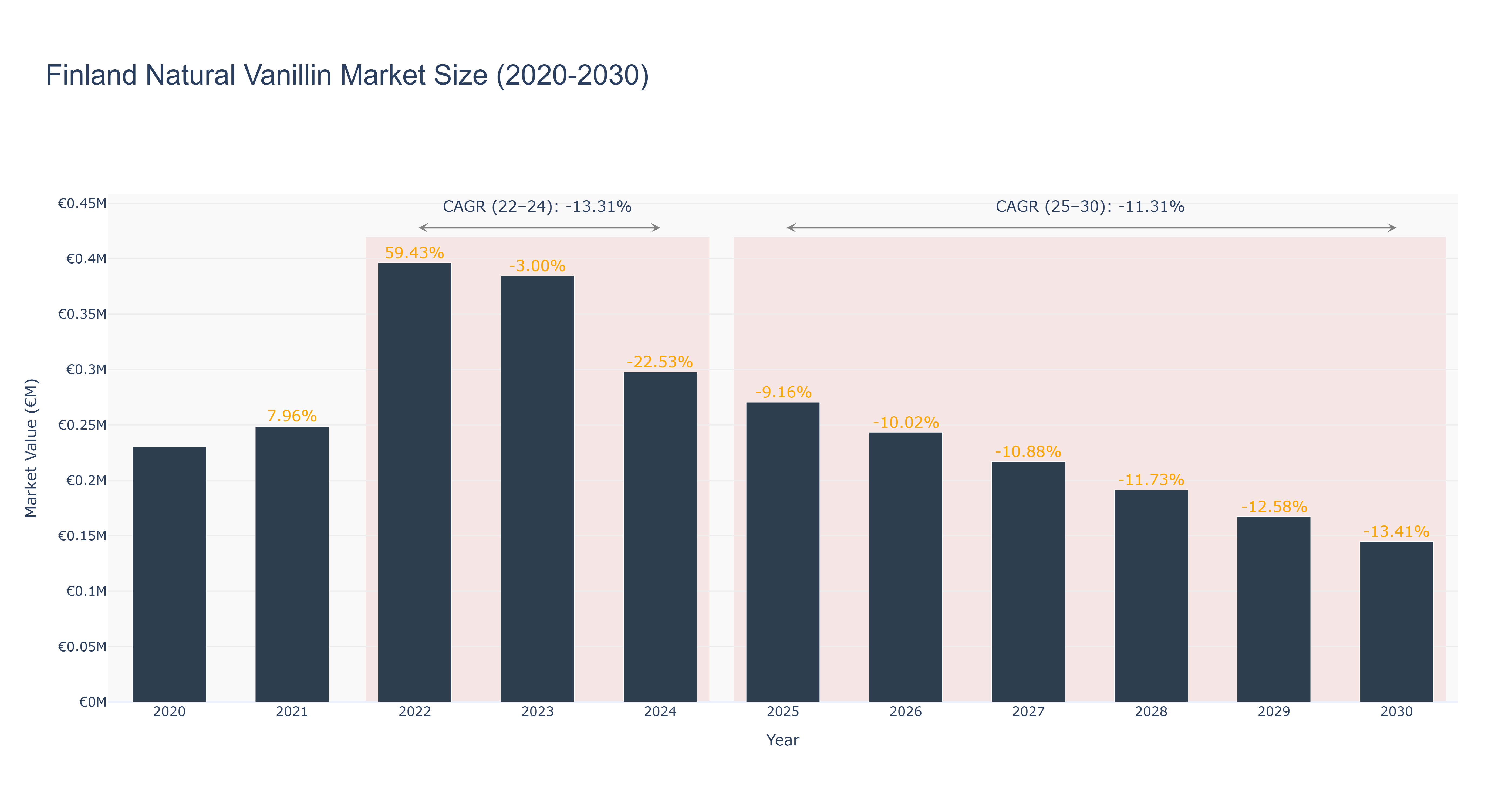
The Finland Natural Vanillin Market reached its peak size of €396.26 thousand in 2022, reflecting an impressive growth of 59.43% from the previous year. However, this growth trajectory has shifted dramatically, with actual market sizes declining to €384.38 thousand in 2023 and €297.80 thousand in 2024, resulting in a negative CAGR of -13.31% from 2022 to 2024. The projected outlook for 2025-2030 indicates a continued downward trend, with forecasted market sizes decreasing from €270.53 thousand in 2025 to €144.93 thousand by 2030, corresponding to a CAGR of -11.31%. This decline can be attributed to several factors, including increased competition from synthetic vanillin, fluctuating consumer preferences, and economic challenges impacting purchasing power. While no specific upcoming projects in the market have been highlighted, broader trends towards natural and sustainable products may offer potential avenues for recovery if navigated effectively.
Finland Natural Vanillin Market: Production & Trade Performance (2019-2025)
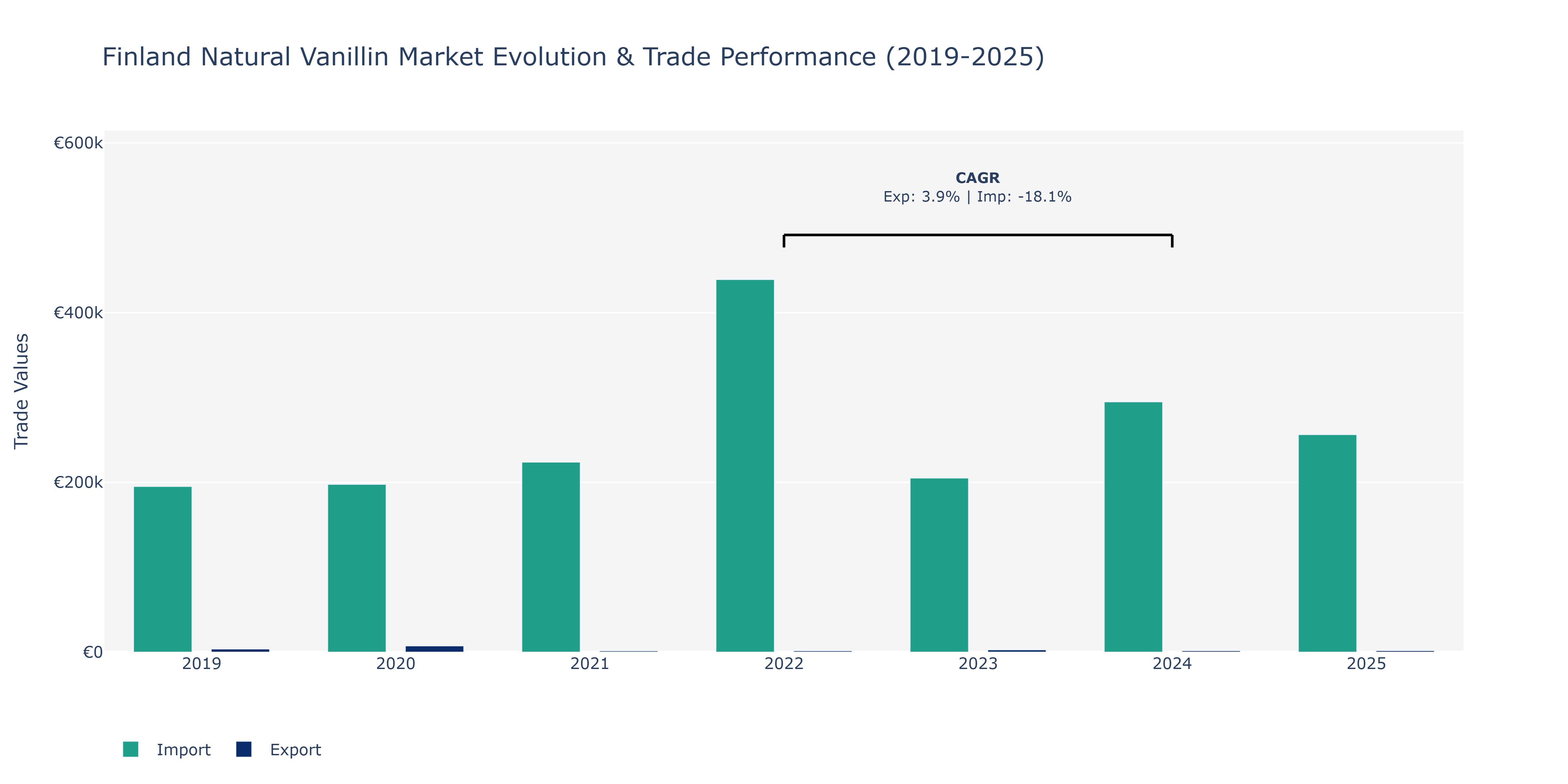
In the Finland Natural Vanillin Market, exports experienced notable fluctuations over the years. In 2019, exports stood at €3.47 thousand, showing a substantial increase to €7.11 thousand in 2020, marking a peak point. However, a sharp decline was observed in 2021, with exports falling to €1.27 thousand. The following years saw a gradual recovery, reaching €2.48 thousand in 2023 before declining again to €1.45 thousand in 2024. Imports, on the other hand, displayed a more stable trend. Starting at €195.01 thousand in 2019, imports increased steadily each year, peaking at €438.89 thousand in 2022. A slight decrease was noted in 2023 to €204.94 thousand, followed by a moderate rise to €294.66 thousand in 2024. The market's export fluctuations can be attributed to changing global demand, supply chain disruptions, and competition from synthetic vanillin sources. Imports, on the other hand, reflect the country's reliance on external suppliers for raw materials and finished products.
Finland Natural Vanillin Market Overview
The natural vanillin market in Finland is expanding as the demand for natural flavoring ingredients in food and beverages rises. Natural vanillin, derived from vanilla beans, is seen as a healthier alternative to synthetic vanillin in the growing clean-label trend.
Drivers of the market
The natural vanillin market in Finland is expanding as the demand for natural flavorings in food, beverages, and fragrances continues to rise. Sourced from vanilla beans or through biotechnological processes, natural vanillin is seen as a healthier, more sustainable option compared to synthetic vanilla, driving consumer preference for products with natural ingredients.
Challenges of the market
The Natural Vanillin market in Finland faces challenges related to the cost and availability of natural sources of vanillin, such as vanilla beans, which can be affected by climate change and market demand. The market also competes with synthetic vanillin, which is more affordable and widely available. Furthermore, the growing demand for organic and sustainably sourced ingredients adds complexity to supply chain management.
Government Policy of the market
Finlands policies promoting the use of natural and organic ingredients in food and beverage products contribute to the growth of the natural vanillin market. Regulations around food safety and consumer preferences for clean-label products encourage the demand for natural vanillin as a flavoring agent. Finlands focus on sustainability and eco-friendly food production further supports this market.
Key Highlights of the Report:
- Finland Natural Vanillin Market Outlook
- Market Size of Finland Natural Vanillin Market, 2024
- Forecast of Finland Natural Vanillin Market, 2031
- Historical Data and Forecast of Finland Natural Vanillin Revenues & Volume for the Period 2021-2031
- Finland Natural Vanillin Market Trend Evolution
- Finland Natural Vanillin Market Drivers and Challenges
- Finland Natural Vanillin Price Trends
- Finland Natural Vanillin Porter`s Five Forces
- Finland Natural Vanillin Industry Life Cycle
- Historical Data and Forecast of Finland Natural Vanillin Market Revenues & Volume By Source for the Period 2021-2031
- Historical Data and Forecast of Finland Natural Vanillin Market Revenues & Volume By Vanilla Bean Extract for the Period 2021-2031
- Historical Data and Forecast of Finland Natural Vanillin Market Revenues & Volume By Ferulic Acid Synthesis for the Period 2021-2031
- Historical Data and Forecast of Finland Natural Vanillin Market Revenues & Volume By Eugenol Synthesis for the Period 2021-2031
- Historical Data and Forecast of Finland Natural Vanillin Market Revenues & Volume By Application for the Period 2021-2031
- Historical Data and Forecast of Finland Natural Vanillin Market Revenues & Volume By Food & Beverages for the Period 2021-2031
- Historical Data and Forecast of Finland Natural Vanillin Market Revenues & Volume By Pharmaceuticals for the Period 2021-2031
- Historical Data and Forecast of Finland Natural Vanillin Market Revenues & Volume By Cosmetics & Personal Care for the Period 2021-2031
- Finland Natural Vanillin Import Export Trade Statistics
- Market Opportunity Assessment By Source
- Market Opportunity Assessment By Application
- Finland Natural Vanillin Top Companies Market Share
- Finland Natural Vanillin Competitive Benchmarking By Technical and Operational Parameters
- Finland Natural Vanillin Company Profiles
- Finland Natural Vanillin Key Strategic Recommendations






































