Finland Non-Ferrous Metal - Market Production Statistics (2019-2025)
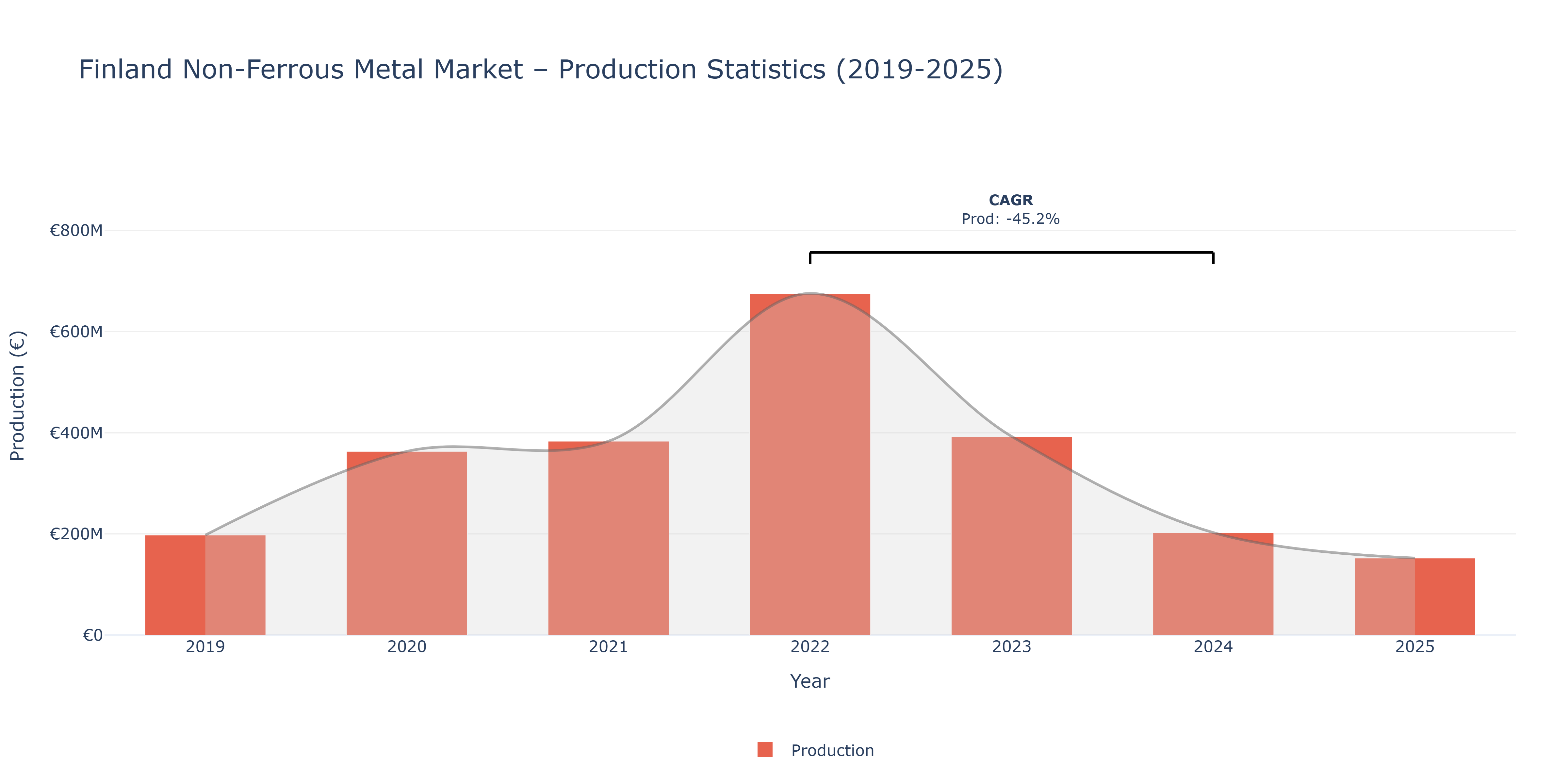
The production in the Finland Non-Ferrous Metal Market has shown significant fluctuations over the years. A notable increase was observed from 2019 to 2020, with production rising from €197.64 million to €363.25 million, indicating a growing demand for non-ferrous metals. The peak in production was reached in 2022 at €675.46 million, driven by increased industrial activities and infrastructure projects. However, a sharp decline followed in 2023, dropping to €392.63 million, possibly due to market saturation or economic slowdown. The subsequent decrease to €202.57 million in 2024 could be attributed to supply chain disruptions or regulatory changes impacting production. The negative CAGR of -45.24% from 2022 to 2024 reflects the market's struggle to maintain growth amidst challenging conditions, emphasizing the need for strategic planning and adaptation to market dynamics.
Key Highlights of the Report:
- Finland Non-ferrous Metal Market Outlook
- Market Size of Finland Non-ferrous Metal Market, 2024
- Forecast of Finland Non-ferrous Metal Market, 2031
- Historical Data and Forecast of Finland Non-ferrous Metal Revenues & Volume for the Period 2021-2031
- Finland Non-ferrous Metal Market Trend Evolution
- Finland Non-ferrous Metal Market Drivers and Challenges
- Finland Non-ferrous Metal Price Trends
- Finland Non-ferrous Metal Porter`s Five Forces
- Finland Non-ferrous Metal Industry Life Cycle
- Historical Data and Forecast of Finland Non-ferrous Metal Market Revenues & Volume By Types for the Period 2021-2031
- Historical Data and Forecast of Finland Non-ferrous Metal Market Revenues & Volume By Aluminum for the Period 2021-2031
- Historical Data and Forecast of Finland Non-ferrous Metal Market Revenues & Volume By Copper for the Period 2021-2031
- Historical Data and Forecast of Finland Non-ferrous Metal Market Revenues & Volume By Lead for the Period 2021-2031
- Historical Data and Forecast of Finland Non-ferrous Metal Market Revenues & Volume By Tin for the Period 2021-2031
- Historical Data and Forecast of Finland Non-ferrous Metal Market Revenues & Volume By Nickel for the Period 2021-2031
- Historical Data and Forecast of Finland Non-ferrous Metal Market Revenues & Volume By Titanium for the Period 2021-2031
- Historical Data and Forecast of Finland Non-ferrous Metal Market Revenues & Volume By Zinc for the Period 2021-2031
- Historical Data and Forecast of Finland Non-ferrous Metal Market Revenues & Volume By Applications for the Period 2021-2031
- Historical Data and Forecast of Finland Non-ferrous Metal Market Revenues & Volume By Automobile Industry for the Period 2021-2031
- Historical Data and Forecast of Finland Non-ferrous Metal Market Revenues & Volume By Electronic Power Industry for the Period 2021-2031
- Historical Data and Forecast of Finland Non-ferrous Metal Market Revenues & Volume By Construction Industry for the Period 2021-2031
- Historical Data and Forecast of Finland Non-ferrous Metal Market Revenues & Volume By Other for the Period 2021-2031
- Finland Non-ferrous Metal Import Export Trade Statistics
- Market Opportunity Assessment By Types
- Market Opportunity Assessment By Applications
- Finland Non-ferrous Metal Top Companies Market Share
- Finland Non-ferrous Metal Competitive Benchmarking By Technical and Operational Parameters
- Finland Non-ferrous Metal Company Profiles
- Finland Non-ferrous Metal Key Strategic Recommendations






































