Finland Pipe Market Size (2020-2030)
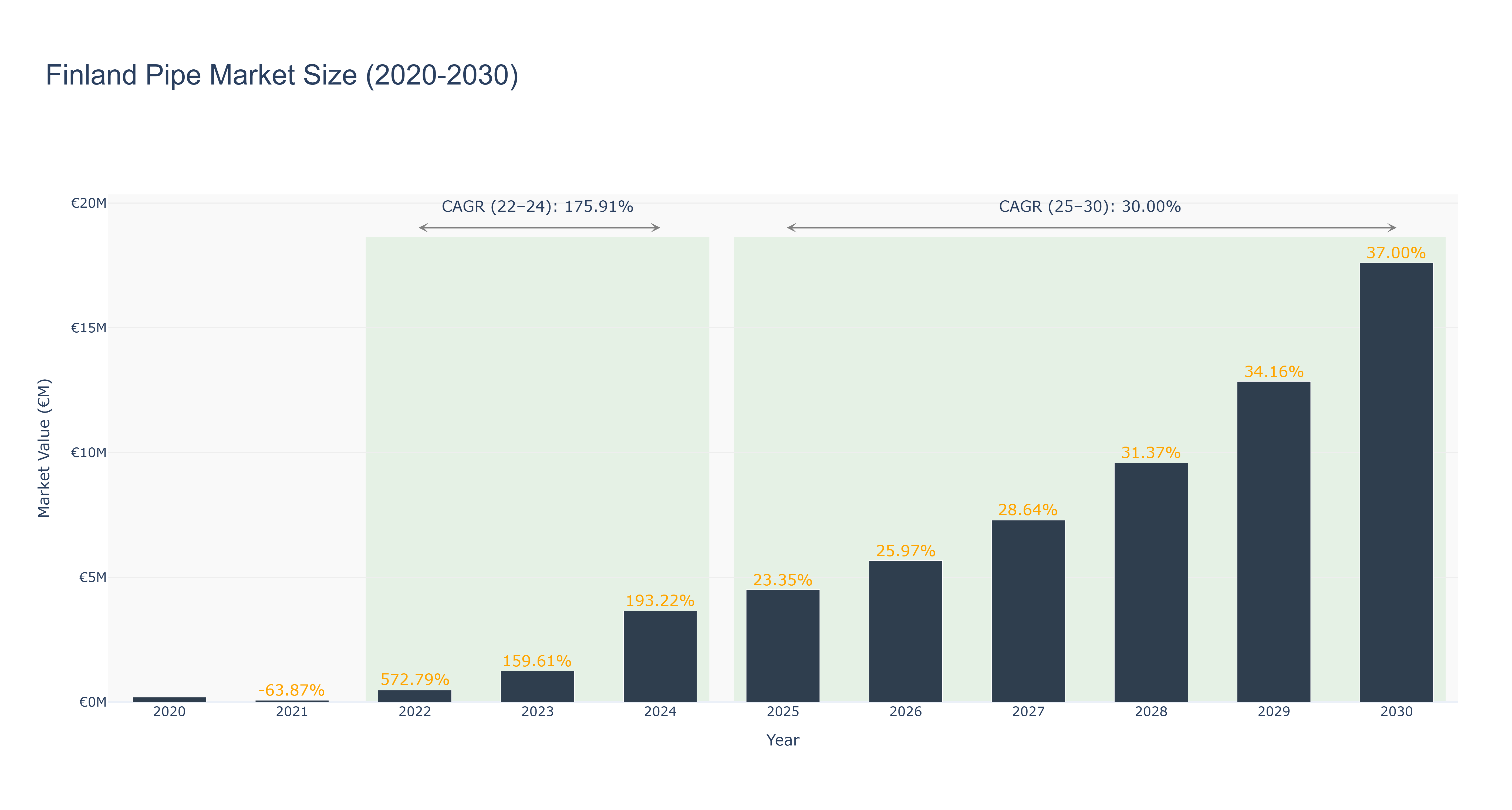
Finland Pipe Market has shown a remarkable growth trajectory over the years. The market reached its peak size of €17.60 million in 2030, showcasing consistent growth since 2020 when it was valued at €0.20 million. From 2020 to 2024, the market saw exponential growth, with the market size increasing from €0.20 million to €3.65 million due to increased infrastructure projects and demand for efficient piping systems. The forecasted market size from 2025 to 2030 is projected to continue growing steadily, with a CAGR of 30.0%. The CAGR for the period 2022-24 was notably high at 175.91%, indicating a period of rapid expansion driven by technological advancements and increased investments in the sector. Looking ahead, Finland is set to invest in sustainable pipe infrastructure projects to further boost the market growth and cater to growing environmental concerns.
Finland Pipe Market: Production & Trade Performance (2019-2025)
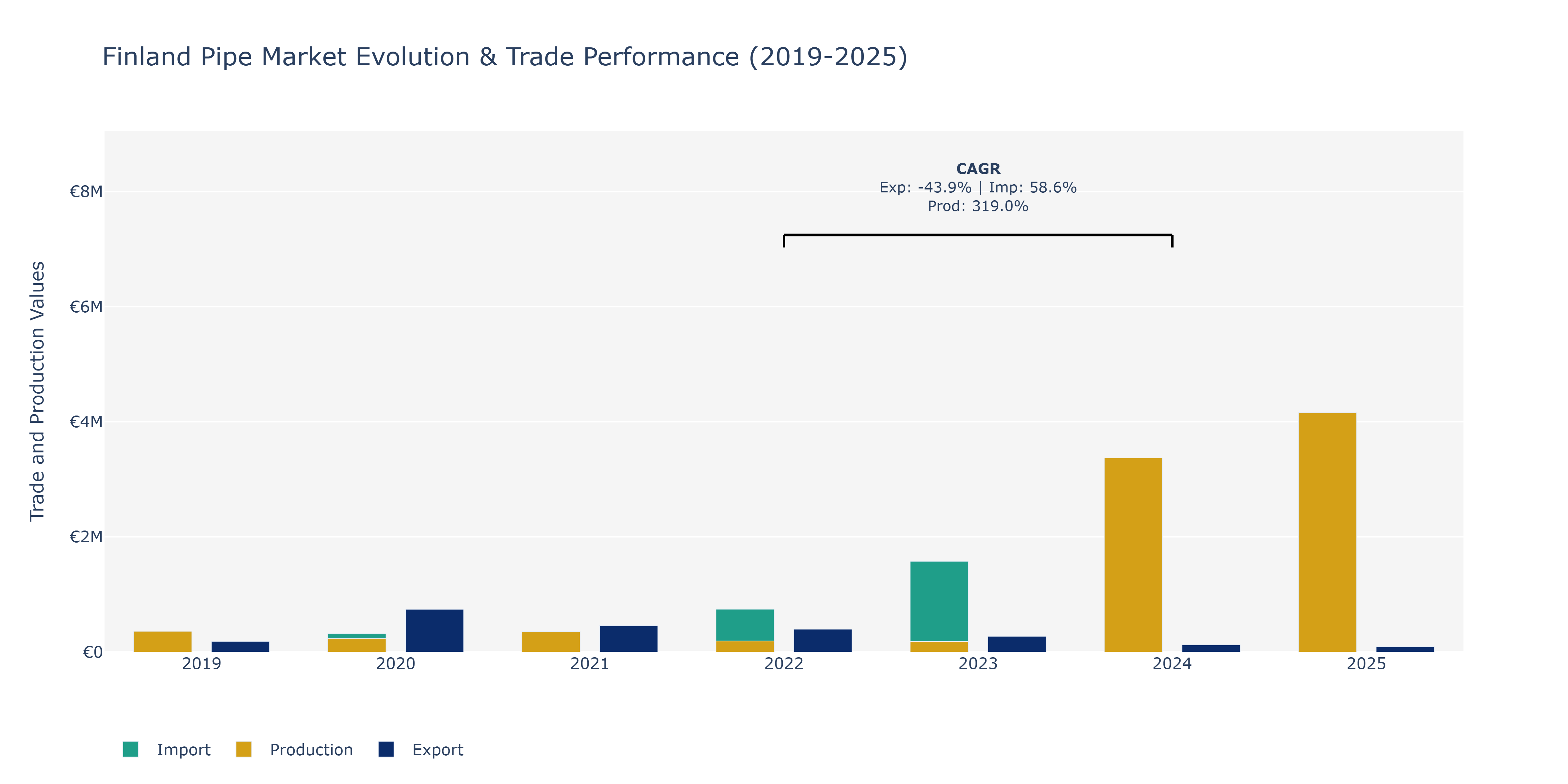
In the Finland Pipe Market, the period from 2019 to 2025 witnessed notable shifts in exports, imports, and production. Exports peaked in 2020 at approximately €743.87 thousand, reflecting a substantial increase from 2019. However, a downward trend followed, with 2025 showing exports at around €94.02 thousand. Imports, on the other hand, saw a steady rise from 2019 to 2025, reaching around €2.31 million. The production of pipes surged dramatically from €397.19 thousand in 2022 to over €4.1 million in 2025, showcasing significant growth. These fluctuations can be attributed to various factors such as changes in demand for pipe products, global market dynamics, and technological advancements in the pipe manufacturing sector. The surge in production could be linked to increased infrastructure projects, while the decline in exports may be influenced by shifting trade policies or competition from other markets. It is essential for stakeholders in the Finland Pipe Market to closely monitor these trends to make informed business decisions and adapt to the evolving market landscape.
Key Highlights of the Report:
- Finland Pipe Market Outlook
- Market Size of Finland Pipe Market, 2024
- Forecast of Finland Pipe Market, 2031
- Historical Data and Forecast of Finland Pipe Revenues & Volume for the Period 2021- 2031
- Finland Pipe Market Trend Evolution
- Finland Pipe Market Drivers and Challenges
- Finland Pipe Price Trends
- Finland Pipe Porter's Five Forces
- Finland Pipe Industry Life Cycle
- Historical Data and Forecast of Finland Pipe Market Revenues & Volume By Material for the Period 2021- 2031
- Historical Data and Forecast of Finland Pipe Market Revenues & Volume By Concrete for the Period 2021- 2031
- Historical Data and Forecast of Finland Pipe Market Revenues & Volume By Thermoset and composite for the Period 2021- 2031
- Historical Data and Forecast of Finland Pipe Market Revenues & Volume By Metal for the Period 2021- 2031
- Historical Data and Forecast of Finland Pipe Market Revenues & Volume By Thermoplastic for the Period 2021- 2031
- Historical Data and Forecast of Finland Pipe Market Revenues & Volume By Diameter for the Period 2021- 2031
- Historical Data and Forecast of Finland Pipe Market Revenues & Volume By DN upto 50 mm for the Period 2021- 2031
- Historical Data and Forecast of Finland Pipe Market Revenues & Volume By DN 51 to 150 mm for the Period 2021- 2031
- Historical Data and Forecast of Finland Pipe Market Revenues & Volume By DN 151 to 300 mm for the Period 2021- 2031
- Historical Data and Forecast of Finland Pipe Market Revenues & Volume By DN 301 to 500 mm for the Period 2021- 2031
- Historical Data and Forecast of Finland Pipe Market Revenues & Volume By DN above 501 mm for the Period 2021- 2031
- Historical Data and Forecast of Finland Pipe Market Revenues & Volume By Application for the Period 2021- 2031
- Historical Data and Forecast of Finland Pipe Market Revenues & Volume By Water and wastewater for the Period 2021- 2031
- Historical Data and Forecast of Finland Pipe Market Revenues & Volume By Industrial for the Period 2021- 2031
- Historical Data and Forecast of Finland Pipe Market Revenues & Volume By Oil and gas for the Period 2021- 2031
- Historical Data and Forecast of Finland Pipe Market Revenues & Volume By Other for the Period 2021- 2031
- Finland Pipe Import Export Trade Statistics
- Market Opportunity Assessment By Material
- Market Opportunity Assessment By Diameter
- Market Opportunity Assessment By Application
- Finland Pipe Top Companies Market Share
- Finland Pipe Competitive Benchmarking By Technical and Operational Parameters
- Finland Pipe Company Profiles
- Finland Pipe Key Strategic Recommendations






































