Finland Pneumatic Cylinder Market Size (2020-2030)
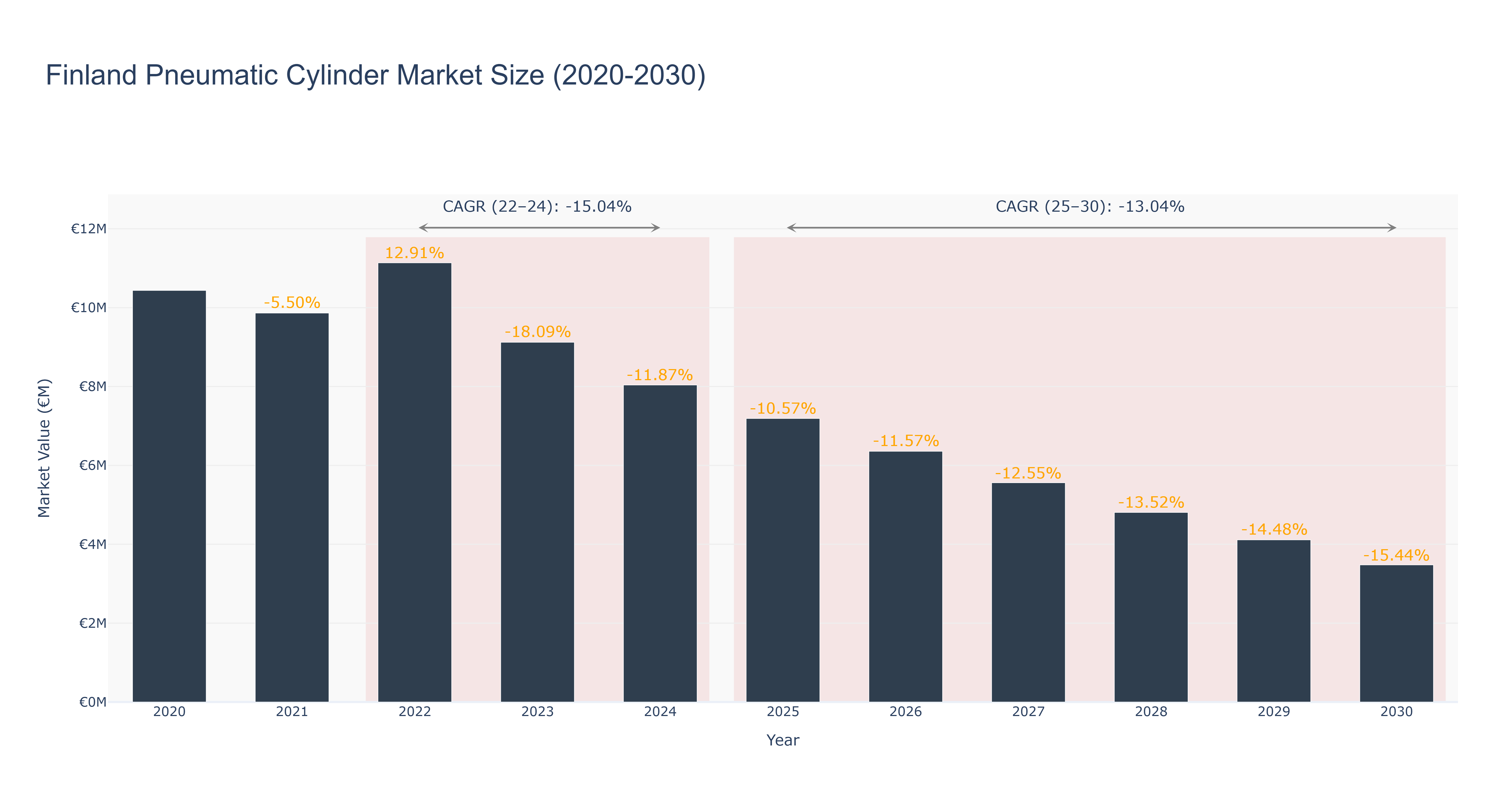
The Finland Pneumatic Cylinder Market experienced significant fluctuations between 2020 and 2024, peaking in 2020 with a market size of €10.44 million. Following this peak, the market contracted in 2021 to €9.86 million, reflecting a decline of 5.50%, before rebounding to €11.14 million in 2022, with a growth rate of 12.91%. However, the market faced considerable challenges again, dropping to €9.12 million in 2023 and €8.04 million in 2024, resulting in a compound annual growth rate (CAGR) of -15.04% for the actual period. Looking ahead, the market is projected to decline further, with forecasted values decreasing from €7.19 million in 2025 to €3.48 million by 2030, reflecting a CAGR of -13.04%. This decline is driven by factors such as the increasing automation in manufacturing processes and a shift towards more efficient technologies. Future developments in sustainable manufacturing practices may offer potential opportunities for recovery, yet the overall outlook remains challenging.
Finland Pneumatic Cylinder Market: Production & Trade Performance (2019-2025)
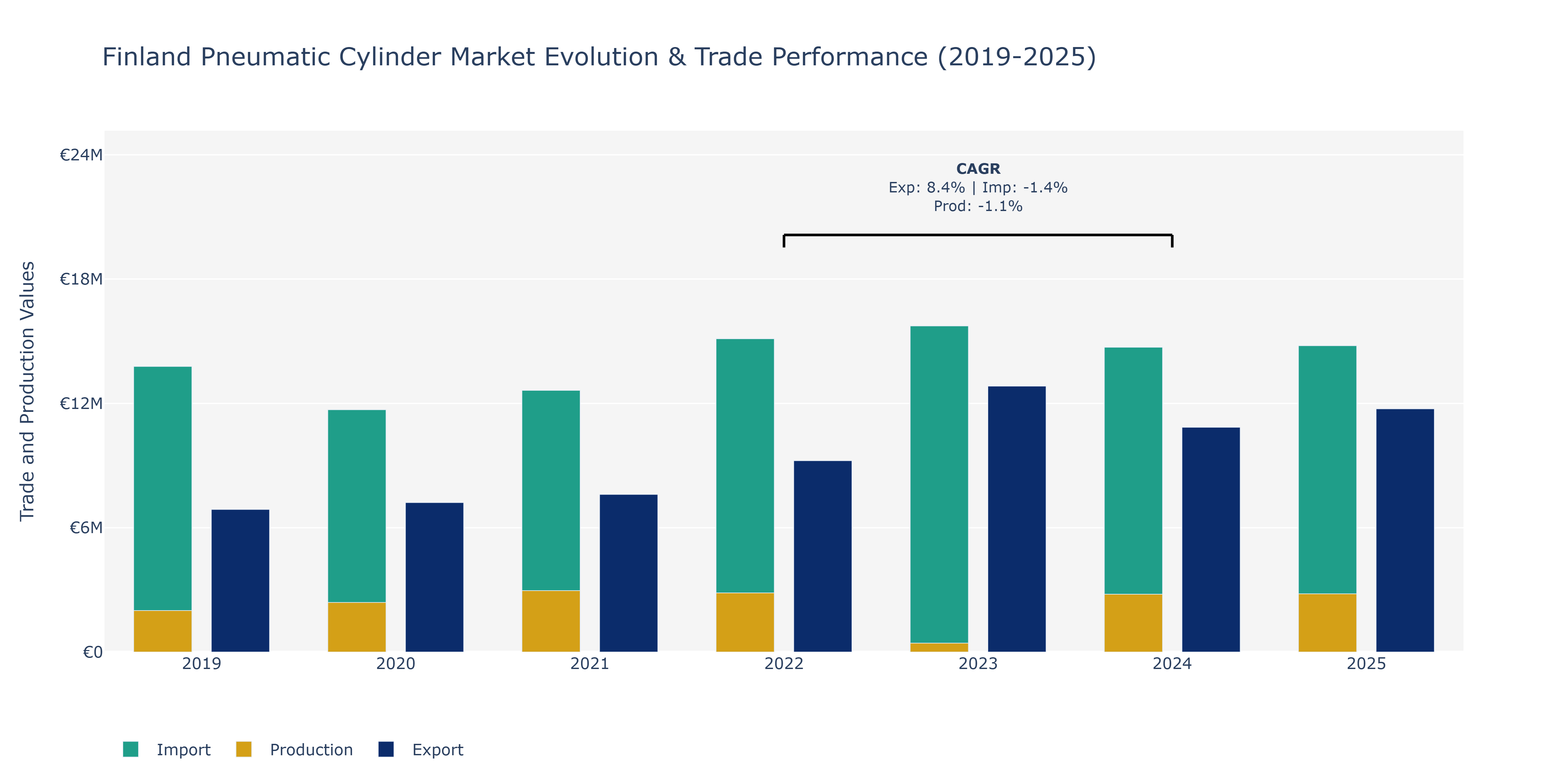
Between 2019 and 2025, the Finland Pneumatic Cylinder Market witnessed fluctuations in Exports, Imports, and Production. Exports experienced a steady increase from €6.88 million in 2019 to €11.74 million in 2025, with a peak in 2023 at €12.83 million. Imports followed a similar trend, starting at €13.78 million in 2019, peaking in 2023 at €15.74 million, and decreasing slightly to €14.79 million in 2025. Production, on the other hand, fluctuated, reaching its peak in 2021 at €2.96 million, then dropping to €0.43 million in 2023 before recovering to €2.81 million in 2025. These fluctuations can be attributed to various factors such as the global economic environment, technological advancements in automation impacting demand, and possibly shifts in supply chain dynamics affecting trade volumes. As the market continues to evolve, manufacturers may need to adapt to changing demand patterns and focus on innovation to remain competitive in the pneumatic cylinder industry.
Key Highlights of the Report:
- Finland Pneumatic Cylinder Market Outlook
- Market Size of Finland Pneumatic Cylinder Market, 2024
- Forecast of Finland Pneumatic Cylinder Market, 2031
- Historical Data and Forecast of Finland Pneumatic Cylinder Revenues & Volume for the Period 2021- 2031
- Finland Pneumatic Cylinder Market Trend Evolution
- Finland Pneumatic Cylinder Market Drivers and Challenges
- Finland Pneumatic Cylinder Price Trends
- Finland Pneumatic Cylinder Porter's Five Forces
- Finland Pneumatic Cylinder Industry Life Cycle
- Historical Data and Forecast of Finland Pneumatic Cylinder Market Revenues & Volume By Type for the Period 2021- 2031
- Historical Data and Forecast of Finland Pneumatic Cylinder Market Revenues & Volume By Single-Acting Cylinder for the Period 2021- 2031
- Historical Data and Forecast of Finland Pneumatic Cylinder Market Revenues & Volume By Double- Acting Cylinder for the Period 2021- 2031
- Historical Data and Forecast of Finland Pneumatic Cylinder Market Revenues & Volume By Movement for the Period 2021- 2031
- Historical Data and Forecast of Finland Pneumatic Cylinder Market Revenues & Volume By Linear for the Period 2021- 2031
- Historical Data and Forecast of Finland Pneumatic Cylinder Market Revenues & Volume By Rotary for the Period 2021- 2031
- Historical Data and Forecast of Finland Pneumatic Cylinder Market Revenues & Volume By End-Use for the Period 2021- 2031
- Historical Data and Forecast of Finland Pneumatic Cylinder Market Revenues & Volume By Construction for the Period 2021- 2031
- Historical Data and Forecast of Finland Pneumatic Cylinder Market Revenues & Volume By Manufacturing for the Period 2021- 2031
- Historical Data and Forecast of Finland Pneumatic Cylinder Market Revenues & Volume By Robotics for the Period 2021- 2031
- Historical Data and Forecast of Finland Pneumatic Cylinder Market Revenues & Volume By Automotive for the Period 2021- 2031
- Finland Pneumatic Cylinder Import Export Trade Statistics
- Market Opportunity Assessment By Type
- Market Opportunity Assessment By Movement
- Market Opportunity Assessment By End-Use
- Finland Pneumatic Cylinder Top Companies Market Share
- Finland Pneumatic Cylinder Competitive Benchmarking By Technical and Operational Parameters
- Finland Pneumatic Cylinder Company Profiles
- Finland Pneumatic Cylinder Key Strategic Recommendations






































