Finland Potato Starch Market Size (2020-2030)
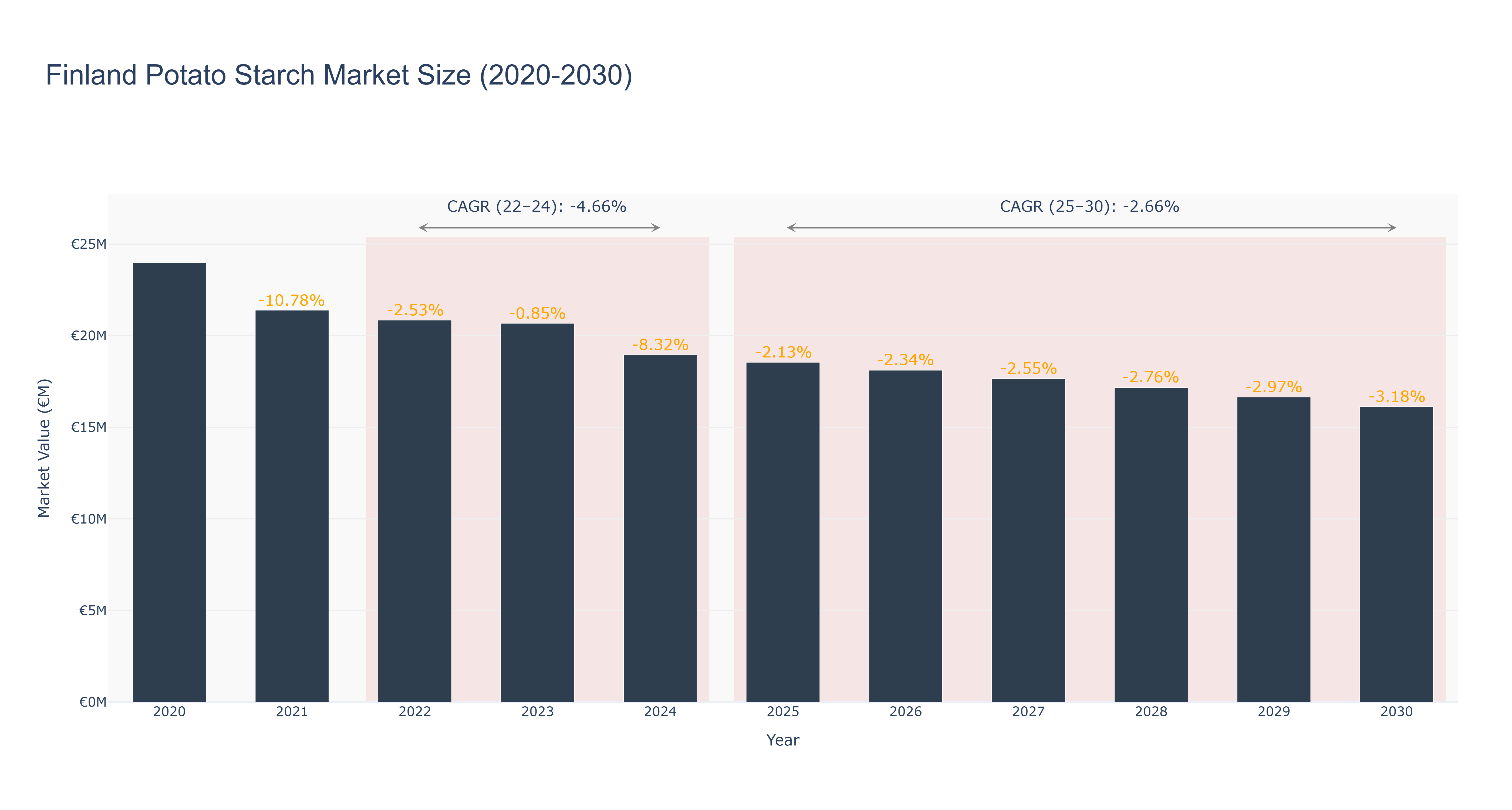
The Finland Potato Starch Market experienced a peak in 2020 with a market size of €23.98 million, followed by a gradual decline in subsequent years. By 2024, the market size decreased to €18.96 million, representing a negative growth trend. The forecasted market size from 2025 to 2030 continues to show a downward trajectory, with an expected size of €16.13 million in 2030. The CAGR for the period 2022-24 is -4.66%, while for 2025-30, it stands at -2.66%. This decline can be attributed to changing consumer preferences towards healthier alternatives and increased competition in the starch market. Looking ahead, Finland is set to invest in sustainable production practices and innovative product development to revitalize the potato starch market in the coming years.
Finland Potato Starch Market: Production & Trade Performance (2019-2025)
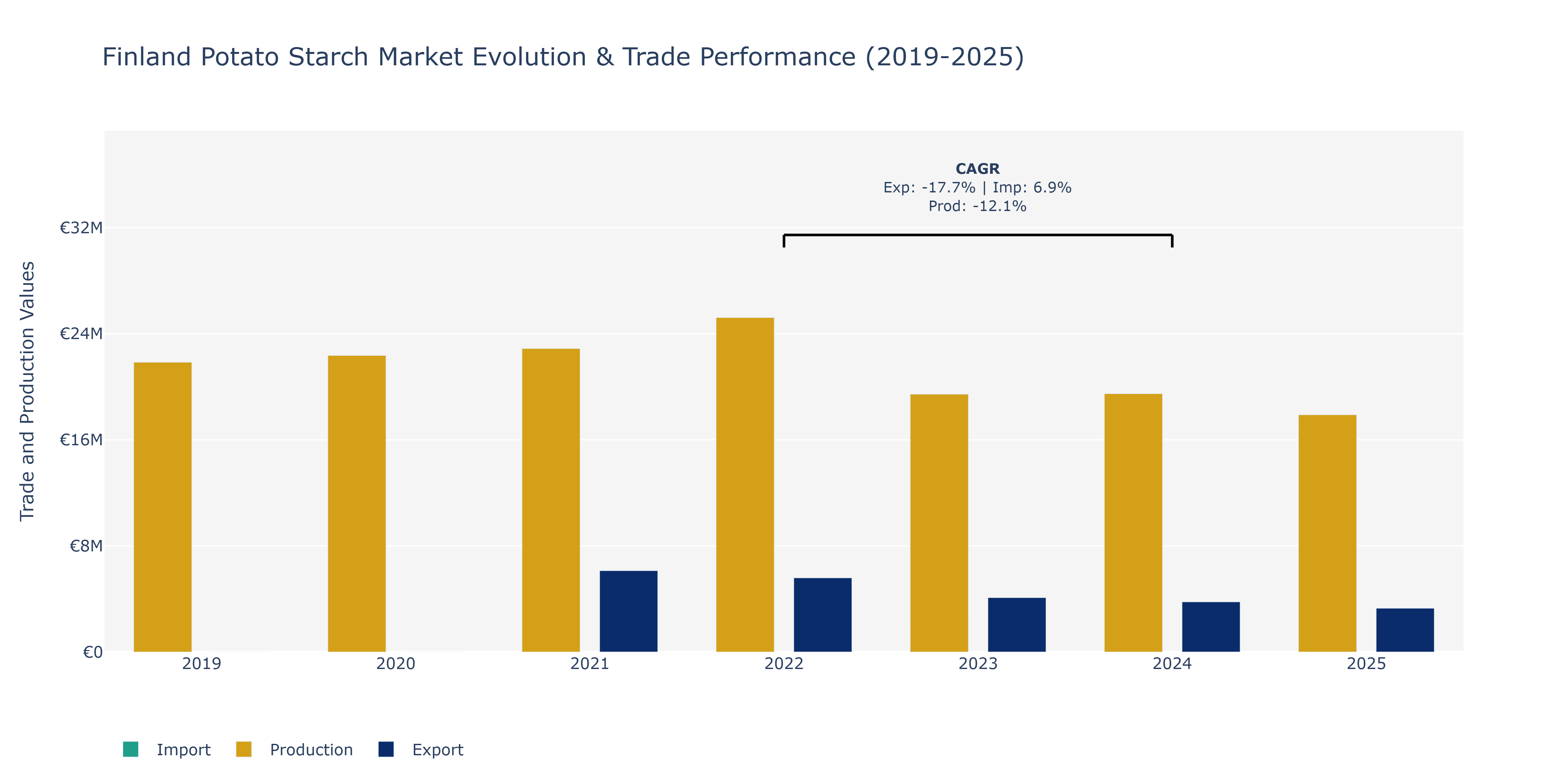
Between 2019 and 2025, Finland's Potato Starch Market witnessed varying trends in Exports, Imports, and Production. In 2021, Exports surged to €6.14 million, marking a substantial increase compared to the previous year. However, from 2022 to 2025, Exports experienced a gradual decline to around €3.31 million in 2025. Imports demonstrated a fluctuating pattern, with a peak in 2022 at €2.86 million before stabilizing around €3.50 million in 2025. Production, on the other hand, saw a notable decline from €25.22 million in 2022 to approximately €17.89 million in 2025. The market's dynamics could be attributed to global demand shifts, changes in supply chain logistics, and evolving consumer preferences for starch alternatives. To maintain competitiveness, industry players may need to focus on innovation, sustainable sourcing practices, and market diversification strategies in response to these market fluctuations.
Finland Potato Starch Market Overview
The potato starch market in Finland is expanding as potato starch is widely used in the food industry as a thickening agent, as well as in textiles, paper, and pharmaceuticals. The growing demand for natural, non-GMO starches is driving market growth for potato starch.
Drivers of the market
The potato starch market in Finland is driven by the growing use of potato starch in food processing, pharmaceuticals, and industrial applications. Potato starch is valued for its thickening properties and is commonly used in the production of various food products, such as sauces and soups. The expanding demand for natural, non-GMO starch alternatives is also contributing to market growth.
Challenges of the market
The Potato Starch market in Finland is affected by fluctuating raw material prices and the need for sustainable production practices. Additionally, the growing demand for clean-label and natural ingredients in food and beverage products requires innovation and new product development. The market also faces competition from other starch sources like corn and tapioca, which offer similar functionalities.
Government Policy of the market
Government policies in Finland focusing on agricultural sustainability, environmental protection, and food processing technologies influence the potato starch market. Regulations encouraging the efficient use of agricultural resources, reduction of waste, and sustainable practices in food production play a key role in shaping market trends. Finlands commitment to maintaining high standards of food safety and quality control ensures that potato starch production remains safe and efficient. Furthermore, government-backed research initiatives in food science and material science support the development of new applications for potato starch in industries such as food, pharmaceuticals, and bioplastics.
Key Highlights of the Report:
- Finland Potato Starch Market Outlook
- Market Size of Finland Potato Starch Market, 2024
- Forecast of Finland Potato Starch Market, 2031
- Historical Data and Forecast of Finland Potato Starch Revenues & Volume for the Period 2021-2031
- Finland Potato Starch Market Trend Evolution
- Finland Potato Starch Market Drivers and Challenges
- Finland Potato Starch Price Trends
- Finland Potato Starch Porter`s Five Forces
- Finland Potato Starch Industry Life Cycle
- Historical Data and Forecast of Finland Potato Starch Market Revenues & Volume By Nature for the Period 2021-2031
- Historical Data and Forecast of Finland Potato Starch Market Revenues & Volume By Organic for the Period 2021-2031
- Historical Data and Forecast of Finland Potato Starch Market Revenues & Volume By Conventional for the Period 2021-2031
- Historical Data and Forecast of Finland Potato Starch Market Revenues & Volume By End-users for the Period 2021-2031
- Historical Data and Forecast of Finland Potato Starch Market Revenues & Volume By Textile & Paper for the Period 2021-2031
- Historical Data and Forecast of Finland Potato Starch Market Revenues & Volume By Food & Beverages for the Period 2021-2031
- Historical Data and Forecast of Finland Potato Starch Market Revenues & Volume By Pharmaceuticals for the Period 2021-2031
- Finland Potato Starch Import Export Trade Statistics
- Market Opportunity Assessment By Nature
- Market Opportunity Assessment By End-users
- Finland Potato Starch Top Companies Market Share
- Finland Potato Starch Competitive Benchmarking By Technical and Operational Parameters
- Finland Potato Starch Company Profiles
- Finland Potato Starch Key Strategic Recommendations






































