Finland Precast Concrete Market Size (2020-2030)
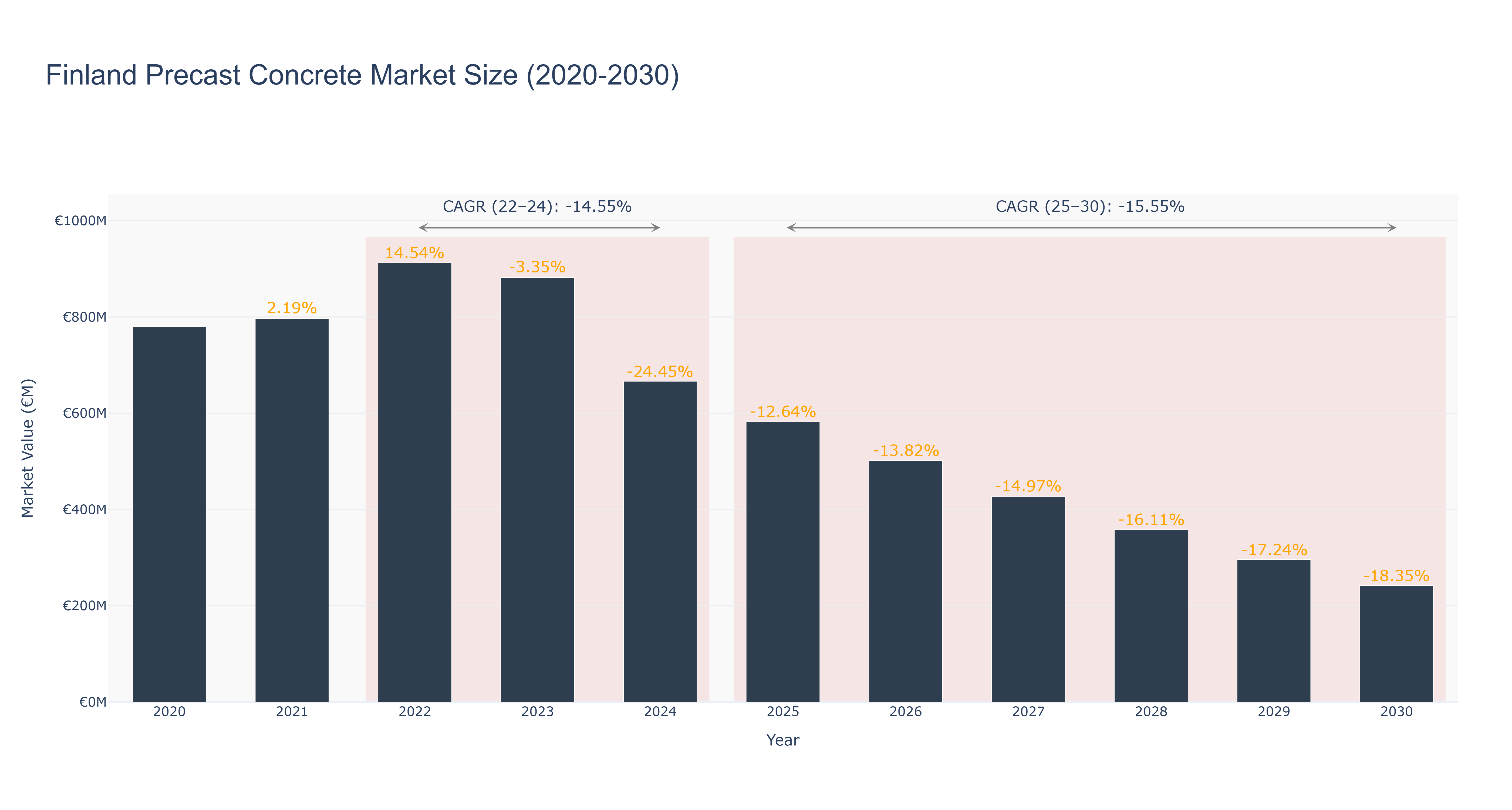
Finland Precast Concrete Market has experienced a fluctuating trend over the past decade. The peak market size of €912.48 million was recorded in 2022, followed by a significant decline to €241.79 million in 2030. The market saw a sharp decrease in size from 2024 to 2026, attributed to a compound annual growth rate (CAGR) of -13.82%. This downward trend is expected to continue with a forecasted CAGR of -15.55% from 2025 to 2030. Industry drivers such as changing construction trends and economic factors have contributed to these shifts. Looking ahead, Finland is set to embark on sustainable precast concrete projects to align with environmental initiatives, ensuring a competitive edge in the market.
Finland Precast Concrete Market: Production & Trade Performance (2019-2025)
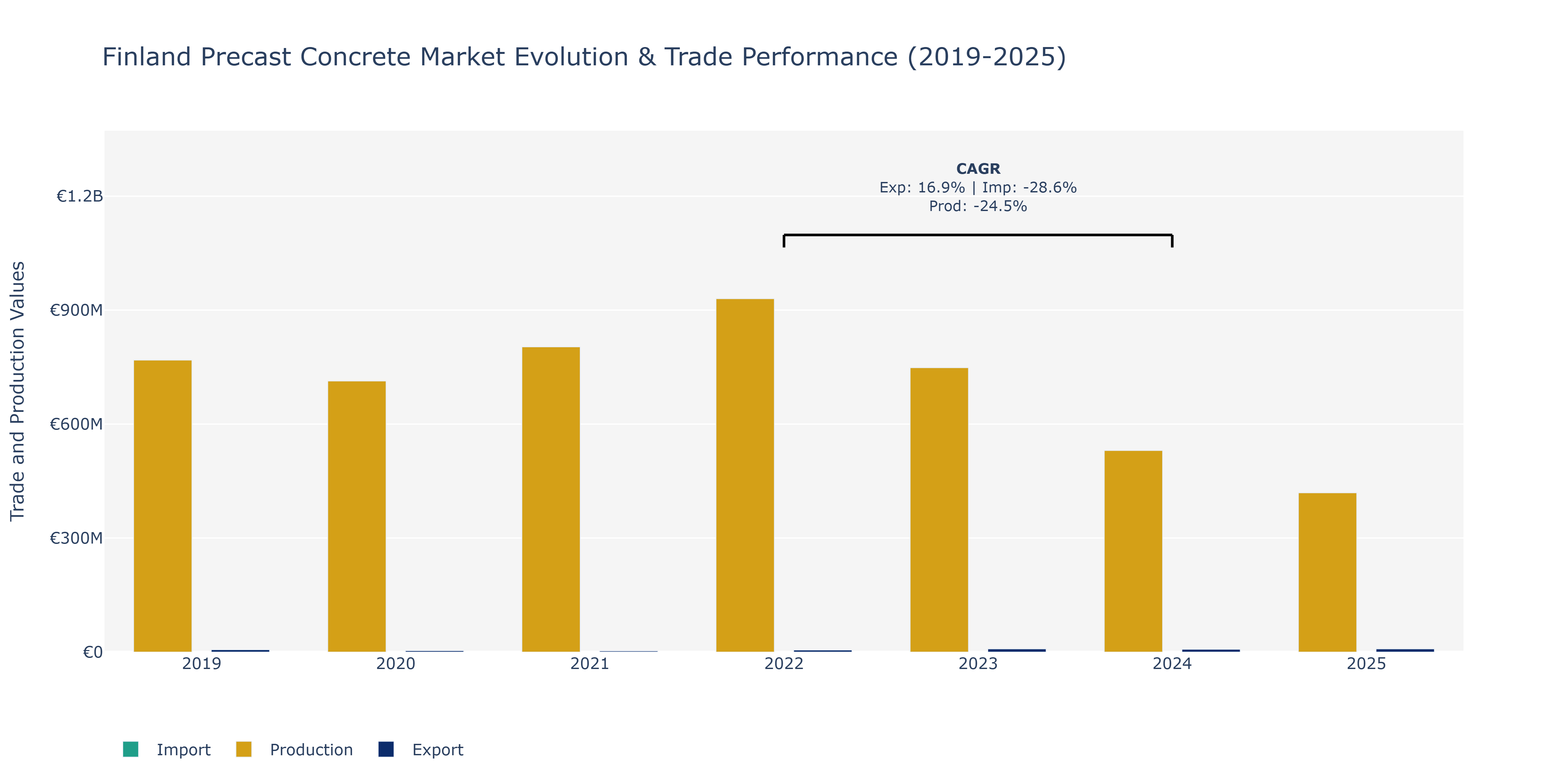
Between 2019 and 2025, Finland's Precast Concrete market witnessed varying performances in Exports, Imports, and Production. Exports demonstrated a decline from €6.1 million in 2019 to around €8.1 million in 2025, reaching a peak in 2023 at €8.23 million. Imports, on the other hand, experienced a fluctuating trend, dropping from €36.18 million in 2019 to approximately €19.38 million in 2025. Production value followed a downward trajectory from €768.38 million in 2019 to about €419.07 million in 2025. The market saw a production peak in 2022 at €929.97 million. The decrease in production can be attributed to factors like fluctuating demand due to economic conditions and evolving construction technologies impacting the precast concrete sector. The decline in imports may be influenced by changes in global trade dynamics and local sourcing initiatives within the construction industry. To maintain market competitiveness, industry players may need to focus on innovation, sustainability practices, and strategic partnerships.
Key Highlights of the Report:
- Finland Precast Concrete Market Outlook
- Market Size of Finland Precast Concrete Market, 2024
- Forecast of Finland Precast Concrete Market, 2031
- Historical Data and Forecast of Finland Precast Concrete Revenues & Volume for the Period 2021-2031
- Finland Precast Concrete Market Trend Evolution
- Finland Precast Concrete Market Drivers and Challenges
- Finland Precast Concrete Price Trends
- Finland Precast Concrete Porter`s Five Forces
- Finland Precast Concrete Industry Life Cycle
- Historical Data and Forecast of Finland Precast Concrete Market Revenues & Volume By Product for the Period 2021-2031
- Historical Data and Forecast of Finland Precast Concrete Market Revenues & Volume By Structural Building Components for the Period 2021-2031
- Historical Data and Forecast of Finland Precast Concrete Market Revenues & Volume By Architectural Building Components for the Period 2021-2031
- Historical Data and Forecast of Finland Precast Concrete Market Revenues & Volume By Transportation Products for the Period 2021-2031
- Historical Data and Forecast of Finland Precast Concrete Market Revenues & Volume By Water & Waste Handling Products for the Period 2021-2031
- Historical Data and Forecast of Finland Precast Concrete Market Revenues & Volume By Others for the Period 2021-2031
- Historical Data and Forecast of Finland Precast Concrete Market Revenues & Volume By End-use for the Period 2021-2031
- Historical Data and Forecast of Finland Precast Concrete Market Revenues & Volume By Residential for the Period 2021-2031
- Historical Data and Forecast of Finland Precast Concrete Market Revenues & Volume By Non-residential for the Period 2021-2031
- Historical Data and Forecast of Finland Precast Concrete Market Revenues & Volume By Infrastructure for the Period 2021-2031
- Finland Precast Concrete Import Export Trade Statistics
- Market Opportunity Assessment By Product
- Market Opportunity Assessment By End-use
- Finland Precast Concrete Top Companies Market Share
- Finland Precast Concrete Competitive Benchmarking By Technical and Operational Parameters
- Finland Precast Concrete Company Profiles
- Finland Precast Concrete Key Strategic Recommendations






































