Finland Prepaid Cards Market Top 5 Importing Countries and Market Competition (HHI) Analysis
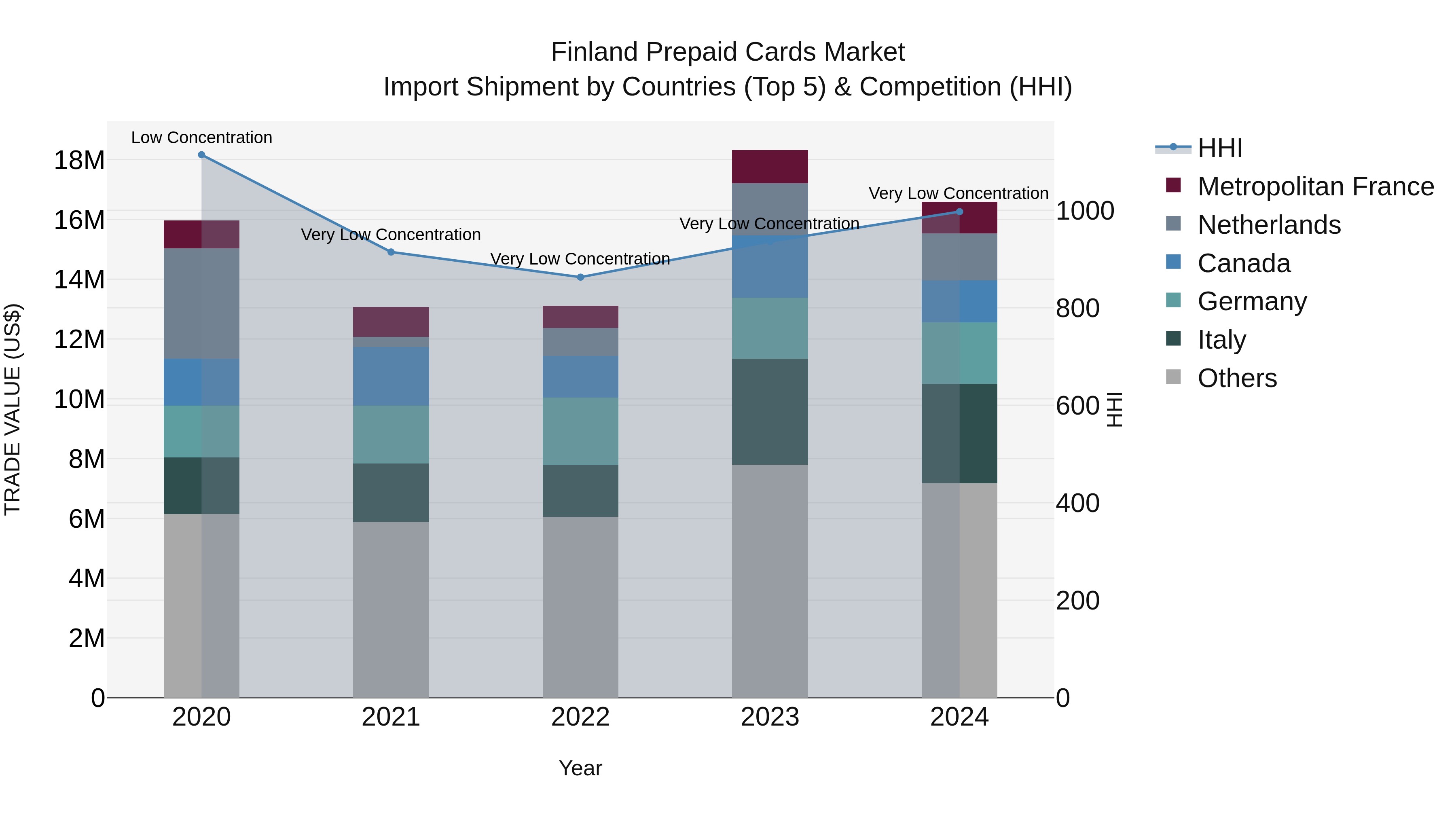
In 2024, Finland saw a steady increase in prepaid cards import shipments with Italy, Germany, Estonia, Netherlands, and Canada leading the way. The market continues to show low concentration with a Herfindahl-Hirschman Index (HHI) remaining very low. Despite a slight decline in growth rate from 2023 to 2024, the compound annual growth rate (CAGR) over the period 2020-2024 indicates a positive trend at 0.96%. With diversified sources of imports, Finland`s prepaid card market remains dynamic and resilient.
Finland Prepaid Cards Market Overview
The prepaid cards market in Finland is expanding as consumers increasingly prefer cashless payment methods and seek convenient solutions for budgeting and gifting. Prepaid cards offer a simple and secure alternative to credit and debit cards, making them popular for travel, online shopping, and gifting. As the adoption of digital payments rises, prepaid cards are becoming a mainstream financial tool in Finland, particularly in the consumer sector.
Drivers of the market
The prepaid cards market in Finland is expanding as consumers increasingly seek convenient, secure, and cashless payment methods. The growth of e-commerce, alongside the demand for digital wallets and prepaid travel cards, is fueling market growth. Additionally, financial inclusion initiatives and the shift away from traditional banking services are encouraging the adoption of prepaid cards in various segments.
Challenges of the market
The Prepaid Cards market in Finland faces challenges from the increasing competition in the digital payment space, particularly from mobile wallets and other digital payment solutions. Additionally, concerns regarding security and fraud prevention have led to stricter regulations, which could increase operational costs for prepaid card providers. Consumer preference for more convenient and innovative payment methods also adds pressure on market players.
Government Policy of the market
The prepaid cards market in Finland is influenced by government policies related to digital payments, financial inclusion, and consumer protection. Finland`s regulatory framework supports the adoption of digital financial services, including prepaid cards, by ensuring that these services are secure, accessible, and compliant with EU financial regulations. The Finnish government`s push for a cashless society and the increasing use of digital payments further boost the market for prepaid cards. Policies aimed at reducing cash transactions, promoting financial literacy, and encouraging the use of secure, convenient payment methods help drive the growth of prepaid card usage in the country.
Key Highlights of the Report:
- Finland Prepaid Cards Market Outlook
- Market Size of Finland Prepaid Cards Market, 2024
- Forecast of Finland Prepaid Cards Market, 2031
- Historical Data and Forecast of Finland Prepaid Cards Revenues & Volume for the Period 2021-2031
- Finland Prepaid Cards Market Trend Evolution
- Finland Prepaid Cards Market Drivers and Challenges
- Finland Prepaid Cards Price Trends
- Finland Prepaid Cards Porter`s Five Forces
- Finland Prepaid Cards Industry Life Cycle
- Historical Data and Forecast of Finland Prepaid Cards Market Revenues & Volume By Offering for the Period 2021-2031
- Historical Data and Forecast of Finland Prepaid Cards Market Revenues & Volume By General Purpose Card for the Period 2021-2031
- Historical Data and Forecast of Finland Prepaid Cards Market Revenues & Volume By Gift Card for the Period 2021-2031
- Historical Data and Forecast of Finland Prepaid Cards Market Revenues & Volume By Government Benefit/Disbursement Card for the Period 2021-2031
- Historical Data and Forecast of Finland Prepaid Cards Market Revenues & Volume By Incentive/Payroll Card for the Period 2021-2031
- Historical Data and Forecast of Finland Prepaid Cards Market Revenues & Volume By Others for the Period 2021-2031
- Historical Data and Forecast of Finland Prepaid Cards Market Revenues & Volume By Card Type for the Period 2021-2031
- Historical Data and Forecast of Finland Prepaid Cards Market Revenues & Volume By Closed Loop Card for the Period 2021-2031
- Historical Data and Forecast of Finland Prepaid Cards Market Revenues & Volume By Open Loop Card for the Period 2021-2031
- Historical Data and Forecast of Finland Prepaid Cards Market Revenues & Volume By End User for the Period 2021-2031
- Historical Data and Forecast of Finland Prepaid Cards Market Revenues & Volume By Retail for the Period 2021-2031
- Historical Data and Forecast of Finland Prepaid Cards Market Revenues & Volume By Corporate for the Period 2021-2031
- Historical Data and Forecast of Finland Prepaid Cards Market Revenues & Volume By Government/Public Sector for the Period 2021-2031
- Finland Prepaid Cards Import Export Trade Statistics
- Market Opportunity Assessment By Offering
- Market Opportunity Assessment By Card Type
- Market Opportunity Assessment By End User
- Finland Prepaid Cards Top Companies Market Share
- Finland Prepaid Cards Competitive Benchmarking By Technical and Operational Parameters
- Finland Prepaid Cards Company Profiles
- Finland Prepaid Cards Key Strategic Recommendations






































