Finland Probiotic Yeast Market Size (2020-2030)
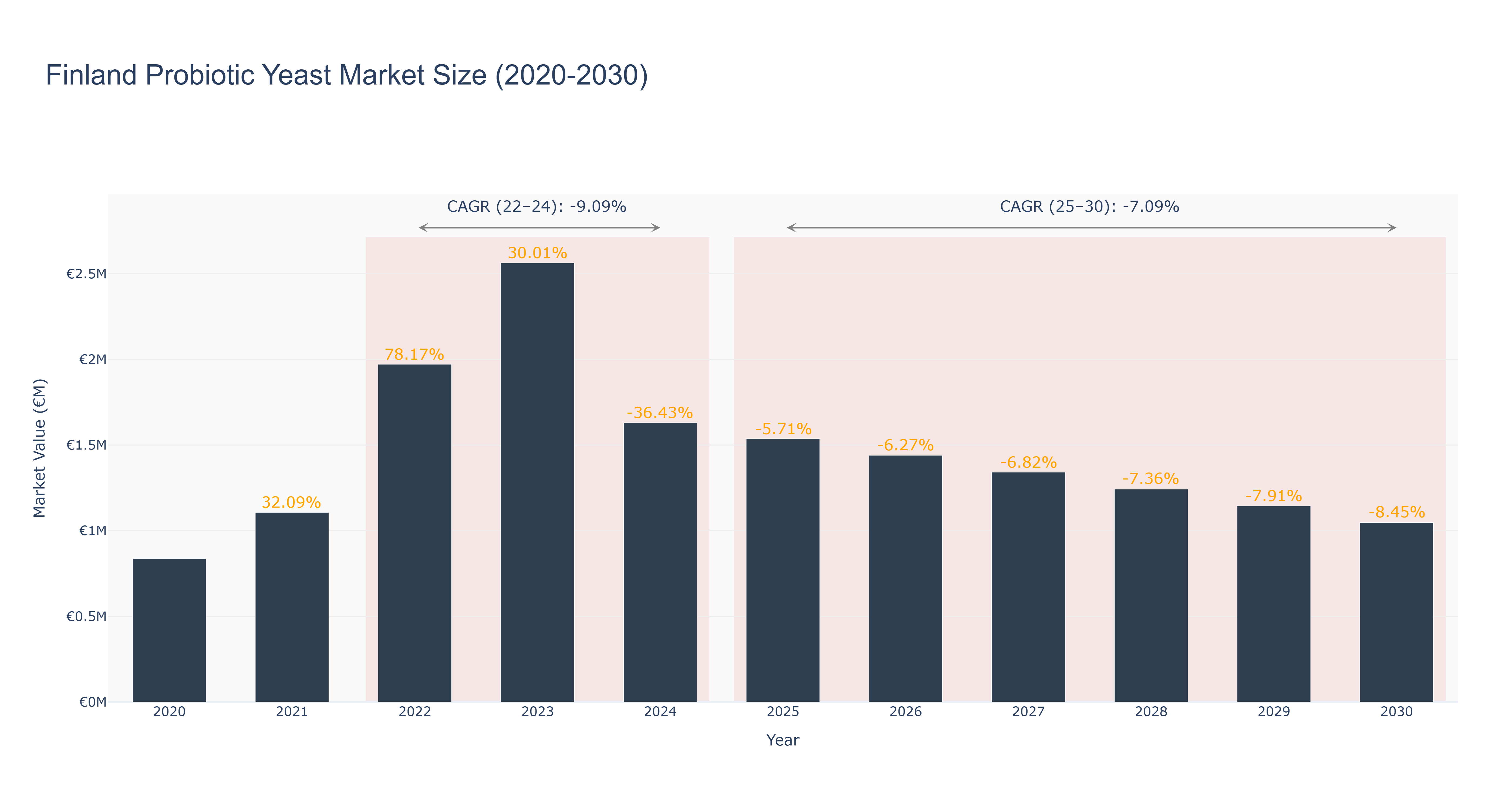
The Finland Probiotic Yeast Market experienced a peak market size of €2.56 million in 2023, with a subsequent decline to €1.63 million in 2024. The forecasted market size shows a continued downward trend, reaching €1.05 million in 2030. The CAGR for the period 2022-24 was -9.09%, while for 2025-30 it stands at -7.09%. The market faced challenges due to changing consumer preferences towards other health supplements and increased competition from alternative products. However, recent developments in research and technology aim to enhance the efficacy and variety of probiotic yeast products, potentially revitalizing market interest in the near future. As of 2026, collaborations between local producers and international research institutions are set to drive innovation and product diversification in the Finland Probiotic Yeast Market.
Finland Probiotic Yeast Market: Production & Trade Performance (2019-2025)
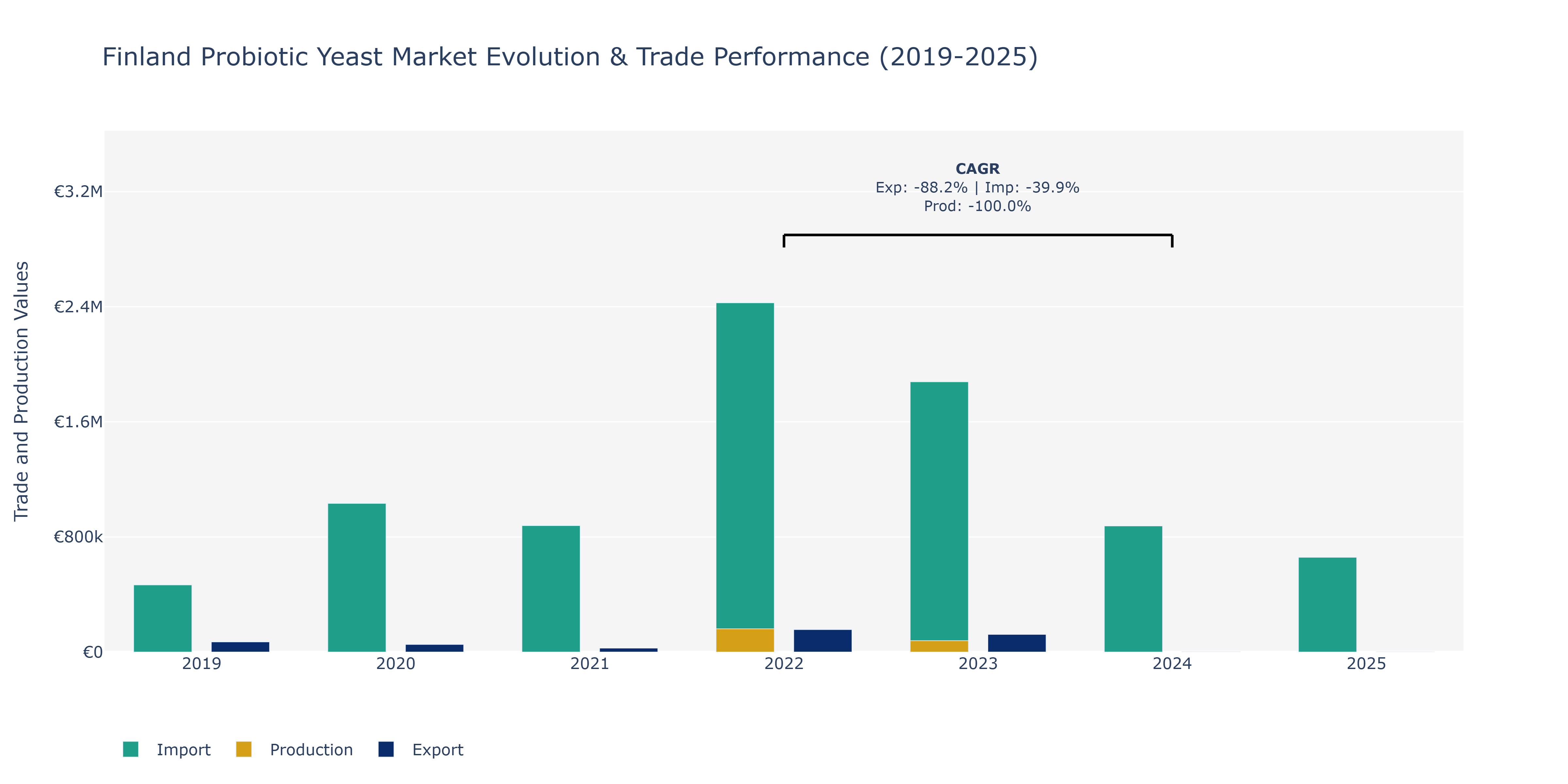
In the Finland Probiotic Yeast Market, a notable fluctuation in exports, imports, and production was observed over the years. In 2019, exports stood at €70.43 thousand, sharply declining in 2020 to €52.54 thousand, and further decreasing to €27.07 thousand in 2021. This decline could be attributed to various factors such as changes in consumer demand, international trade dynamics, or disruptions in the supply chain. Imports, on the other hand, significantly increased from €466.31 thousand in 2019 to €1.03 million in 2020, then slightly decreased to €878.34 thousand in 2021. The surge in imports could be linked to increased demand for raw materials or finished products. Production, with figures available only for 2022 and 2023, dropped from €156.07 thousand to €122.31 thousand, showing a notable decrease. This decline may be due to changes in production capacity, efficiency, or market demand for probiotic yeast products. The sharp decrease in exports in 2024 to €2.18 thousand and a subsequent slight decline in imports to €876.19 thousand could signify market challenges or shifts in global trade patterns impacting the Finland market. Lastly, in 2025, exports decreased further to around €1.64 thousand, and imports also declined to approximately €658.68 thousand, showcasing a potential need for market adaptation strategies to address changing demands or competitive pressures.
Key Highlights of the Report:
- Finland Probiotic Yeast Market Outlook
- Market Size of Finland Probiotic Yeast Market, 2025
- Forecast of Finland Probiotic Yeast Market, 2032
- Historical Data and Forecast of Finland Probiotic Yeast Revenues & Volume for the Period 2022 - 2032F
- Finland Probiotic Yeast Market Trend Evolution
- Finland Probiotic Yeast Market Drivers and Challenges
- Finland Probiotic Yeast Price Trends
- Finland Probiotic Yeast Porter`s Five Forces
- Finland Probiotic Yeast Industry Life Cycle
- Historical Data and Forecast of Finland Probiotic Yeast Market Revenues & Volume By Form for the Period 2022 - 2032F
- Historical Data and Forecast of Finland Probiotic Yeast Market Revenues & Volume By Powder for the Period 2022 - 2032F
- Historical Data and Forecast of Finland Probiotic Yeast Market Revenues & Volume By Capsules for the Period 2022 - 2032F
- Historical Data and Forecast of Finland Probiotic Yeast Market Revenues & Volume By Application for the Period 2022 - 2032F
- Historical Data and Forecast of Finland Probiotic Yeast Market Revenues & Volume By Nutrition and Supplement for the Period 2022 - 2032F
- Historical Data and Forecast of Finland Probiotic Yeast Market Revenues & Volume By Food and Beverages for the Period 2022 - 2032F
- Historical Data and Forecast of Finland Probiotic Yeast Market Revenues & Volume By Animal feed for the Period 2022 - 2032F
- Historical Data and Forecast of Finland Probiotic Yeast Market Revenues & Volume By Sales Channel for the Period 2022 - 2032F
- Historical Data and Forecast of Finland Probiotic Yeast Market Revenues & Volume By Online for the Period 2022 - 2032F
- Historical Data and Forecast of Finland Probiotic Yeast Market Revenues & Volume By Offline for the Period 2022 - 2032F
- Finland Probiotic Yeast Import Export Trade Statistics
- Market Opportunity Assessment By Form
- Market Opportunity Assessment By Application
- Finland Probiotic Yeast Top Companies Market Share
- Finland Probiotic Yeast Competitive Benchmarking By Technical and Operational Parameters
- Finland Probiotic Yeast Company Profiles
- Finland Probiotic Yeast Key Strategic Recommendations






































