Finland Soy Flour Market Size (2020-2030)
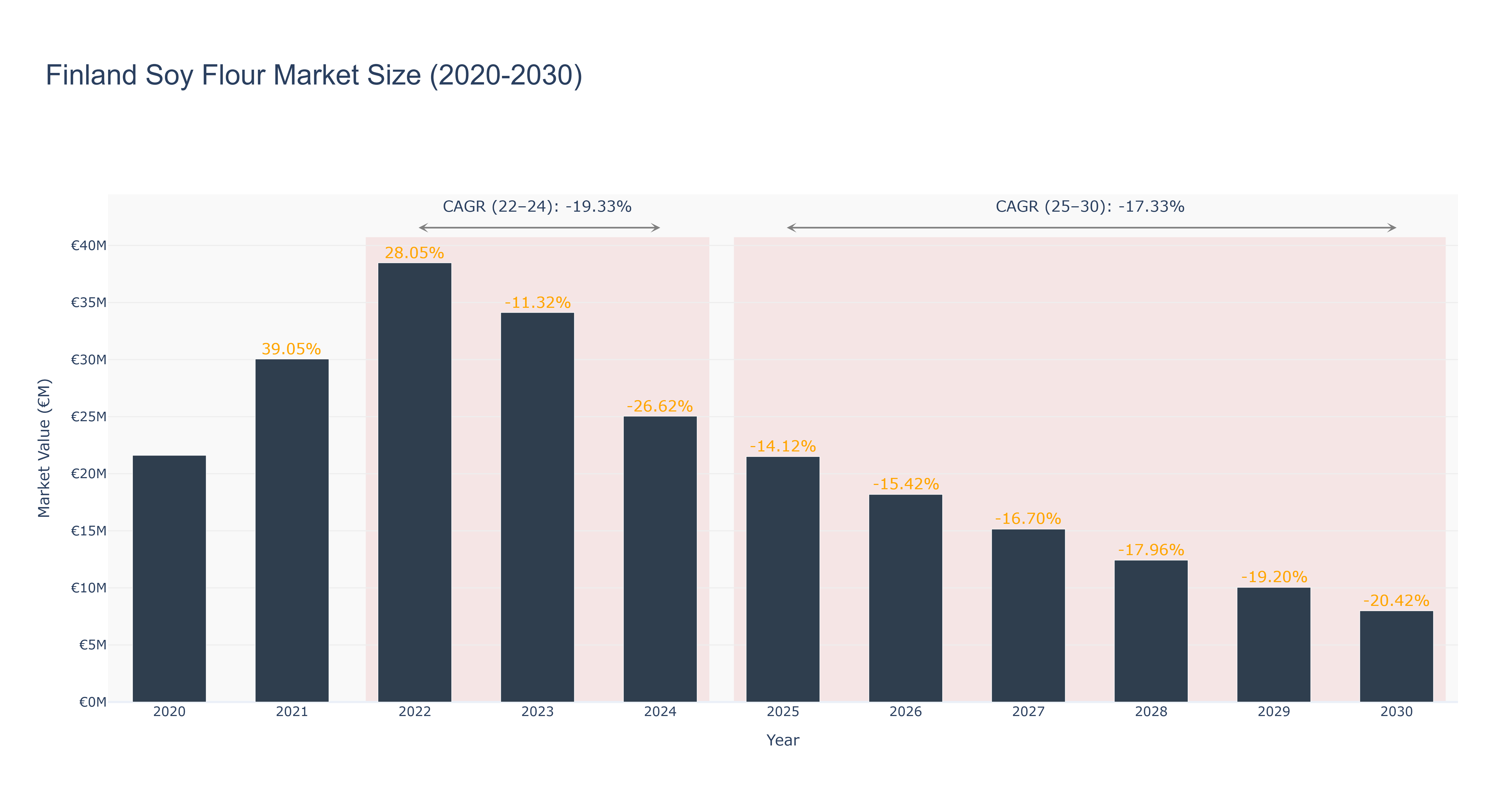
The Finland Soy Flour Market experienced significant growth from 2020 to 2022, peaking at €38.48 million in 2022, with a notable increase of 39.05% in 2021 and 28.05% in 2022. However, this upward trend has reversed sharply in 2023, with the market contracting to €34.12 million, marking an 11.32% decline, followed by a substantial decrease to €25.04 million in 2024, translating to a CAGR of -19.33% for the actual period from 2022 to 2024. Looking ahead to the forecasted period from 2025 to 2030, the market is projected to continue its downward trajectory, with sizes declining from €21.50 million in 2025 to €7.99 million by 2030, reflecting a CAGR of -17.33%. This contraction can be attributed to shifting consumer preferences, increased competition from alternative protein sources, and economic factors affecting purchasing power. While the future remains challenging, potential developments in value-added soy flour products may offer some resilience in this evolving market landscape.
Finland Soy Flour Market: Production & Trade Performance (2019-2025)
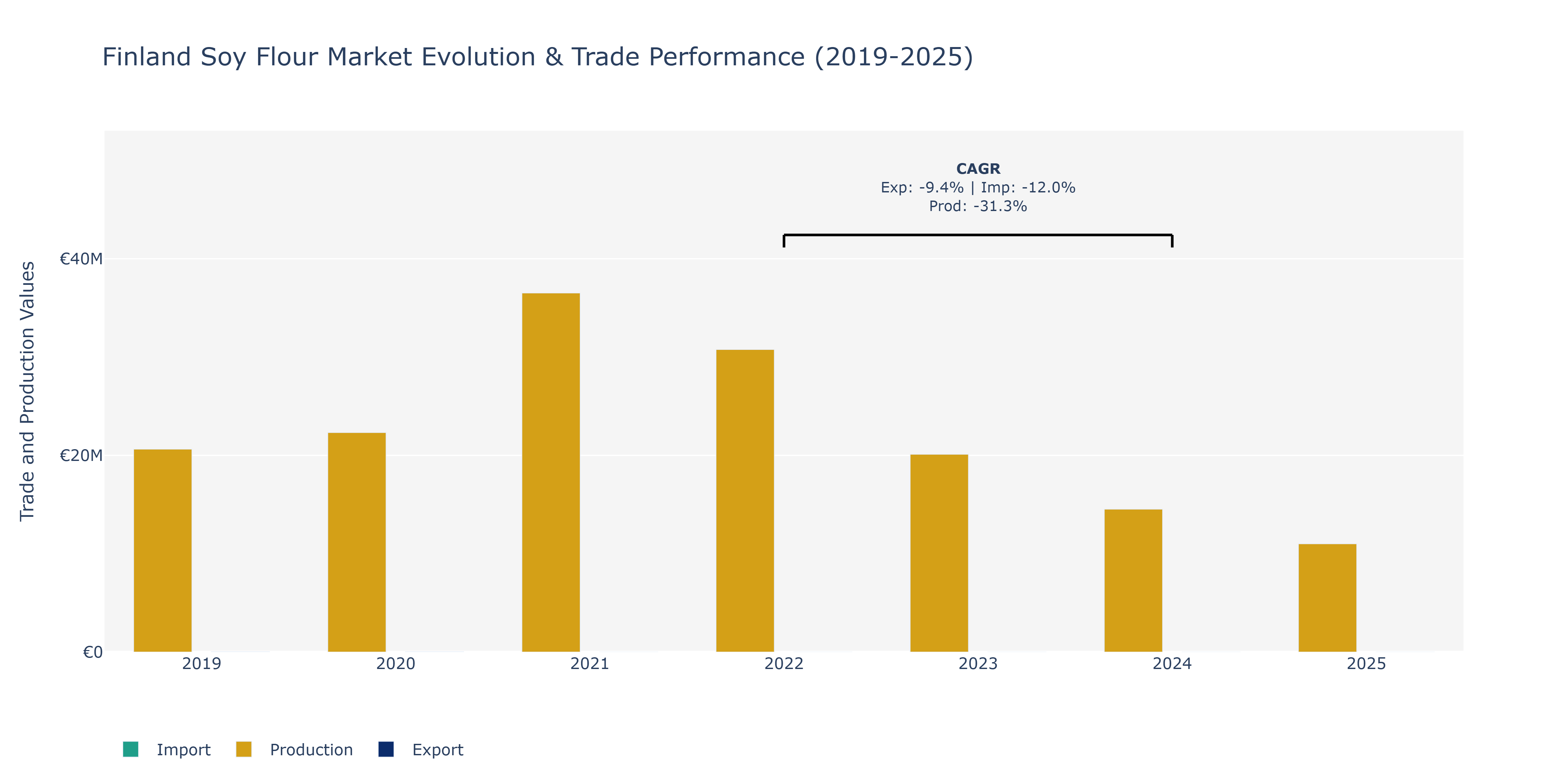
In the Finland Soy Flour Market, exports witnessed fluctuations over the years, with a notable peak in 2020 at €27.2 thousand before decreasing to €0.91 thousand in 2021. The subsequent increase in 2022 and 2023 to €1.38 thousand reflected a recovery trend. However, by 2024, exports declined sharply to €0.71 thousand. Imports experienced a similar pattern, reaching a peak of €152.65 thousand in 2019, followed by a consistent decline to €5.5 million in 2024. Production, on the other hand, declined steadily from €20.63 million in 2019 to €11.01 million in 2025. These trends could be attributed to various factors, including changes in consumer preferences, global market demand, and domestic production capacities. The decline in production could be influenced by shifts in agricultural practices, technological advancements, and competitive pressures in the soy flour market. Further analysis incorporating supply chain disruptions and regulatory changes could provide deeper insights into these market dynamics.
Key Highlights of the Report:
- Finland Soy Flour Market Outlook
- Market Size of Finland Soy Flour Market, 2024
- Forecast of Finland Soy Flour Market, 2031
- Historical Data and Forecast of Finland Soy Flour Revenues & Volume for the Period 2021-2031
- Finland Soy Flour Market Trend Evolution
- Finland Soy Flour Market Drivers and Challenges
- Finland Soy Flour Price Trends
- Finland Soy Flour Porter`s Five Forces
- Finland Soy Flour Industry Life Cycle
- Historical Data and Forecast of Finland Soy Flour Market Revenues & Volume By Type for the Period 2021-2031
- Historical Data and Forecast of Finland Soy Flour Market Revenues & Volume By Full-fat Soy Flour for the Period 2021-2031
- Historical Data and Forecast of Finland Soy Flour Market Revenues & Volume By Defatted Soy Flour for the Period 2021-2031
- Historical Data and Forecast of Finland Soy Flour Market Revenues & Volume By Application for the Period 2021-2031
- Historical Data and Forecast of Finland Soy Flour Market Revenues & Volume By Bakery & Confectionery for the Period 2021-2031
- Historical Data and Forecast of Finland Soy Flour Market Revenues & Volume By Meat Substitute for the Period 2021-2031
- Historical Data and Forecast of Finland Soy Flour Market Revenues & Volume By Soup & Sausages for the Period 2021-2031
- Historical Data and Forecast of Finland Soy Flour Market Revenues & Volume By Meat and Poultry for the Period 2021-2031
- Historical Data and Forecast of Finland Soy Flour Market Revenues & Volume By Others for the Period 2021-2031
- Historical Data and Forecast of Finland Soy Flour Market Revenues & Volume By Distribution Channel for the Period 2021-2031
- Historical Data and Forecast of Finland Soy Flour Market Revenues & Volume By Online Stores for the Period 2021-2031
- Historical Data and Forecast of Finland Soy Flour Market Revenues & Volume By Convenience Store for the Period 2021-2031
- Historical Data and Forecast of Finland Soy Flour Market Revenues & Volume By Departmental Store for the Period 2021-2031
- Historical Data and Forecast of Finland Soy Flour Market Revenues & Volume By Direct Sales for the Period 2021-2031
- Historical Data and Forecast of Finland Soy Flour Market Revenues & Volume By Others for the Period 2021-2031
- Finland Soy Flour Import Export Trade Statistics
- Market Opportunity Assessment By Type
- Market Opportunity Assessment By Application
- Market Opportunity Assessment By Distribution Channel
- Finland Soy Flour Top Companies Market Share
- Finland Soy Flour Competitive Benchmarking By Technical and Operational Parameters
- Finland Soy Flour Company Profiles
- Finland Soy Flour Key Strategic Recommendations






































